Unraveling the Puzzle of Human Migration in Floodplains
Published in Social Sciences and Earth & Environment





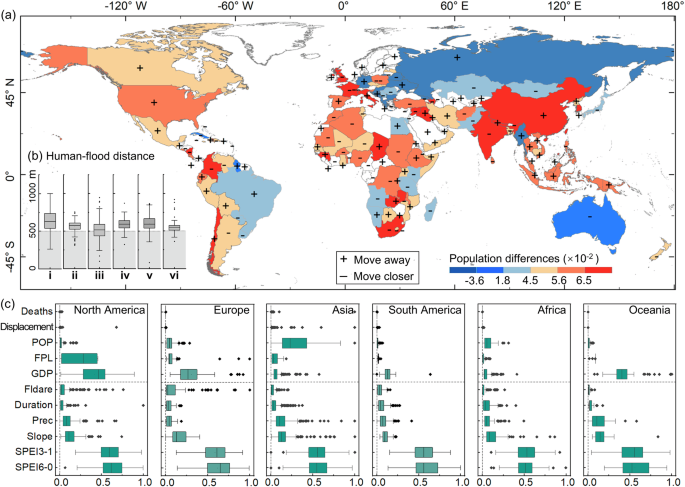

Floodplains are some of the most dynamic and challenging environments on Earth. They’re fertile, resource-rich, and often densely populated, but they’re also prone to devastating floods that can upend lives. As climate change intensifies and human populations grow, understanding why people move toward or away from these flood-prone areas has never been more urgent. Our recent study, published in Communications Earth & Environment, dives into this complex issue, introducing a new way to measure human migration in floodplains and uncovering the surprising interplay of climatic and human-driven factors shaping these movements from 2000 to 2018. In this blog, I’ll take you behind the scenes of our research, explain why it matters, and share the stories that emerged from the data.
Why Study Migration in Floodplains?
Floodplains have always been a double-edged sword. They offer flat land, fertile soil, and access to water, making them ideal for agriculture and settlement. But they’re also nature’s overflow zones, where rivers swell during heavy rains, sometimes with catastrophic consequences. Globally, over 2 billion people live in or near floodplains, and floods are among the most frequent and destructive natural disasters. In 2022 alone, floods displaced millions and caused billions in damages, from Pakistan’s devastating monsoon floods to Nigeria’s overwhelmed river systems.
Yet, people don’t always flee flood-prone areas after a disaster. Some stay, some return, and others even move closer to these risky zones. Why? That’s the question that drove our research. Migration is a deeply human response to environmental and social pressures, but the patterns are far from simple. Economic needs, cultural ties, government policies, and even memories of past floods all play a role. To unravel this puzzle, we needed a new approach—one that could capture the nuances of human movement in floodplains worldwide.
A New Lens: The Human-Flood Distance Metric
One of the biggest challenges in studying migration in floodplains is quantifying it. Traditional metrics, like population density or displacement counts, don’t tell the whole story. They miss the direction and motivation behind people’s movements. To address this, we developed a novel metric called the change in human-flood distance. This measures how far people are moving relative to flood-prone areas—whether they’re getting closer to or farther from the hazard.
Think of it like tracking someone’s relationship with a river. If a family moves 5 kilometers away from a floodplain after a flood, their human-flood distance increases. If another family moves toward the river to access fertile land, their distance decreases. By analyzing satellite data, population records, and flood maps from 2000 to 2018, we calculated these changes worldwide. This gave us a global snapshot of migration patterns and allowed us to dig into the why behind them.
What We Found: A Tale of Contrasts
Our findings revealed a fascinating patchwork of migration behaviors, shaped by a mix of climatic and human factors. Let’s break it down with some key examples:
Developing Countries: Floods as a Push and Pull
In countries like India, Nigeria, Brazil, and Argentina, floods are a major driver of migration, but not always in the way you’d expect. Flood fatalities and displacement often push people away from floodplains, as the trauma of loss and destruction lingers—what we call “flood damage memory.”
But there’s a twist: some populations move toward floodplains. Why? Resources. Floodplains offer fertile soil and water for farming, which is critical in regions where livelihoods depend on agriculture. In Africa, for example, we found that economic necessity often pulls people back to flood-prone areas, even after disasters. This push-and-pull dynamic highlights the tough choices people face: safety versus survival.
Developed Countries: Protection Matters
In contrast, regions with stronger flood defenses, like the United States, showed a clearer trend: people tend to move away from floodplains. Robust infrastructure—think levees, dams, and early warning systems—reduces the immediate threat of floods, giving people the confidence to relocate to safer areas without sacrificing their livelihoods. For example, in the U.S., post-Hurricane Katrina migration patterns showed significant movement away from vulnerable coastal floodplains in Louisiana.
This contrast underscores a stark reality: access to flood protection shapes migration decisions. In wealthier nations, infrastructure and resources make it easier to prioritize safety. In developing countries, the lack of such protections often leaves people with no choice but to stay or return.
A Complex Dance: Drought and Floods in the Philippines and Kenya
Perhaps the most surprising finding came from the Philippines and Kenya, where we observed increased movement toward floodplains. Why would people move closer to danger? The answer lies in the interplay of multiple hazards. In these regions, the easing of drought-flood abrupt alternation—rapid shifts between extreme dryness and flooding—has made floodplains more appealing. During droughts, water scarcity pushes people toward rivers and floodplains, where water is more reliable. When floods subside, the fertile land left behind becomes a magnet for farming communities. This dynamic shows how climate hazards don’t operate in isolation; they interact in ways that shape human behavior.
Why This Matters
Our study isn’t just about mapping migration patterns—it’s about understanding the human stories behind the numbers. Every data point represents a family, a community, or an individual making a life-altering decision. By identifying the factors driving these choices, we can help policymakers design better strategies to protect vulnerable populations.
For example, in developing countries, improving flood defenses and providing alternative livelihoods could reduce the need for people to return to risky floodplains. In regions like the Philippines, addressing drought and flood cycles together—through water management or climate-resilient agriculture—could stabilize migration patterns. And globally, as climate change intensifies floods, our findings highlight the need for tailored, region-specific solutions.
Looking Ahead
Our study is just the beginning. The human-flood distance metric opens new doors for exploring how people adapt to environmental hazards, not just floods but also droughts, storms, and sea-level rise. We’re already planning follow-up research to look at how migration patterns evolve in the future, as climate change accelerates and urbanization reshapes floodplains.
For now, I hope this research sparks conversations about how we live with water in a changing world. Floodplains will always be part of the human story, but with the right tools and policies, we can make them safer and more sustainable for everyone.
Follow the Topic
-
Communications Earth & Environment
An open access journal from Nature Portfolio that publishes high-quality research, reviews and commentary in the Earth, environmental and planetary sciences.

Related Collections
With Collections, you can get published faster and increase your visibility.
Climate extremes and water-food systems
Publishing Model: Open Access
Deadline: May 31, 2026
Drought
Publishing Model: Hybrid
Deadline: Jun 30, 2026


Please sign in or register for FREE
If you are a registered user on Research Communities by Springer Nature, please sign in