Unsettling Power Dynamics: Collective Dialogues to Transform North-South Academic Partnerships
Published in Social Sciences, Sustainability, and Education






Academic collaborations between institutions in the Global North and South often carry the weight of colonial legacies. Despite good intentions, power asymmetries persist, with Northern partners frequently acting as donors, agenda-setters, and decision-makers. Southern collaborators, in contrast, are often relegated to roles as implementers or data providers. These dynamics hinder equitable knowledge production and perpetuate exclusion.
In our recent work—published as Against Self-Reflexive Confessions: Collective Dialogues to Progressively Transform Academic North-South Collaborations in the European Journal of Development Research—we critiqued self-reflexivity as often insufficient when practiced in isolation. Instead, we developed collective reflexive dialogues as a relational process to challenge and unsettle entrenched dynamics. Here, we share insights into our journey and reflect on how these dialogues created spaces for accountability, transformation, and hope.
Beyond Self-Reflexivity: Toward a Collective Approach
Self-reflexivity is frequently promoted as a way to confront privilege and positionality in academic work. However, when practiced alone, it risks becoming performative and self-serving. Individual reflections, even when well-meaning, often fail to disrupt the systemic and relational nature of power dynamics in North-South collaborations.
Our critique of self-reflexivity builds on Judith Butler’s work, which emphasizes the relational and interdependent nature of subject formation. Reflexivity, we argue, should not stay only with the self. Instead, it must involve engaging with others in ways that foster dialogue, accountability, and mutual transformation. This shift—from solitary to collective reflexivity—allows researchers to confront complicity in neocolonial practices while working toward more equitable and pluralistic academic partnerships.
The Transformative Power of Dialogue
Between June 2021 and October 2022, we engaged in monthly online dialogues that became a space for collective reflection. We represented diverse backgrounds—a sociologist from Africa, a first-generation academic from Latin America, and a European researcher in environmental studies—and our conversations drew on personal experiences, failures, and aspirations.
These dialogues were transformative in several ways:
- Recognizing Complicity: By listening to one another’s stories, we confronted our roles in perpetuating neocolonial practices, even when we saw ourselves as victims of structural inequities. This dual perspective helped us understand how privilege and oppression coexist.
- Learning from Failure: Early in our collaboration, a short-term project on decoloniality faltered due to top-down planning and insufficient stakeholder engagement. Reflecting on this failure, we began to see how systemic asymmetries were mirrored in our academic practices.
- Creating Relational Spaces: Through empathy and trust, we built a space where we could address discomfort and vulnerability without fear of judgment. This environment encouraged us to question our assumptions and co-create new approaches to collaboration.
Illustrative Stories: Moments of Reflection and Growth
Our dialogues revealed insights through vivid, personal vignettes. For instance:
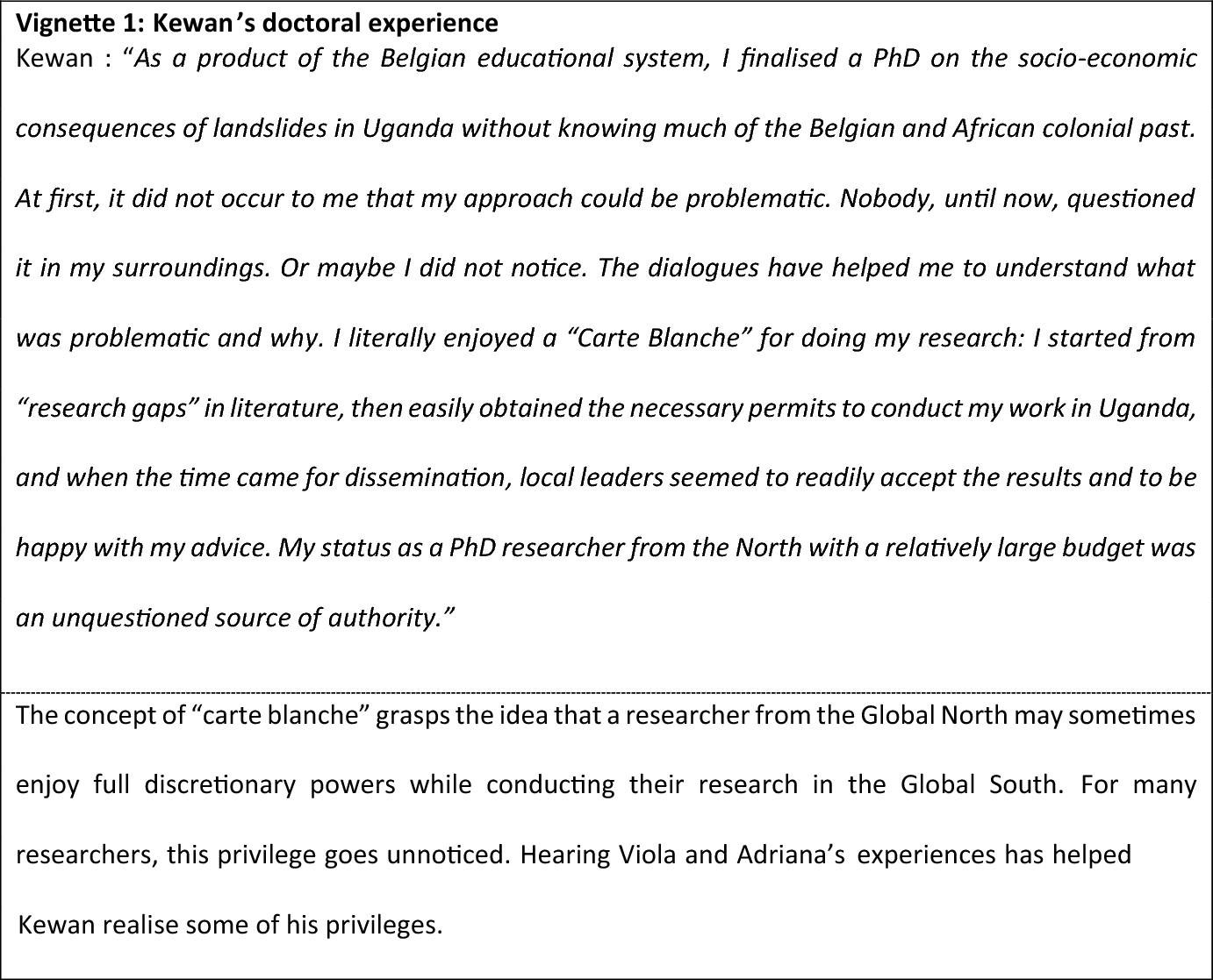
- One of us described navigating an imbalanced co-supervision arrangement in a North-South doctoral program. The Northern supervisor’s unilateral decisions left the Southern counterpart sidelined, highlighting how entrenched hierarchies persist even in collaborative structures designed for equity.
- Another shared the emotional toll of publishing a co-authored paper in English to meet Northern standards. While intended to amplify Southern voices, the process ultimately centered the Northern researcher’s career advancement, underscoring the complexities of balancing individual and collective goals.
These stories, while personal, reflect systemic patterns that many researchers in North-South partnerships might recognize.
A Meeting in Brussels: Bridging the Virtual and Physical
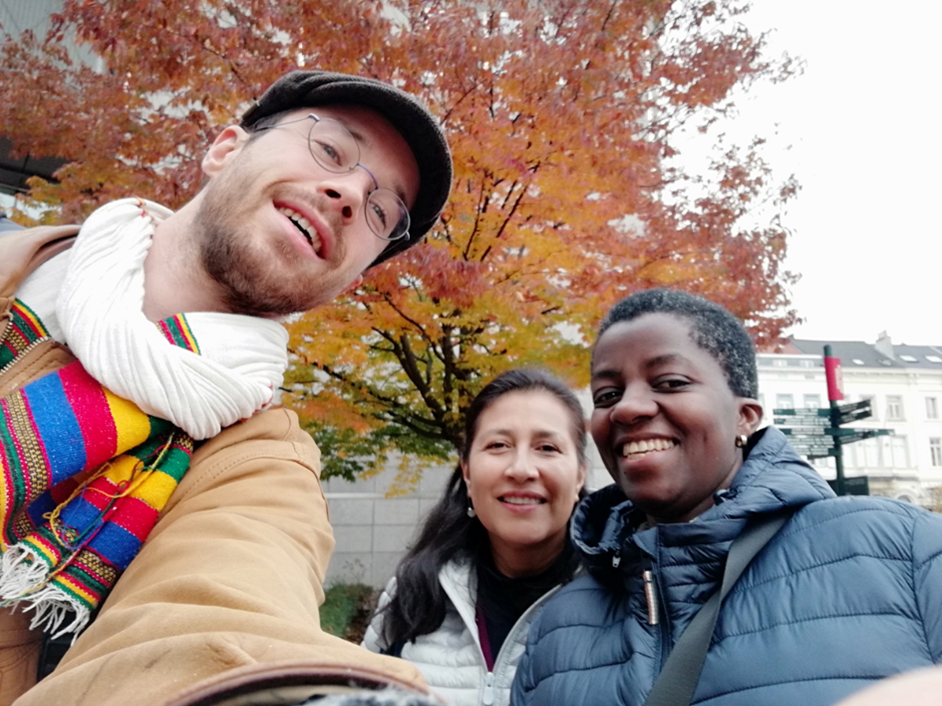
Our dialogues culminated in a long-anticipated in-person meeting in Brussels. After years of virtual collaboration, sitting together in the same space was profoundly affirming. We shared stories, laughter, and plans for future projects.
Implications for Academic Practice
Collective reflexive dialogues offer a framework for addressing structural imbalances in North-South collaborations. They:
- Illuminate how systemic dynamics manifest in interpersonal relationships, encouraging researchers to take responsibility for their roles.
- Create spaces for mutual accountability and transformative learning.
- Highlight the importance of embracing vulnerability, discomfort, and failure as opportunities for growth.
However, this approach also requires time, trust, and a commitment to relational work—resources that are often scarce in academia. As such, it may not be accessible to everyone, especially those navigating precarity or heavy workloads. Institutions must recognize the value of this work and provide supportive environments for its practice.
Looking Ahead: Toward Relational Academic Practices
Our work is ongoing and necessarily incomplete. We continue to grapple with our complicity and to seek ways to foster relational accountability. Transformative dialogues are not a panacea, but they represent a powerful tool for reimagining academic relationships and challenging entrenched inequalities.
As we reflect on our journey, we invite other academics to join us in this exploration. How can we create spaces for collective reflexivity in our own contexts? What stories do we need to share, and what silences must we break? Let’s continue this conversation and work together to transform the structures that shape our academic collaborations.
Follow the Topic
-
The European Journal of Development Research
This journal redefines and modernises what global development is, recognising the many schools of thought on what development constitutes, encouraging debate between competing approaches.
Related Collections
With Collections, you can get published faster and increase your visibility.
Economic, Social and Political Development in Developing Countries
A selection of Springer journals within the business, economics, and social science disciplines are inviting submissions for a new collection on Development in support of the Sustainable Development Goal for Decent Work and Economic Growth (SDG 8).
The Collection on Economic, Social, and Political Development in Developing Countries is interdisciplinary and includes development research from political, economic, sociological, and anthropological perspectives. The Collection aims to synthesize and integrate research experience, activism, and alternative thinking in the development space, thereby promoting sustainability.
The Collection welcomes papers rooted in any field, including (but not limited to): development, economics, finance, social policy, politics, sociology, political science, anthropology, development studies, decentralization, urbanization, management, and sustainability. This Collection will gather varying perspectives, theories, policies, and research on evidence-based practice in one place to further support SDG 8 to be utilized by both researchers and practitioners.
We encourage the submission of research and review articles on the following topics:
- Expanding access to banking and financial services
- Trade support for developing countries
- Sustaining economic growth in developing countries
- Economic development in the global south
- Community economic development
- Decentralization and development
- Sustainable consumption
- Early social development and schooling
- Social protection
- Political, social, economic, and environmental change in local, national, and international contexts
- Urbanization and decent employment
- Information and Communications Technology (ICT) and their socio-economic effects
- Global health and economic outcomes
We are also interested in receiving submissions on research discussing the post-pandemic world. Some of the key questions are:
1. What are the directions in which society will be moving in the 'new normal' in the post-pandemic world?
2. What aspects of the economy should receive more attention in the new normal process of development?
3. Is there a dynamic process for the evolving policy of developing countries? What forces guide such political developments?
Interested authors are invited to submit to the collection through the submission portal of their selected participating journal, in accordance with that journal’s submission guidelines. To ensure a paper is considered for the collection, reply “yes” when asked during submission whether it is intended for a special issue, and select “Economic, Social and Political Development in Developing Countries” from the drop-down menu.
Submitted manuscripts must be original and must not be under consideration for publication elsewhere. All submissions are subject to a rigorous peer-review process, per the standard evaluation process of the selected journal. Please refer to the submission guidelines of the selected journal for more detailed information on the peer review process.
Accepted papers will be published in the journal to which they were submitted and included in this cross-journal collection.
Publishing Model: Hybrid
Deadline: Ongoing
Focus on Latin America and the Caribbean
Development in Latin America and the Caribbean is facing significant challenges. The region is grappling with a changing environment characterized by uncertainty, overlapping crises, and interconnected pressures, such as rapid technological shift, deepening social division, and climate change. These issues have revealed major vulnerabilities in the region’s development path, making it harder to sustain and advance progress.
In this line, EJDR puts the focus in the region with a selection of the articles published in the journal since 2021 that will be updated periodically.
This collection is curated by the Editors.
Publishing Model: Hybrid
Deadline: Ongoing