Vector gravity unites Dark energy in the universe and elementary particles




Mysterious dark energy causes the universe to expand at an accelerated rate which, in the standard model of cosmology, is described by a nonzero cosmological constant having experimental value of ΩΛ =0.686±0.02. Einstein’s theory of gravity, derived from the postulate that spacetime geometry is gravitational field, does not predict ΩΛ.
Assumption that universe has a fixed four-dimensional Euclidean background geometry and gravity is a vector field in the Euclidean space yields an alternative vector theory of gravity proposed in 2017 [1]. It is a Lagrangian-based metric theory of gravity with fixed background geometry. That is matter interacts with gravitational field as if the spacetime geometry is described by an equivalent metric different from the isotopic Euclidean space, and particles move along geodesics of the equivalent metric. Vector field breaks the Euclidean symmetry; field direction gives the time coordinate, while three perpendicular directions are spatial coordinates. Vector gravity predicts no spacetime singularities such as black holes and, despite being fundamentally different from general relativity, passes all gravitational tests, including gravitational wave detection by LIGO and Virgo (see Fig. 1).
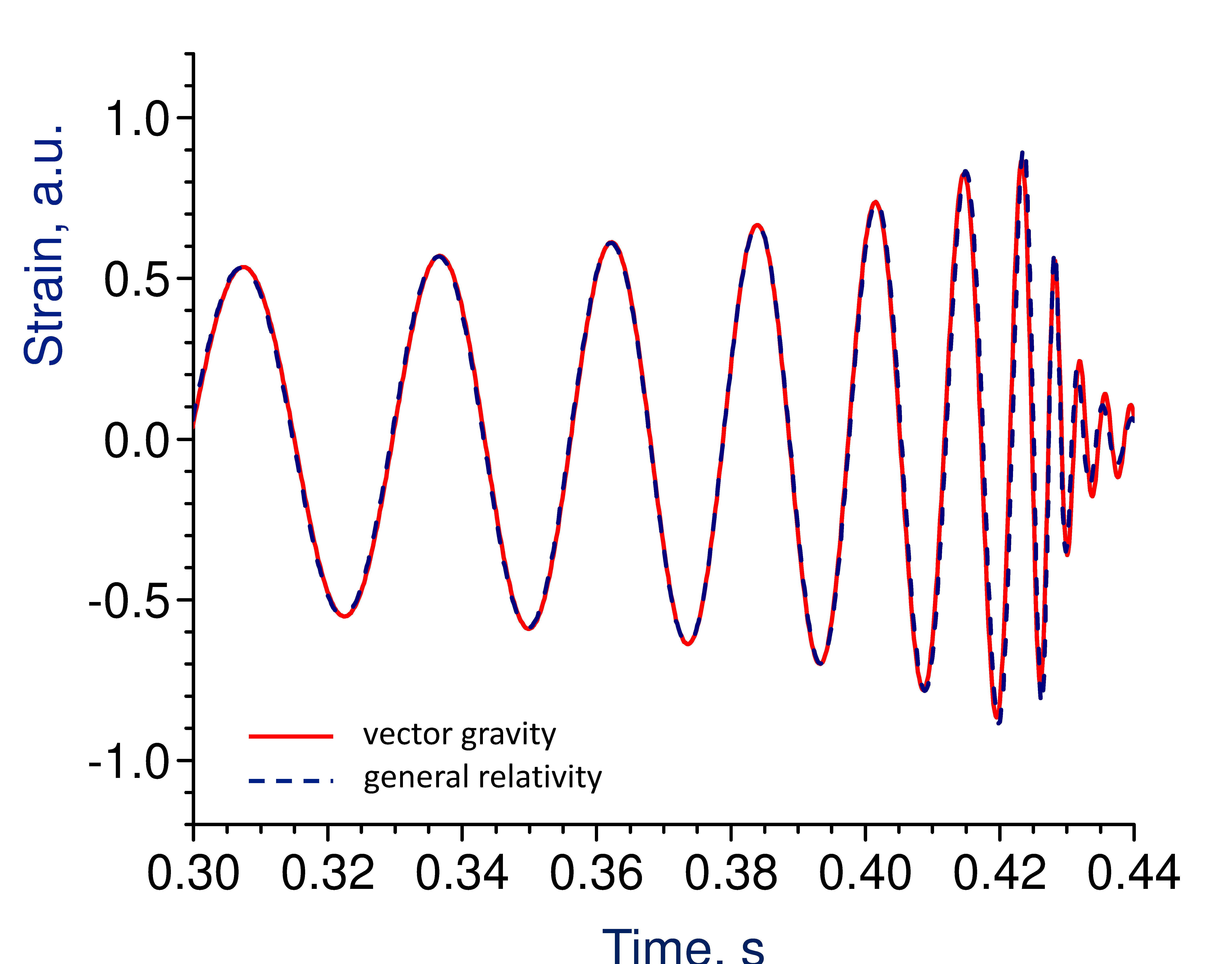
Figure 1: Gravitational waveform (in arbitrary units) as a function of time produced by the merger of compact objects in vector gravity (solid red line) and general relativity (dashed blue line). Orbital parameters (masses of objects in the binaries, orientation of the orbital plane, wave propagation direction) are chosen to obtain the best fit of the LIGO GW150914 event signal and varied independently for vector gravity and general relativity. The two radiation waveforms are indistinguishable within the sensitivity limit of LIGO and Virgo interferometers. Adopted from Fig. 7 of Ref. [1].
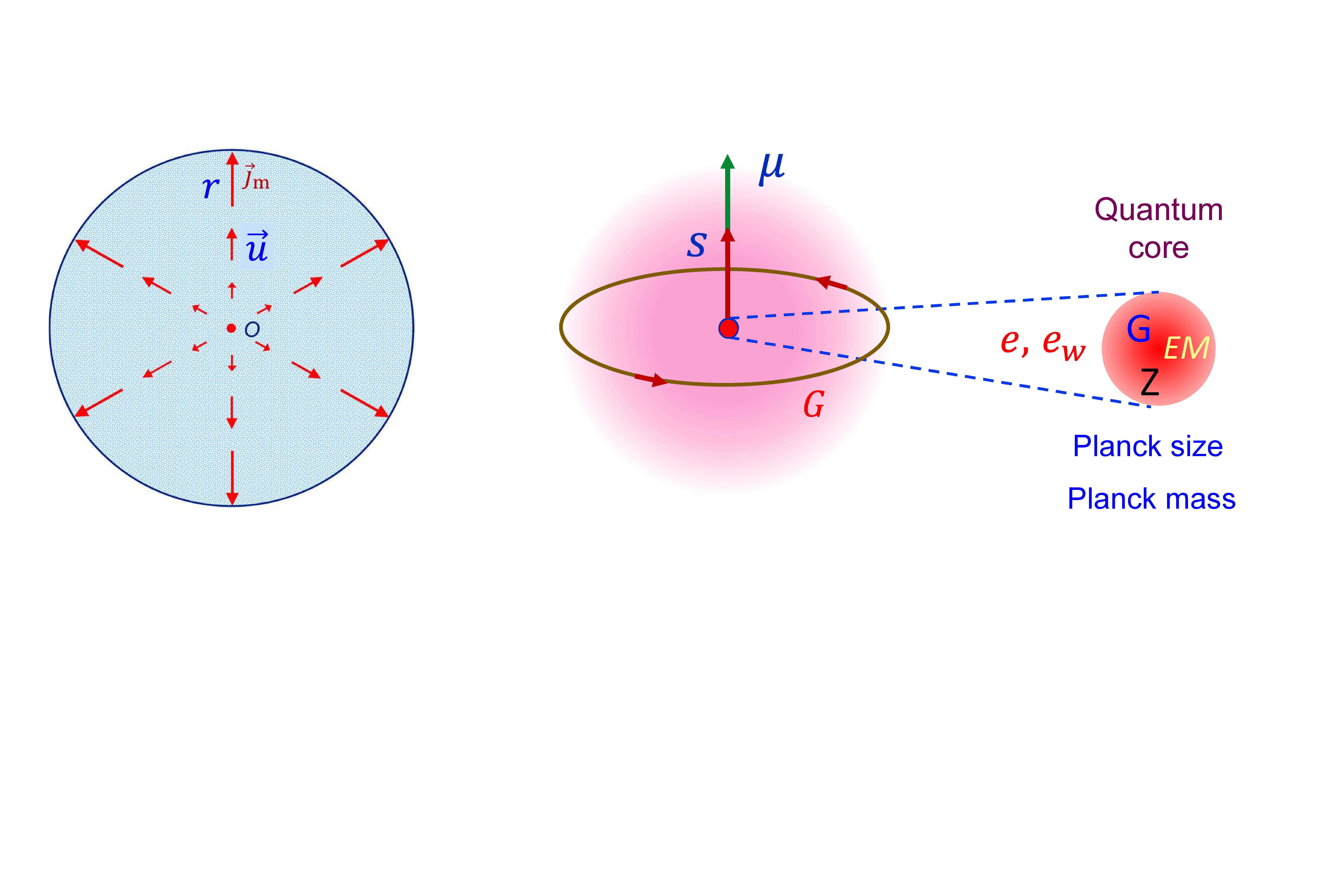
In contrast to general relativity, vector gravity explains dark energy as the energy of gravitational field induced by the universe expansion (Fig. 2a). In vector gravity, the energy density of such induced gravitational field is negative, which produces apparent acceleration of the universe expansion. With no free parameters, vector gravity predicts the value of ΩΛ =2/3, in agreement with observations.
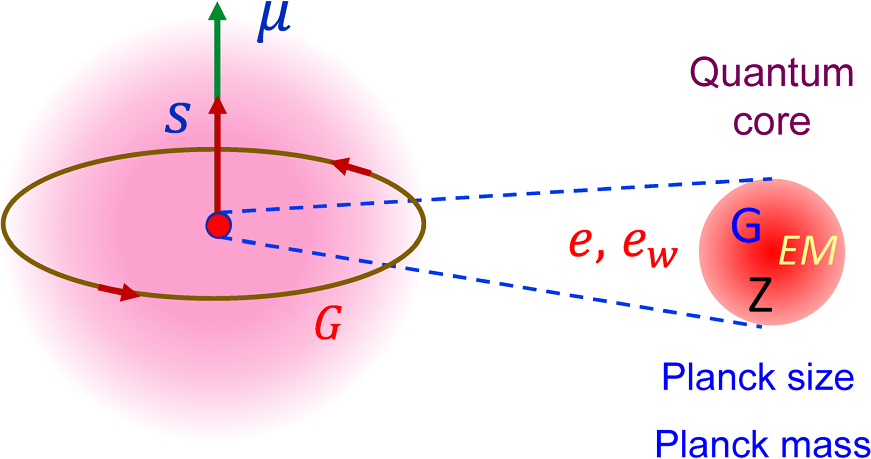
Recent paper [3] studies elementary particles in the framework of vector gravity and shows that charged elementary particles are nonsingular bound states of fundamental fields held together by gravity (Fig. 2b). For example, electron is the lowest-energy bound state of electromagnetic, weak and gravitational fields. Energy of the bound state solutions yields particle masses (e.g., electron and muon) in excellent agreement with experiment without free parameters [3].
In addition to the energy of the bound state calculated in vector gravity, there is a small self-energy correction to the mass of a particle arising from emission and reabsorption of virtual photons, calculated by Schwinger and Feynman in 1948. Accuracy of the total mass calculation is limited by the 1% accuracy of this quantum correction that contains a high-energy cutoff parameter under the logarithm. Vector gravity prediction for the particle masses agrees with experiment within this 1% accuracy.
The striking agreement with experiment indicates that vector gravity gives correct microscopic description of elementary particles and that particle masses are not generated by the Higgs mechanism. Instead, particle mass is simply the total energy of the fields forming the bound state. Higgs boson naturally appears in vector gravity as a quantum of a scalar field restoring the gauge symmetry of gravity at low energy, and the emerging scalar particle has properties of the Higgs boson discovered at the Large Hadron Collider (LHC) in 2012. Namely, vector gravity predicts that the Higgs boson should exist (together with Z boson, the carrier of weak interaction) and it is coupled to the rest mass of particles (see Sect. 8 in Ref. [3]).
The latter property was confirmed by ATLAS and CMS experiments at LHC by measuring decay rates of the Higgs boson into different particle channels. The measured rates are found to be proportional to the particle masses, as predicted by the Higgs mechanism, which is considered by many as the conformation of the latter. However, vector gravity predicts existence of the Higgs boson with the same properties without Higgs mechanism. That is, there is no Higgs condensate, and the vacuum expectation value of the Higgs field is equal to zero.
Vector gravity yields small value of particle’s mass on the Planck scale, because in vector gravity, the spinning gravitational field can have negative energy density, which screens the large positive contribution to the mass from the electromagnetic field. Thus, dark energy in the universe and lightness of elementary particles have the same physical origin. In both cases, the negative energy of gravitational field causes the effect.
Vector gravity also predicts existence of nonsingular bound state formed solely from the gravitational field. The corresponding particle does not carry electroweak or color charges and couples only to the mass through gravity. Thus, such a particle very weakly interacts with ordinary matter, and is a natural candidate for the dark matter in the universe.
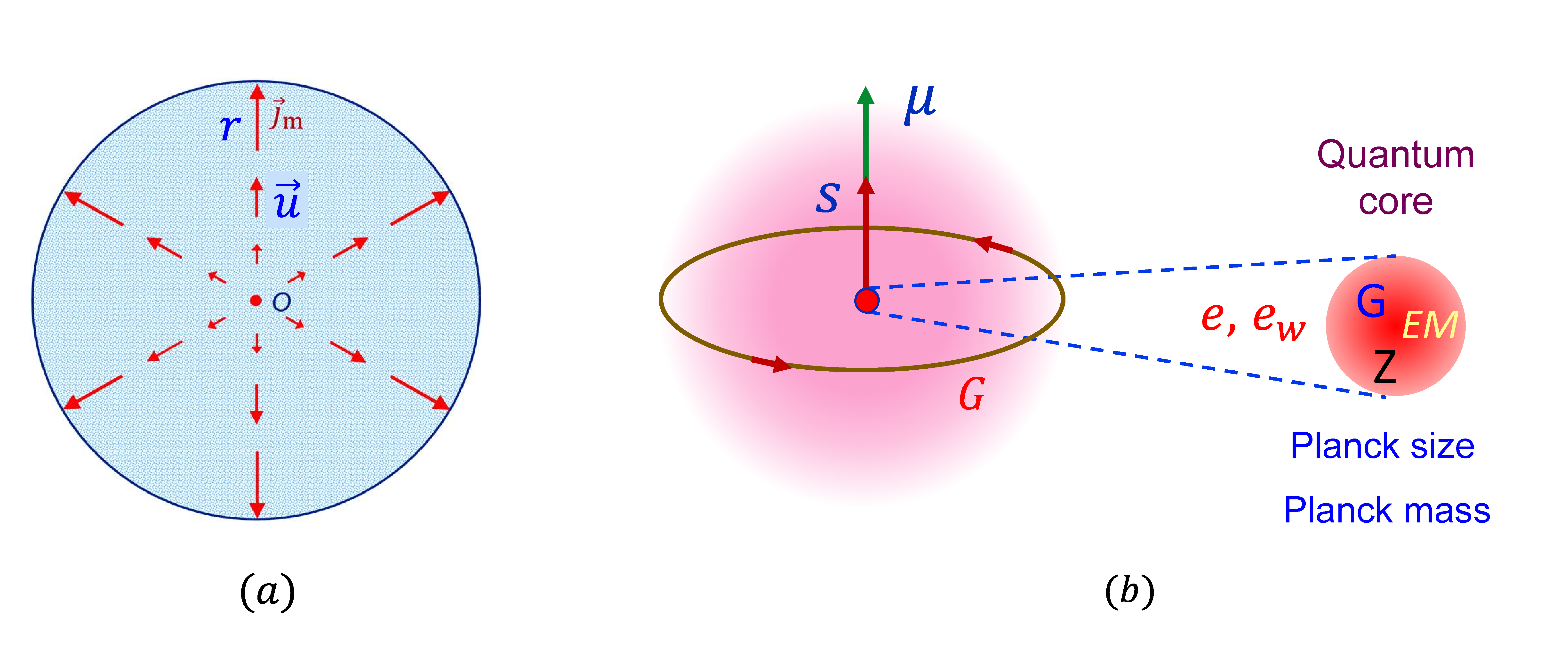
Figure 2: (a) Universe expansion generates matter current directed away from an observer O. Such current induces longitudinal gravitational field which has negative energy density and produces apparent acceleration of the universe expansion. (b) Structure of charged leptons from vector gravity perspective. The particle center contains a quantum core of Planck size and Planck mass, which is the lowest energy bound state of electromagnetic, weak (Z), and gravitational (G) fields. At distance greater than Planck length the core behaves as a point electroweak charge. In vector gravity, similarly to dark energy, the spinning gravitational field can have negative energy. To decrease the particle energy (mass), the field around the core spins, which reduces the mass from the Planck scale to the orders of magnitude smaller value of elementary particle masses we observe in experiment. In the presence of the electric field, the spinning gravitational field induces a magnetic moment due to field dragging. For the given electroweak charge and spin, a spinning gravitational field can be attached to the core in different bound state configurations, yielding electron, muon, tau lepton, W boson, and much heavier particles not yet discovered [3].
There is evidence that LIGO-Virgo gravitational wave detection of the binary neutron star event GW170817 supports the vector gravitational wave polarization predicted by vector gravity and rules out the tensor polarization of general relativity [2]. Prediction for the sky location of the gravitational wave source, based on the LIGO-Virgo gravitational wave detection, is very sensitive to the assumption about gravitational wave polarization, yielding very different sky regions for the tensor and vector polarizations (see Fig. 3). It is also sensitive to the ratio of signal amplitudes measured by different interferometers.
Article [2] shows that for the GW170817 event the source location was accidentally predicted correctly by general relativity because LIGO-Livingston signal amplitude was erroneously underestimated due to unaccounted signal reduction caused by noise filtering. The error cancelation yielded the same prediction for the source location by general relativity as vector gravity if for the latter the signal amplitude is estimated correctly (see Fig. 4). It was a pure coincidence, which is unlikely to happen again. The fact that during almost a decade of gravitational wave detection the source was discovered only for the GW170817 event supports this conclusion and suggests that astronomers attempt to locate electromagnetic counterparts in the “wrong” patches in the sky predicted by general relativity. If search continues in the sky regions predicted by general relativity, then likely no gravitational wave sources will be identified in the future LIGO - Virgo - KAGRA observing runs as well.
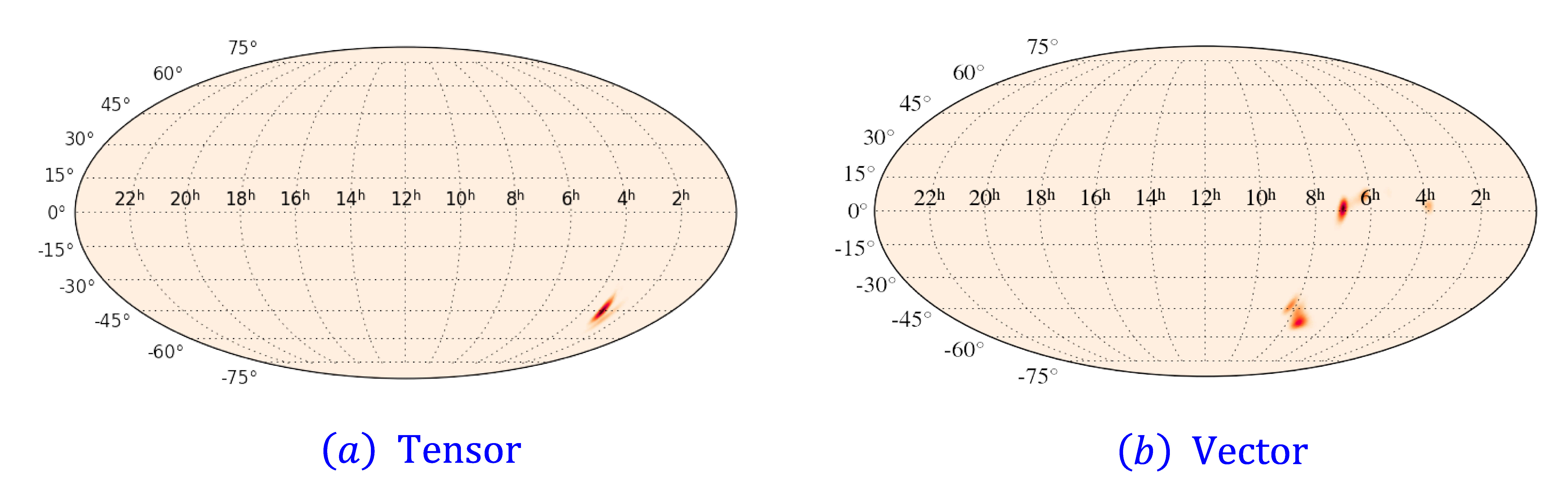
Figure 3: Reconstructed sky location of the source for the GW170814 event detected by two LIGOs and Virgo instruments under the assumption of tensor (a) and vector (b) gravitational wave polarization hypotheses. Color represents probability density, as a function of equatorial coordinates in a Mollweide projection. Adopted from Fig. 6.2 of Ref. [4].
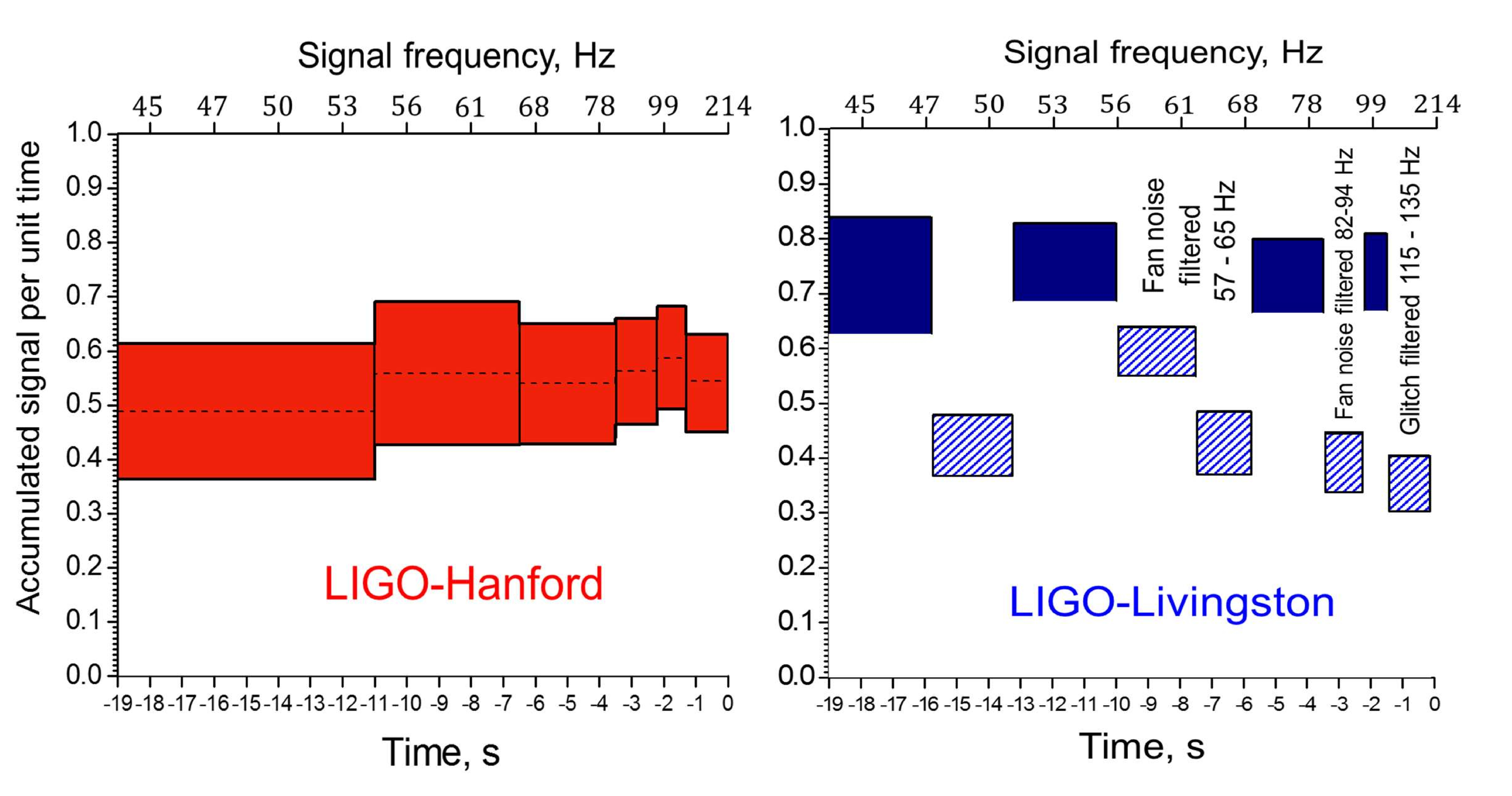
Figure 4: Adjusted gravitational wave signal amplitude measured by LIGO-Hanford (a) and LIGO-Livingston (b) detectors for the GW170817 event using different signal collection time intervals (frequency bands). Times are shown relative to the moment of neutron stars merger. The adjusted amplitude must be the same in different intervals if signal is not depleted by noise filtering. Adjusted signal amplitudes in different frequency bands are consistent for the Hanford detector, indicating that noise filtering has not altered the signal. This is not the case for the LIGO-Livingston detector. Frequency regions in which the LIGO-Livingston signal is reduced by noise subtraction are indicated as dashed bars. It would be a mistake to include those "corrupted" frequency intervals in the data analysis. If they are included, after averaging over the whole detector bandwidth, the signal amplitude is underestimated, which alters the conclusion about gravitational wave polarization. Namely, if the "corrupted" frequency intervals are included the tensor gravitational wave polarization is consistent with the sky location of the kilonova, discovered in close proximity to the galaxy NGC 4993, while vector polarization is ruled out. But if the "corrupted" frequency intervals are excluded, the conclusion is the opposite - pure vector gravitational wave polarization is consistent with the sky location and distance to the source, while tensor polarization is ruled out. Adopted from Fig. 9 of Ref. [2].
When a star exhausts its nuclear fuel, thermal pressure can no longer support the star against the force of gravity, leading to collapse. In general relativity, a massive star collapses to zero volume leading to formation of a singularity with infinite matter density and infinite spacetime curvature, known as a black hole. In contrast, in vector gravity, gravitational collapse creates exponentially large volume of space in the inner region, rather than a singularity. Collapsing star expands into this self-generated “infinite” volume in the vicinity of r = 0, leaving behind a very cold dilute cloud of gas and dust that produce no radiation, resembling black hole interior. For a distant observer, the generated “infinite” volume of space appears as a point-like dark object in the sky with exponentially large gravitational redshift. Such spacetime structure - “infinite” volumes of essentially flat space (exterior and interior) separated by a region with large spacetime curvature – is known as a wormhole (see Fig. 5).
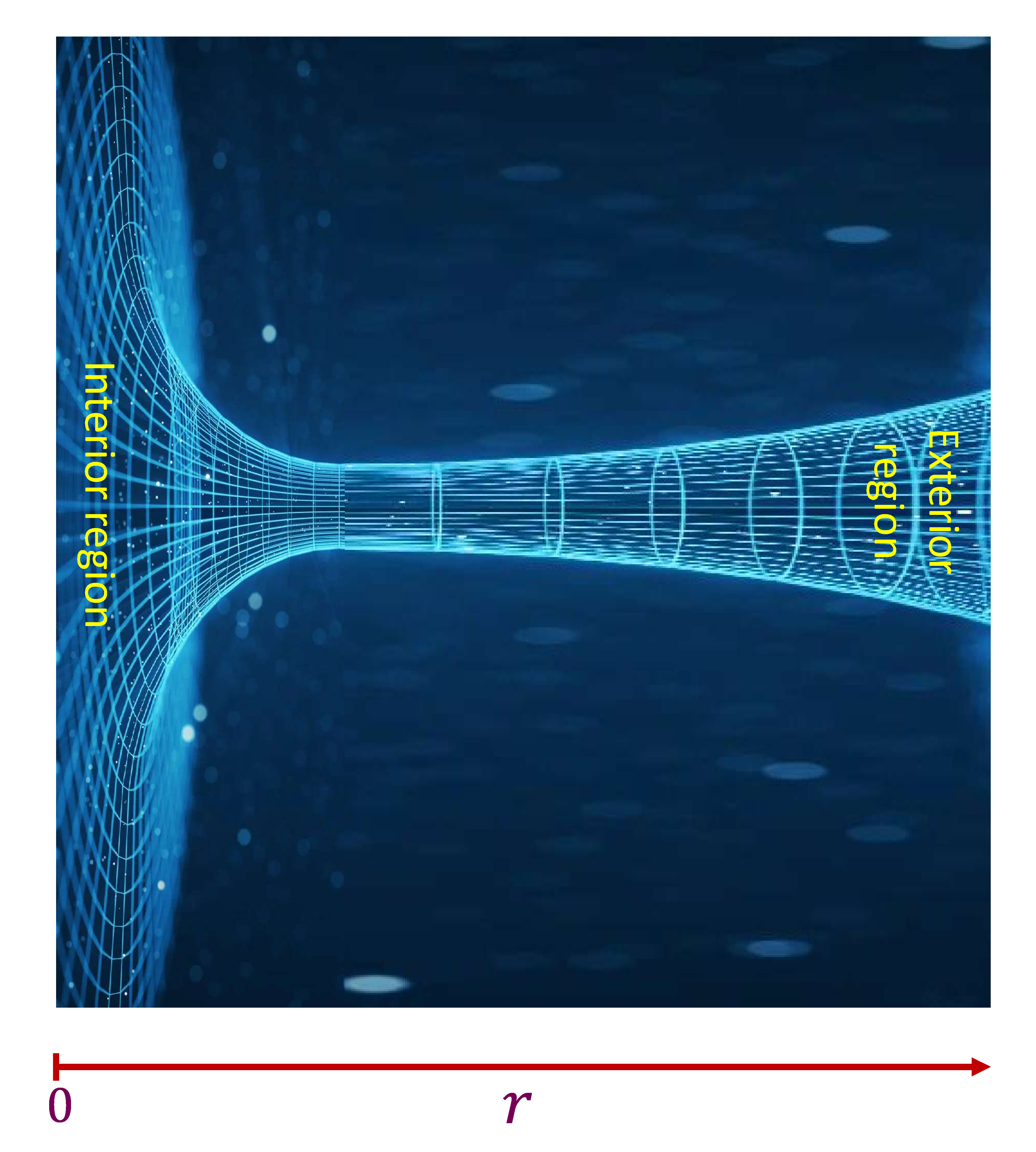
Figure 5: Illustration of a wormhole – a tunnel that connects one universe (interior region) with another (exterior region). Figure shows the area of the spherical surface of constant radial coordinate r as a function of r. The area is a concave function of r and has a minimum at the throat of the wormhole. In vector gravity, stable wormholes form as a result of gravitational collapse of massive stars.
According to vector gravity, gravitational wave events interpreted in general relativity as merger of black holes, are produced by the merger of the collapsed point-like objects with exponential spacetime geometry, which mimic black holes. The point-like collapsed objects made of baryonic or dark matter with large masses could be the supermassive compact objects residing in galactic centers. In vector gravity, exterior region of the collapsed object is described by exponential metric, which produces essentially the same shadow due to gravitational bending of light and the same size of the accretion disk as the black hole geometry predicted by general relativity. Resolution of modern telescopes cannot catch the small difference and cannot distinguish between the two theories (see Fig. 6).
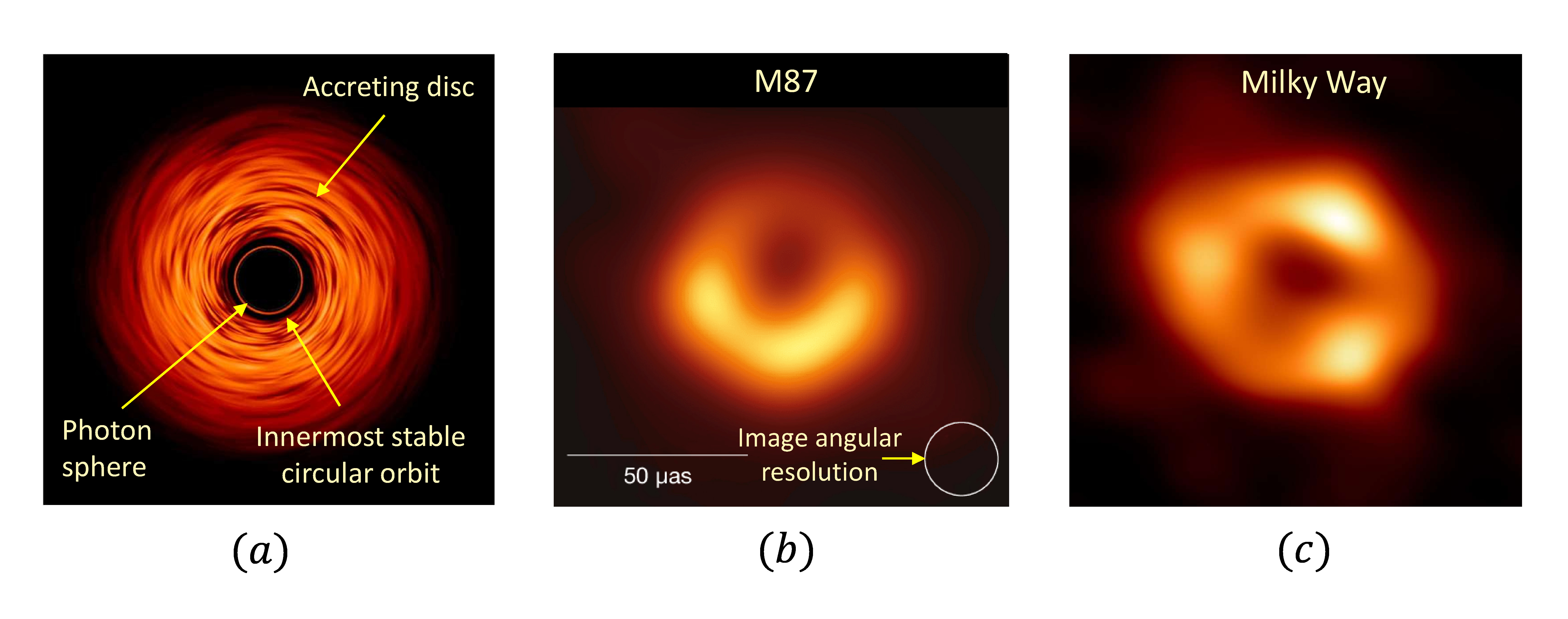
Figure 6: (a): Sketch of the luminous accretion disk of hot material that encircles a dark compact object. The inner radius of the disk corresponds to the innermost stable orbit, while the bright circle inside the disk is the photon sphere. (b,c): The Event Horizon Telescope images of supermassive objects at the center of M87 (b) and the Milky Way (c) galaxies with colors indicating the brightness temperature. The telescope image angular resolution of 20 micro-arcseconds (shown as a circle in (b)) is insufficient to capture the 4% difference between general relativity and vector gravity predictions for the size of the accreting disc and the radius of the photon sphere.
In contrast to merger of massive point-like collapsed objects, mergers of low-mass neutron stars are expected to produce a strong burst of EM radiation. This is known as a kilonova - a transient astronomical event that occurs in a compact binary system when two neutron stars collide. In this case, the chance of finding EM counterpart of gravitational wave signal is pretty big provided the sky localization is predicted correctly. The compact binary merger candidate S251112cm is an example of such sub-solar-mass gravitational wave detection occurred on November 12, 2025. Analysis based on the tensor gravitational wave polarization assumption resulted in a credible sky-localization region of 1681 deg2, but no EM counterpart was found in this region. Perhaps, if the sky localization was calculated based on the vector polarization, astronomers would have discovered another event for multi-messenger astronomy.
One might ask a reasonable question: Why is general relativity so successful in describing many experiments, including those in which gravitational field is not weak? Such a success considered by many as a confirmation of the Einstein's theory of gravity. A comparison of general relativity and vector gravity shows that this happens because general relativity mimics vector gravity on those “successful” occasions, and both theories pass the corresponding gravity tests. For these “successful” mimicking the experimental accuracy is not sufficient to distinguish between the two theories. This is, e.g., the case for all solar system tests of gravity because general relativity is equivalent to vector gravity in the post-Newtonian limit [1]; for LIGO - Virgo - KAGRA measurements of gravitational waveforms produced by merger of compact objects in binary systems (Fig. 1); imaging of compact supermassive objects at galactic centers by the Event Horizon Telescope (Fig. 6); etc.
In situations where general relativity and vector gravity predictions are substantially different and can be noticed experimentally, general relativity fails to describe observations. For example, general relativity is:
- incompatible with quantum mechanics
- predicts spacetime singularities
- does not explain dark energy
- does not explain elementary particles and origin of charges
- does not predict dark matter particle
- does not explain matter generation at Big Bang
- does not explain why universe is spatially flat
These “unsuccessful” occasions are usually justified by arguing that general relativity is incomplete. For example, to eliminate singularities, various extensions of general relativity have been proposed - string theory, loop quantum gravity, etc. However, so far there is no experimental evidence for those.
In contrast, vector gravity is compatible with quantum mechanics, predicts no spacetime singularities, and answers the other questions listed above (see Refs. [1-3,5]). In particular, a spatially flat universe is the only solution of equations of vector gravity in the cosmological model, while dark energy is simply the energy of the gravitational field induced by the expanding universe.
Agreement between predictions of vector gravity and observations suggests the following:
- Einstein's general relativity is ruled out together with black holes. The latter are replaced with nonsingular dark point-like objects described by the exponential metric which mimic black holes (see Sect. 3.1 in Ref. [3]).
- Higgs mechanism of mass generation is ruled out. That is, there is no Higgs condensate, which is the essence of the Higgs mechanism of mass generation in particle physics. Neutral particles, such as Higgs and Z bosons, are predicted by vector gravity based on gauge symmetry arguments [3], and their predicted properties - coupling of the Higgs boson to mass and Z boson to weak charge - agree with LHC experiments.
- String theory, as a physical theory describing elementary particles, is ruled out. According to our findings, charged elementary particles (electrons, quarks, etc.) are bound states of fundamental fields held together by gravity, and they are not vibrating strings or branes. Particle mass is simply the total energy of the fields forming the bound state, which is physically intuitive.
Vector gravity can be further tested by searching for gravitational wave sources in the sky regions reconstructed from LIGO - Virgo - KAGRA detection under the assumption of vector gravitational wave polarization; measuring polarization of stochastic gravitational wave background using pulsar timing arrays; searching for new elementary particles predicted by vector gravity in the electroweak sector (see Fig. 9 in Ref. [3]) and the predicted dark matter particle which interacts only gravitationally; improving angular resolution of the Event Horizon Telescope images of galactic centers which would allow us to distinguish between the exponential and the black hole spacetime geometries.
One should note that apart from transverse vector gravitational waves, vector gravity predicts existence of traceless longitudinal scalar waves (see Eq. (51) in Ref. [1]). Even though, in vector gravity, scalar gravitational waves are not emitted by orbiting binary systems, they could be generated during gravitational collapse and contribute to the gravitational wave background probed by the pulsar timing array.
References:
[1] A.A. Svidzinsky, Vector theory of gravity: Universe without black holes and solution of dark energy problem. Physica Scripta 92, 125001, (2017). https://iopscience.iop.org/article/10.1088/1402-4896/aa93a8
[2] A.A. Svidzinsky, R.C. Hilborn, GW170817 event rules out general relativity in favor of vector gravity. Eur. Phys. J. Spec. Top. 230, 1149 (2021). https://link.springer.com/article/10.1140/epjs/s11734-021-00080-6
[3] A.A. Svidzinsky, Inner structure of leptons, nature of dark matter, and non-Higgs origin of elementary particle masses. Quantum Stud.: Math. Found. 13, 17 (2026). https://link.springer.com/article/10.1007/s40509-026-00387-w
[4] M. Isi, Fundamental physics in the era of gravitational wave astronomy: the direct measurement of gravitational-wave polarizations and other topics. Ph.D. Thesis, Caltech (2019). https://thesis.caltech.edu/11264/
[5] A.A. Svidzinsky, Simplified equations for gravitational field in the vector theory of gravity and new insights into dark energy. Physics of the Dark Universe 25, 100321 (2019). https://doi.org/10.1016/j.dark.2019.100321

Anatoly Svidzinsky received Ph.D. degree from Moscow Institute of Physics & Technology (V.L. Ginzburg theory group), and second Ph.D. from Stanford University. Currently, he holds Research Professor position at Texas A&M University, has about 150 publications (first author in half of them) and has given about 150 talks at National and International Conferences and Colloquia. He was a co-organizer of 30 National and International conferences (program chair and logistics). His citation index is about 6000, and H-index is 35. In 2018 he was elected as Fellow of Optical Society of America.
Research interests in theoretical physics include Quantum optics; Bose-Einstein condensation; Superconductivity; Chemical physics; Radiation of neutron stars; Vector theory of gravity; Dark matter; Dark energy; Elementary particles.
Follow the Topic
-
Quantum Studies: Mathematics and Foundations
Quantum Studies: Mathematics and Foundations promotes a deeper understanding of all fundamental aspects of quantum theory and bridges between theoretical questions, foundational issues, mathematical methods and the continuing evolution of quantum physics.