What community-level features may promote entrepreneurial opportunity for rural women?
Published in Sustainability, Business & Management, and Economics



The Rural Employment Picture for Women in the U.S.
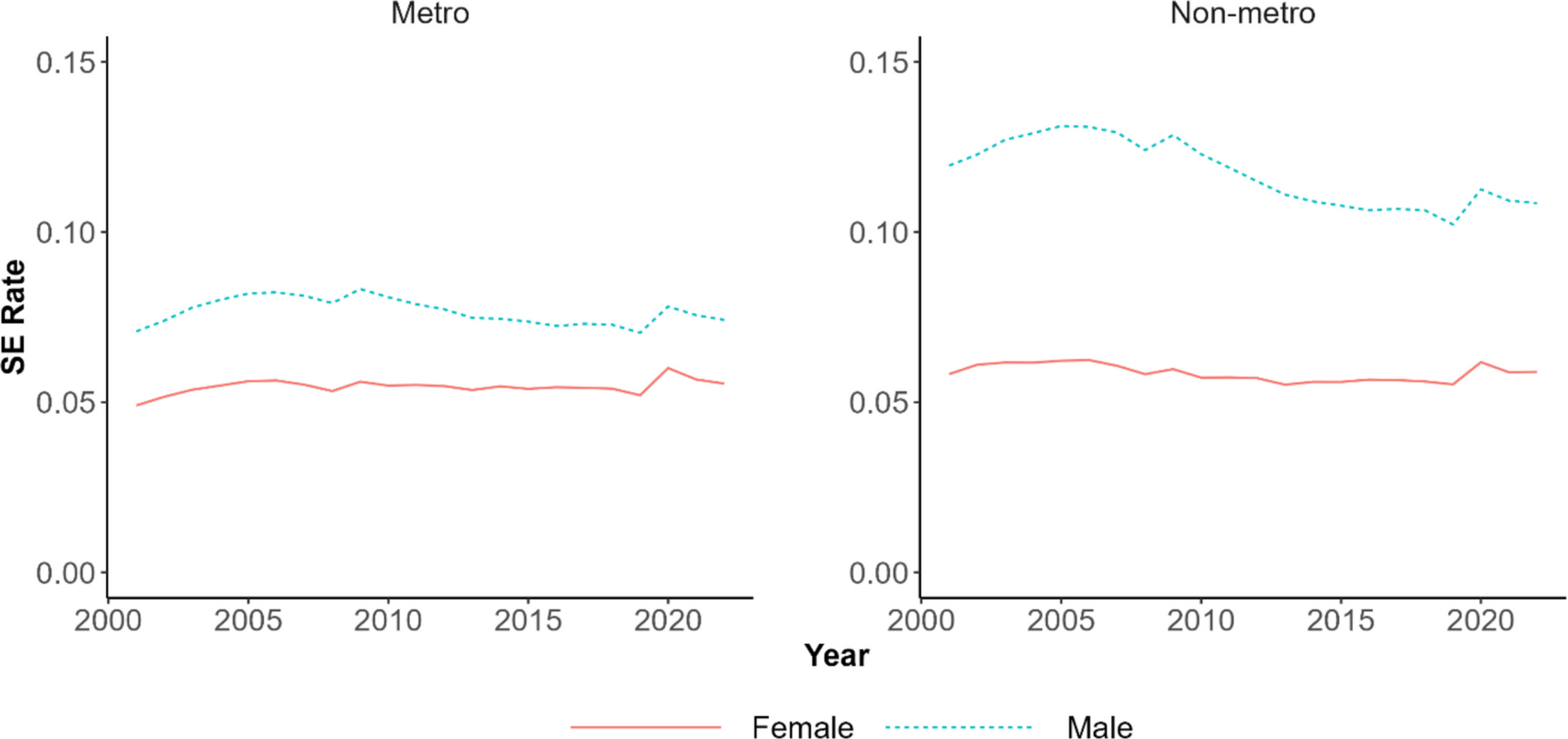
Gender disparities in both labor market participation and entrepreneurial action are well-documented. The latest report from the U.S. Bureau of Labor Statistics shows that U.S. women’s overall labor force participation rate is approximately 57%, compared to 68% for men.[1] Similar to the long-term trend in labor force participation, the gap in the employment–population ratio between men and women in the U.S. has remained around 10 percentage points over the past two decades. Data from the Global Entrepreneurship Monitor (GEM) indicate that in many countries – including the U.S. – rates of early-stage entrepreneurial activity for women also lag those of men at 10.7% compared to 13.2%, respectively.[2] These gaps in labor force and entrepreneurial data persist despite consistent gains for women in the data over time.
Importantly disparities faced by rural women are less often the focus of research seeking to understand these gaps, despite indications these gaps are more acute in non-metropolitan communities. Rural women suffer greater economic inequality due to factors such as occupational segregation and wage penalties, and face more disadvantages compared to rural men and urban women.[3]
Self-employment is often considered a significant driver of economic development and vitality in regions where the paid-wage job market is limited[4] and is a signifier of broader ecosystem support for early-stage entrepreneurial activity. Yet rural women remain underrepresented. Women in the U.S., for example, consistently have lower self-employment rates than men across geographic areas, and the gap is more pronounced in rural areas, where self-employment is otherwise prevalent. However, rural women’s entrepreneurialism remains understudied given much of the literature focusing on urban settings or male entrepreneurs, both of which are dominant (statistically speaking) in national samples. Considering the structural conditions and unique barriers constraining rural women’s entrepreneurial activity, such as limited access to financial capital, inadequate support services, and a disproportionate burden of care work, it is essential to understand their needs and design effective interventions.
Our recent paper, “Perspectives on Rural Entrepreneurial Ecosystems and Women’s Venturing: An Analysis of Local Factors Associated with Female Self-Employment in Non-Metro U.S. Counties,” published in Small Business Economics, an Entrepreneurship Journal, offers new evidence on this topic. Part of a wider forthcoming special issue on rural entrepreneurship, our work offers the first investigation at a broad national scale to disaggregate county-level data for rural communities into those adjacent to metropolitan areas and those remote from them. Findings from this investigation indicate that, on average, coordinators of the most remote rural entrepreneurial ecosystems should adopt different foci for their work to support women’s venturing than those nearer metro neighbors.
Key Findings: What Evidence Shows
There are two key policy-relevant findings from our research that are unique to remote rural areas in the U.S. worth highlighting:
First, access to childcare is positively associated with female self-employment in remote rural communities. Our findings indicate childcare access in remote rural communities may act in an opposite way from what is seen in many studies focused on urban areas, where greater childcare support tends to draw women toward wage and salary employment rather than entrepreneurialism.[5] In remote and rural areas, our findings suggest that childcare support is also critical to enabling women to start their own businesses in places where childcare is often unavailable or unaffordable. Rural women entrepreneurs with children earn on average 25 percent less than those without.[6] Limited childcare access may delay women's entry into entrepreneurship while also constraining their earning ambitions. This finding reinforces a growing body of evidence on the critical role childcare plays in women's labor market decisions and underscores the importance of expanding childcare access in economically distressed communities.
Second, consistent with previous literature, we find that social capital and community engagement is associated with higher female self-employment rates in remote rural areas, suggesting that a closer social network supports rural women entrepreneurs. In communities with limited formal institutional support, informal networks such as peer groups, mentorship ties, and community associations may play a crucial role in enabling women to pursue self-employment by building trust, facilitating knowledge sharing, and encouraging entrepreneurial interaction. Some measures of social capital emphasize institutional organizations, missing the complexity of social capital particularly in diffuse rural areas. However, our analysis uses an emerging measure of social capital, developed by the Joint Economic Committee, which captures greater nuance and detail important for rural communities. Continued research should explore this area to further improve our understanding of social capital’s role in supporting women’s venturing and to meet the needs of rural women entrepreneurs.
Actions to promote inclusive entrepreneurship support
What makes this work meaningful to us is not just the findings themselves, but their potential to drive real change in communities. Building on this research, we are developing an outreach program designed to support community-level assessment of entrepreneurial resources and to guide strategic planning toward a more inclusive entrepreneurial ecosystem. Working with local community partners, we seek to use the program to help identify gaps in existing support structures and expand access to the resources rural women need to thrive as entrepreneurs.
______________________________________________
[1] https://www.bls.gov/opub/reports/womens-databook/2023/home.htm
[2] Global Entrepreneurship Monitor. (2025). GEM 2024/2025 Women’s Entrepreneurship Report: Navigating Challenges, Driving Change. ISBN 978-1-0683380-1-4.
[3] Anthony P. Carnevale, Lulu Kam, and Martin Van Der Werf. Small Towns, Big Opportunities: Many Workers in Rural Areas Have Good Jobs, but These Areas Need Greater Investment in Education, Training, and Career Counseling. Washington, DC: Georgetown University Center on Education and the Workforce, 2024. cew.georgetown.edu/ruralgoodjobs.
[4] Stephens, Heather M. and Mark D. Partridge. (2011). “Do Entrepreneurs Enhance Economic Growth in Lagging Regions?” Growth and Change 42(4): 431–465. https://doi.org/10.1111/j.1468-2257.2011.00563.x
[5] For example: Patrick, Carlianne, Heather M. Stephens, and Amanda Weinstein. 2016. “Where are all the self-employed women? Push and pull factors influencing female labor market decisions.” Small Business Economics. 46(3): 365-390. https://doi.org/10.1007/s11187-015-9697-2
[6] https://www.nwbc.gov/wp-content/uploads/2024/10/FINAL-NWBC-Rural-Landscape-Literature-Review-01.02.24.pdf
Follow the Topic
-
Small Business Economics
Small Business Economics: An Entrepreneurship Journal (SBEJ) publishes original research addressing all aspects of entrepreneurship and small business economics, with a special emphasis on the economic and societal relevance of research findings for scholars, practitioners and policy makers.

📢 Introducing: # Mental Health
Mental Health is a Topic created to increase visibility and impact of research in this area and facilitate exchange amongst researchers.
Continue reading announcementRelated Collections
With Collections, you can get published faster and increase your visibility.
From Shock to Strength: The Endogenous Foundations of Entrepreneurship under Adversity
Extended Abstracts of approximately 800 words are subject to desk review, with submissions open January 1 to February 15, 2026. Abstracts must clearly present the rationale, theoretical background, methods (sample and design), core findings, and contribution. Desk-accepted abstracts will be invited to an online PDW at the 8th Creative Spark Workshop, held March 12–13, 2026, hosted by Indiana University Europe Gateway in Berlin. For full details please the the PDF version of the call for papers below.
This groundbreaking special issue seeks to revolutionize our understanding of how entrepreneurs not only survive but thrive when external support systems fail. We're looking for bold research that explores the endogenous capabilities—the internal resources, psychological strengths, and self-generated mechanisms—that enable entrepreneurial success amid continuous adversity.
While existing literature treats crises as isolated events, we recognize that today's entrepreneurs operate in fundamentally different conditions. When ecosystem support becomes depleted or inaccessible, entrepreneurs must draw upon internal wellspring of innovation, adaptability, and resilience. This is where breakthrough research opportunities lie.
Read the full Call for Papers here.
Publishing Model: Hybrid
Deadline: Oct 31, 2026
Entrepreneurship and the Creation of Decent Work for All
Springer Nature is inviting submissions to our new multi-journal Collection on Entrepreneurship and the Creation of Decent Work for all, reflecting on the U.N. Sustainable Development Goal SDG 8.
Societal changes, environment, political and financial crises inevitably affect labor markets and the quality of employment. Recent pandemic and global political changes have only demonstrated how quickly one´s employment and workplace situation can change. Among other factors, entrepreneurship could play a crucial role in the creation of decent work, especially in a volatile environment.
Understanding the relationship between entrepreneurship and working conditions is crucial for supporting policies and instruments which aim at more productive, decent work, fair wages, better access to the labor market, and improved job opportunities for all.
In order to fully represent this multifaceted topic, we would like to gather a spectrum of current perspectives in a single Collection, facilitating a better understanding of possibilities and ways of striving toward the goal of “achieving full and productive employment and decent work for all” (SDG 8 of the U.N.).
We encourage submissions including, but not limited to, the following topics:
- Equal pay for work of equal value
- Gender discrimination in employment
- Immigration and employment
- Labor shortages after COVID-19
- Modern slavery and child labor
- Labor policy
- Entrepreneurial enterprises, SMEs, and family businesses
- Global entrepreneurial firms: organization design, emerging conceptions in entrepreneurship (i.e. born globals), globalization’s challenges and opportunities, cultural differences
- Remote work
- Opportunity entrepreneurship as a direct way to generate high quality employment
- Measuring and dealing with positive and negative externalities of new businesses
Submissions to this collection may be research or review articles, depending on the individual journal guidelines. Each submission will undergo thorough and rigorous peer review in accordance with each journal’s peer review editorial policy. Accepted articles will be published in the journal they were submitted to, as well as highlighted on this collection page.
Publishing Model: Hybrid
Deadline: Ongoing