What do individuals believe about the safety of manual therapy?
Published in Healthcare & Nursing and Pharmacy & Pharmacology






Manual therapy refers to ‘hands-on’ treatment techniques including spinal joint manipulation and mobilisation as well as soft tissue massage. Manual therapy is used by physiotherapists, osteopaths, chiropractors, as well as other clinicians to treat musculoskeletal pain such as low back pain.
Manual therapy of the spine is considered a safe modality for most patients. Benign adverse events, such as post-treatment soreness or stiffness, are common, whereas serious adverse events are rare [1,2]. However, conversations about manual therapy, in particular spinal manipulation, can be shaped by concerns about risk [3].
But what do patients think about the safety of manual therapy? Understanding what patients believe about manual therapy, including whether they think these treatments are safe, motivated our qualitative study. To answer this question, we interviewed 21 participants with experience of low back pain, recruited from the London region of the UK, with varying levels of experience of manual therapy.
What did we learn about patients’ beliefs about the safety of manual therapy?
A key finding was the considerable level of trust patients place in a manual therapist. When this trust is established, most participants were very certain about holding little or no concerns about safety as expressed by this participant:
“If I had any concerns, I wouldn't have gone […] I had 100% faith and trust in him [the manual therapist].”
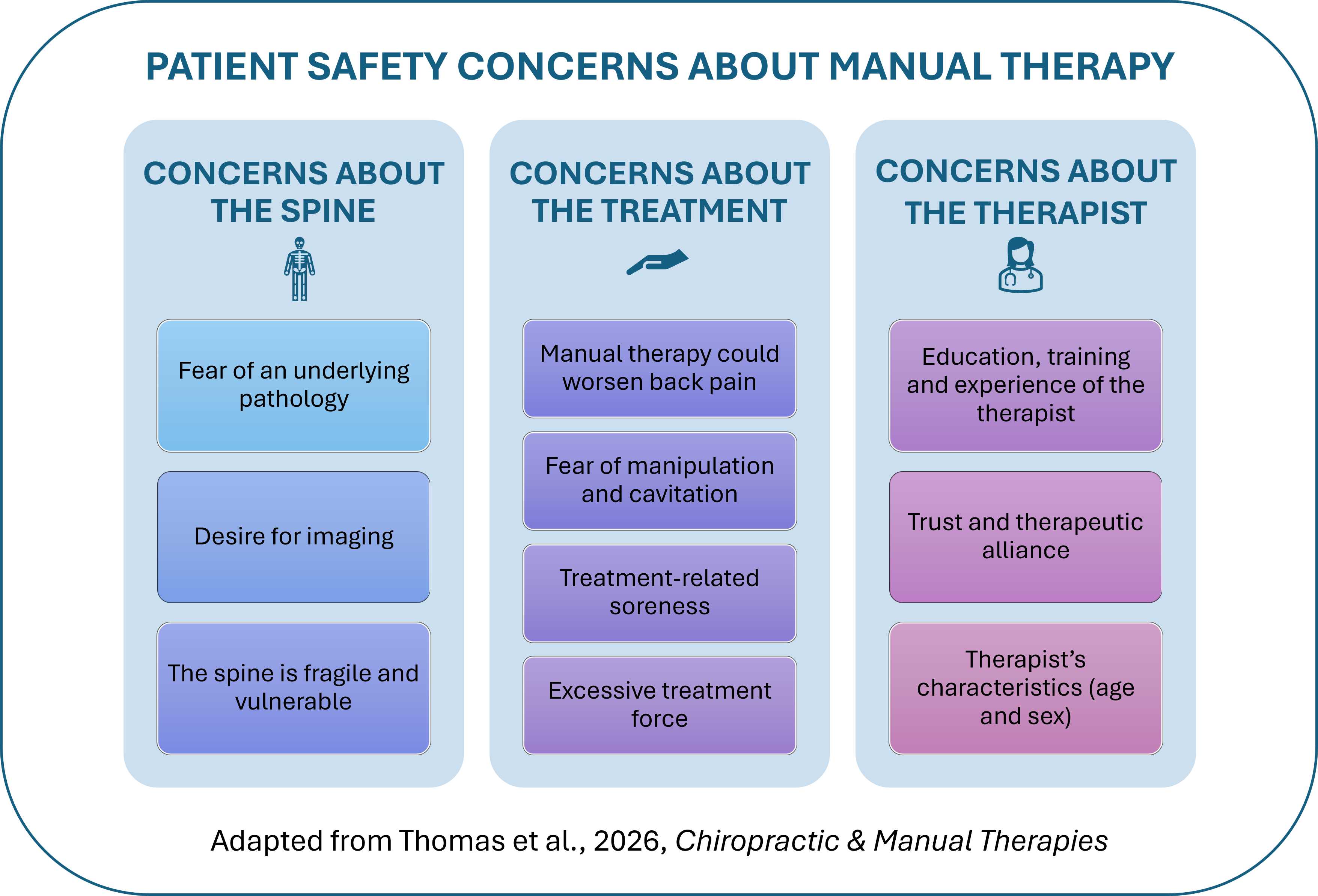
However, some participants did express important concerns about manual therapy as a treatment modality. Most participants were comfortable with treatment-related soreness, especially when it was outweighed by perceived benefits. For some, concerns about soreness during or after treatment acted as a barrier to seeking care:
“But apparently it [manual therapy] works really well. You know, so that's one positive, although I don't know if I want to be put through that amount of pain.”
Patients commonly held underlying mechanical beliefs about how manual therapy works. Many were uncertain about the structures of the spine and the exact mechanism involved. Most participants described treatment as producing movement within the spine to improve flexibility. With this understanding, some participants felt that too much force could potentially cause harm.
Some participants saw their spine as vulnerable and at risk of damage from manual therapy. These concerns were sometimes linked to a desire for diagnostic imaging to rule out serious underlying conditions before treatment. For example:
“Let me take an X-ray first, see if it is broken […] he can be massaging it, he could be making it worse. You got to see if you got a hairline crack first before you start. That's my opinion.”
Interestingly, some participants highlighted the importance of clinician characteristics, including age, profession, education, training, and clinical experience, which influenced their beliefs about safety:
“I probably wouldn't go to see a 25-year-old male osteopath or chiropractor because I think they probably don't know their own strength and nothing's broken on their body yet, so they're less careful with other people's bodies.”
Many participants viewed spinal manipulation as a distinct type of manual therapy. It was often perceived as having the potential to provide greater benefit, but also greater risk. This was often related to the experience of the audible “click”, known as cavitation, the popping or cracking sound often associated with spinal manipulation. Some patients viewed this negatively:
“That sound [cavitation] isn't pleasant […] When you hear that sound, you would immediately associate something negative with it.”
What are the implications for clinical practice?
These findings highlight the importance of clear and balanced communication about the safety of manual therapy. Manual therapy professionals should continue to communicate risk in a way that is accurate and accessible to patients, carers, and other healthcare professionals. The overall message should be that manual therapy is a relatively safe treatment option, while recognising the ongoing need to reduce both the likelihood and severity of adverse events.
Effective clinical communication is not one-sided. In addition to clinicians explaining risks, benefits, and alternatives, patients should disclose relevant information, including their past medical history, current medications, and previous responses to treatment.
Understanding patients’ beliefs about the safety of manual therapy is essential for effective shared decision-making. Some patients may hold significant concerns that need to be considered before care begins. In some cases, treatment may need to be modified, while in others manual therapy may not be the most appropriate option based on patient preference.
Patients should be prepared for common, short-lived effects like soreness with self-management strategies in place. Clinicians should provide clear guidance on what to do if their symptoms worsen, including when to contact the manual therapist or seek urgent medical attention if symptoms suggest a more serious underlying condition.
What is next?
Patient beliefs remain an important and relatively underexplored area of manual therapy research. We are currently developing a questionnaire to measure patients’ beliefs about both the benefits and risks of manual therapy. Such a tool may help clinicians better understand patient perspectives before treatment decisions are made.
Future research could investigate whether these beliefs influence treatment outcomes, including the experience of adverse events, and whether they may help predict response to care. Our aim is to support more informed, patient-centred approaches to manual therapy.
References
[1] Swait G, Finch R. What are the risks of manual treatment of the spine? A scoping review for clinicians. Chiropractic & Manual Therapies. 2017;25(1):37.
[2] Daniels CJ, Farabaugh RJ, Salsbury SA, et al. Adverse events among older adults receiving chiropractic spinal manipulation and related treatments: an updated systematic review. Chiropractic & Manual Therapies. 2026.
[3] Ernst E. Adverse effects of spinal manipulation: a systematic review. Journal of the Royal Society of Medicine. 2007;100(7):330-8.

Follow the Topic
-
Chiropractic & Manual Therapies
This journal aims to improve patient care by publishing basic science, clinical and health services research that is relevant to chiropractors, manual therapists and related fields, including physical therapy, osteopathy, sports medicine, and rehabilitation.

Related Collections
With Collections, you can get published faster and increase your visibility.
Patient safety in chiropractic care and manual therapies
In May 2019, the World Health Organization (WHO) declared the protection of patients a global health priority through the resolution WHA 72.6, titled "Global action on patient safety." Yet, despite its recognized importance and advancements in technology and treatment, safety concerns in healthcare persist worldwide. By prioritizing high standards of care and vigilance, chiropractors may contribute to a safer healthcare system for all stakeholders, particularly patients.
This thematic series in Chiropractic & Manual Therapies (C&MT) is led by a diverse, international team of editors with a track record aligned in patient safety. Namely, senior epidemiologist Prof. Sidney Rubinstein, nurse scientist Dr. Stacie Salsbury, early career researcher Dr. Brian Coleman, whose expertise lies in implementation science and technology, and Prof Simon French, co-Editor-in-Chief at C&MT. Our editorial team invites authors to submit manuscripts focused on patient safety in chiropractic care. Submissions are encouraged in all formats accepted by the journal, including original research articles, systematic and scoping reviews, case reports, and study protocols. In addition, the series welcomes scholarly commentaries, debates, and letters to the editor that explore barriers and propose solutions to fostering and sustaining a strong global patient safety culture within chiropractic.
Submissions may include, but are not limited to, the following patient safety topics:
- Intervention or quality improvement studies of strategies to enhance the patient safety culture in chiropractic clinical settings, including individual practices, multi-specialty group practices, and hospital-based practices.
- Studies investigating perceptions of patient safety in chiropractic from key stakeholders, including patients, family members, chiropractors, and other healthcare professionals.
- The epidemiology of patient safety events where the occurrence and patterns of patient safety events relevant to chiropractic care are evaluated.
- Studies addressing patient safety considerations for special populations seeking or receiving chiropractic care, such as older adults or pregnant patients.
- Studies exploring the intersection of population characteristics and patient safety within chiropractic settings.
- Studies evaluating the effectiveness of curricular content and/or simulation-based training in enhancing chiropractic student and practitioner competency and proficiency in safety-related assessment and management.
Behind the Paper. Hear directly from authors discussing this Collection and research in more details.
- From the authors of Patient safety culture research within the chiropractic profession: a scoping review, explore "Why We Mapped the State of Patient Safety Culture in Chiropractic Care."
- From the authors of Assessing the importance and feasibility of quality measures for chiropractic care: a national survey of U.S. chiropractors, explore "Why quality measures for chiropractic care are important and what we’re doing about it."
- From the authors of ‘It might help, but it won’t fix me’: a qualitative study of individuals’ beliefs about manual therapy for low back pain, explore "What do individuals believe about the safety of manual therapy?"
Online conference. Following the end of this Call, we will organize an online-conference for all authors to present their work and discuss the importance of their findings
This Collection supports and amplifies research related to SDG 3, Good Health and Well-Being.
All submissions in this collection undergo the journal’s standard peer review process. Similarly, all manuscripts authored by a Guest Editor(s) will be handled by the Editor-in-Chief. As an open access publication, this journal levies an article processing fee (details here). We recognize that many key stakeholders may not have access to such resources and are committed to supporting participation in this issue wherever resources are a barrier. For more information about what support may be available, please visit OA funding and support, or email OAfundingpolicy@springernature.com or the Editor-in-Chief.
Publishing Model: Open Access
Deadline: Sep 15, 2026





Please sign in or register for FREE
If you are a registered user on Research Communities by Springer Nature, please sign in