What Flight Data Reveals About Hidden Carbon Efficiency in Aviation — And Why It Matters
Published in Social Sciences, Earth & Environment, and Business & Management



What Flight Data Reveals About Hidden Carbon Efficiency in Aviation — And Why It Matters
Aviation is under growing pressure to reduce its carbon footprint. As global air travel expands, emissions continue to rise, making sustainability an urgent priority. Most discussions focus on technological solutions such as more efficient aircraft or alternative fuels. However, an important part of the solution may already exist in how flights are operated today.
What if a significant part of carbon reduction in aviation depends not on future technology, but on how we operate flights today?
Looking at What We Already Have
The aviation industry has invested heavily in improving aircraft technology. However, technological transitions take time, require large investments, and depend on global coordination. At the same time, thousands of flights operate every day under existing conditions.
This raises an important question:
Are we using current systems as efficiently as possible?
Most studies examine emissions at a macro level, focusing on airlines, countries, or global trends. In contrast, my research focuses on the operational level—how flight activity at a single airport can reveal patterns of carbon efficiency.
Building a Data-Driven Model
To explore this, I combined two sources of publicly available data:
- Flight observations collected from FlightRadar24
- CO₂ efficiency scores from the Atmosfair Airline Index
My aim was to directly link operational decisions—such as flight frequency and load—with carbon efficiency, demonstrating the significant role these factors play, independent of new technology.
I focused on two key variables:
- Total payload (how much weight an aircraft carries)
- Daily landing frequency (how often it operates)
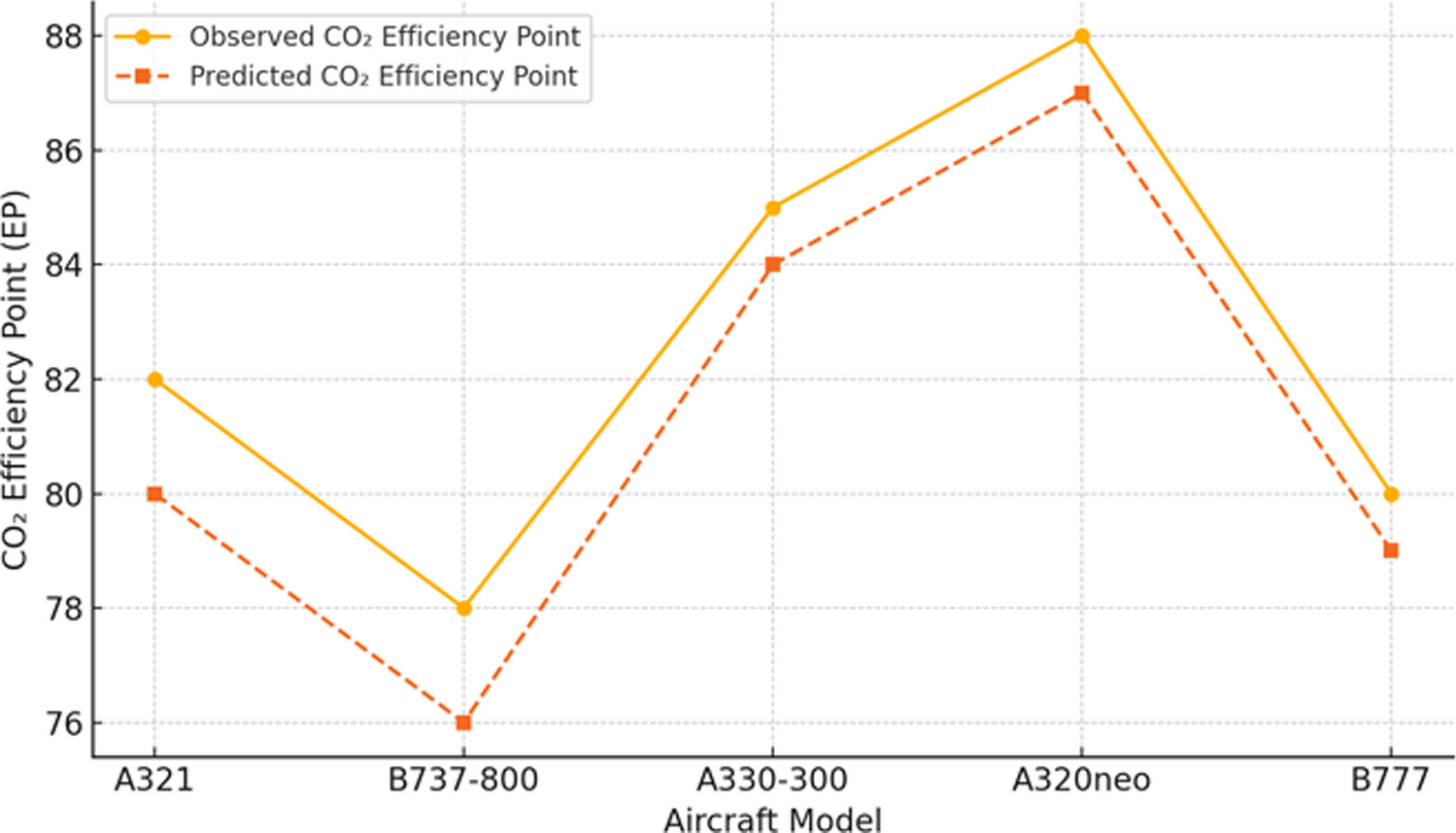
Using these inputs, I developed a machine learning model to predict CO₂ efficiency scores.
What the Results Show
The findings were both clear and surprising.
The model explained a large share of the variation in CO₂ efficiency using only these two variables. This means that operational factors—things that can be adjusted without new technology—play a significant role in environmental performance.
More specifically, the results suggest:
- Aircraft carrying more passengers and cargo tend to be more efficient
- Higher operational intensity can improve efficiency under certain conditions
This leads to an important conclusion:
Carbon efficiency is not only determined by technology, but also by how existing systems are used.
Why This Matters
These findings have several important implications.
First, improving sustainability does not always require waiting for future innovations. Better operational decisions—such as optimizing flight frequency and capacity—can already lead to meaningful improvements.
Second, they highlight the importance of data-driven approaches. By using existing operational data, airlines and airports can better understand where inefficiencies occur and how to address them.
Third, this research supports broader global goals. Organizations such as the International Civil Aviation Organization (ICAO) emphasize that reaching net-zero emissions requires not only technological innovation but also smarter operational strategies.
Challenges Behind the Research
One of the main challenges of this study was data collection. The dataset was relatively small and required manual observation. In addition, only a limited number of variables could be included in the model.
Despite these limitations, the results were consistent and meaningful. This suggests that even simple models, when applied carefully, can provide valuable insights.
This was also a key lesson from the research process:
You do not always need complex systems to uncover important patterns—sometimes, the right question is enough.
Looking Forward
This study is only a starting point. Future research can expand the model by including additional variables such as flight distance, aircraft age, or fuel type. It can also be applied to other airports to test whether similar patterns exist.
Another promising direction is integrating such models into real-time decision systems. Airports and airlines could use data-driven tools to monitor efficiency and dynamically adjust operations.
Final Thoughts
Aviation sustainability is not only a technological challenge. This study’s central finding is that operational improvements, applied to current fleets and systems, offer meaningful—and often overlooked—paths to lower emissions.
By combining real flight data with simple machine learning techniques, it is possible to uncover hidden patterns in carbon efficiency. These insights can support better decision-making and contribute to more sustainable aviation practices.
The path to greener aviation is not only about the technologies we develop in the future, but also about how effectively we use the systems we already have.

I am an academic researcher at Magdeburg-Stendal University of Applied Sciences, specializing at the intersection of environmental sustainability, transport systems, and data-driven analysis. My research primarily addresses environmental and CO₂ efficiency, with a particular emphasis on the aviation and transport sectors, employing machine learning and applied quantitative methods. I am interested in exploring how advanced analytics can support evidence-based policy, sustainability governance, and real-world decision-making.
More broadly, my work is driven by the aim of translating complex data into insights that are accessible to policymakers, practitioners, and a wider audience concerned with climate and sustainability challenges.
Follow the Topic
-
Discover Environment
This is a transdisciplinary, open-access journal that provides a leading platform for the rapid dissemination of knowledge and advances covering the research and innovation that is taking place across the environmental sector.

Related Collections
With Collections, you can get published faster and increase your visibility.
Monitoring environmental pollution and impact on health
The intensification of human activities and the expansion and densification of urban areas cause various damages to the environment, necessitating continuous monitoring to assess the impact and extent of potential risks to both the environment and human health, in order to ensure urban sustainability.
This collection, “Monitoring Environmental Pollution and Impact on Health,” invites contributions that utilize tools related to health impact assessment, human health risk, ecological risk, data modeling, geospatial data, and Geographic Information Systems (GIS) to analyze impacts within urban environments. We also encourage the publication of research on the dynamics of pollution and health in rural and peri-urban areas, interdisciplinary studies between environmental sciences and public health, epidemiology, and urban planning for a holistic assessment of the multifaceted impacts of pollution on human well-being. In addition, studies that contribute actionable policy recommendations for local governments, environmental agencies, or public health institutions dealing with urban pollution are welcome. Research (time series or longitudinal studies) that demonstrate public health trends related to chronic exposure to pollutants, aiming for a better understanding of long-term urban sustainability issues, are also encouraged. Studies addressing health risks for vulnerable populations (such as children, the elderly, or low-income communities) exposed to environmental pollution in densely populated areas are of particular interest. We welcome studies on participatory monitoring and the development of citizen science, empowering communities to act in collaboration with local environmental health surveillance managers. Research involving satellite pollution monitoring and remote sensing is also encouraged. Comparative studies on pollution and health across different regions, identifying critical hotspots and globally replicable mitigation strategies, are of interest. We also welcome research that investigates environmental justice and urban socio-demographic inequalities/disparities in health due to environmental pollution. Review studies and meta-analyses exploring trends, methodologies, and gaps in urban environmental health research are also welcome.
Keywords: Health impact assessment, Environmental quality monitoring (air, water, and soil), Pollution sources and emissions, Spatial analysis, Geospatial technology, Climate change, Urban sustainability, Machine learning, Ecological risk assessment, Human health risk assessment
This Collection supports and amplifies research aligned with the following Sustainable Development Goals (SDGs): SDG 11.
Publishing Model: Open Access
Deadline: Feb 28, 2027
Water Environment: Addressing Global Water Challenges
Water is an indispensable natural resource, yet it faces escalating threats from pollution, climate change, and human activity. The Water Environment: Addressing Global Water Challenges section of Discover Environment Journal is dedicated to publishing innovative research on the dynamics of water systems—tracing their journey from source to fate while examining the interplay between natural processes and anthropogenic influences. This section delves into critical domains, including chemical hydrology, watershed and basin science, glacier environments, and land-use impacts. We welcome contributions that address pressing issues such as water pollution, the transport and transformation of contaminants, hydrological modeling, and sustainable water management strategies. We place particular emphasis on the consequences of land-use changes on hydrological cycles, the stability of glacier-fed water systems, and effective approaches to safeguarding freshwater and marine ecosystems.
Key topics include:
Chemical Hydrology: Analysis of water composition, pollutant behavior, and geochemical interactions shaping water quality.
Basin and Catchment Science: Investigations into watershed hydrology, sediment transport, and hydrogeomorphological processes.
Glacier Environments: Research on cryospheric hydrology, glacier-fed rivers, and the influence of climate change on water availability.
Land-Use Systems: Examining the effects of agriculture, urbanization, deforestation, and industry on water resources.
Water Pollution & Remediation: Addressing emerging contaminants (e.g., microplastics, pharmaceuticals, PFAS), nature-based solutions, and policy frameworks for water protection.
Sustainable Water Management: Innovations in water conservation, resilience-building strategies, and alignment with Sustainable Development Goals (SDGs), particularly SDG 6 (Clean Water and Sanitation).
Methodological advancement in water research
Furthermore, to enhance the scope and impact of the section, we strongly encourage submissions that:
• Include case studies from underrepresented regions, particularly Sub-Saharan Africa and small island states, to showcase diverse hydrological challenges and locally relevant water management solutions.
• Promote the integration of traditional ecological knowledge and community-based water governance practices to enhance the cultural relevance and sustainability of proposed water stewardship strategies.
• Explore transboundary water issues, including shared aquifers and river basins, to highlight the importance of cooperation and policy in sustainable resource management.
• Emphasize the value of coupling remote sensing and GIS technologies with in-situ hydrological data for improved water quality monitoring and modeling accuracy across scales.
• Focus on emerging contaminants such as microplastics, pharmaceuticals, and PFAS in both freshwater and marine environments, reflecting current global research priorities.
• Give greater attention to groundwater-surface water interactions and their implications for long-term water availability, especially under changing climate and land-use patterns.
• Highlight the role of climate change scenarios and projections in shaping adaptive water management frameworks, particularly in glacier-fed and drought-prone regions.
• Feature interdisciplinary collaborations between hydrologists, ecologists, social scientists, and engineers to propose holistic and inclusive water resource solutions.
• Promote alignment of all submissions with SDG targets, especially SDG 6 (Clean Water and Sanitation) and SDG 13 (Climate Action), to strengthen policy relevance.
• Include policy briefs or synthesis articles that translate technical findings into actionable guidance for water managers and decision-makers.
By fostering interdisciplinary collaboration and highlighting diverse perspectives, the Water Environment: Addressing Global Water Challenges section serves as a vital platform for advancing knowledge on global water challenges and informing policy for sustainable water stewardship.
This Collection supports and amplifies research related to: SDG 6 & SDG 13
Keywords: Water Systems, Water Pollution, Climate Change, Land-Use Impacts, Sustainable Water Management, Emerging Contaminants, Hydrological Modeling, Interdisciplinary Collaboration, SDG 6 (Clean Water and Sanitation), Chemical Hydrology, Watershed Science, and Glacier Environments.
Publishing Model: Open Access
Deadline: Dec 30, 2026