What Jupiter's bow shock tells us about the most powerful accelerators in the Universe




Readers of our earlier post on relativistic electrons at Earth will find the physics here familiar. Large-scale transient structures upstream of a planetary bow shock can accelerate electrons to relativistic energies, meaning speeds close to that of light. What is new here is how far they can reach. We move from Earth to Jupiter, where the system is roughly a hundred times larger, and then outward to protostellar jets and supernova remnants, where scales become enormous, thousand times larger than Jupiter.
Monday mornings with Juno
It started with Jamey Szalay and George Clark, who know the Jovian environment well. They pointed us to a set of Juno bow shock crossings worth a closer look. For weeks, my co-author Drew Turner and I worked through them on Monday mornings, with some coffee in hand, one crossing at a time. Most looked as expected. But the more we looked, the more interesting things became. We brought what we had back to Jamey and George, and they confirmed we were seeing something real.
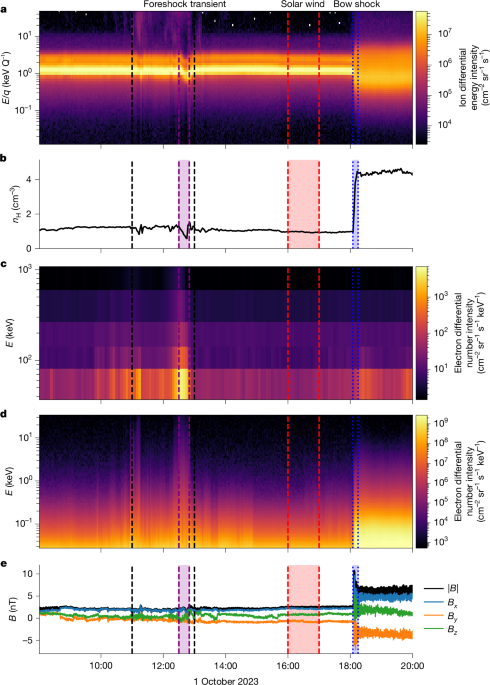
Several hours upstream (in front) of the Jovian bow shock, Juno observed a clean, isolated structure inside the foreshock (the disturbed zone in front of the shock). These structures, are large, turbulent bubbles of plasma that typically form when the solar wind carries a sharp magnetic discontinuity into the planetary bow shock. The signatures were all there: a localized density drop, a magnetic field with a depletion in the middle (core), an increase on each side ( compressive edges), and a burst of energetic electrons reaching above MeV energies (Figure 1). The signal was far stronger than what Juno recorded at the shock crossing a few hours later.
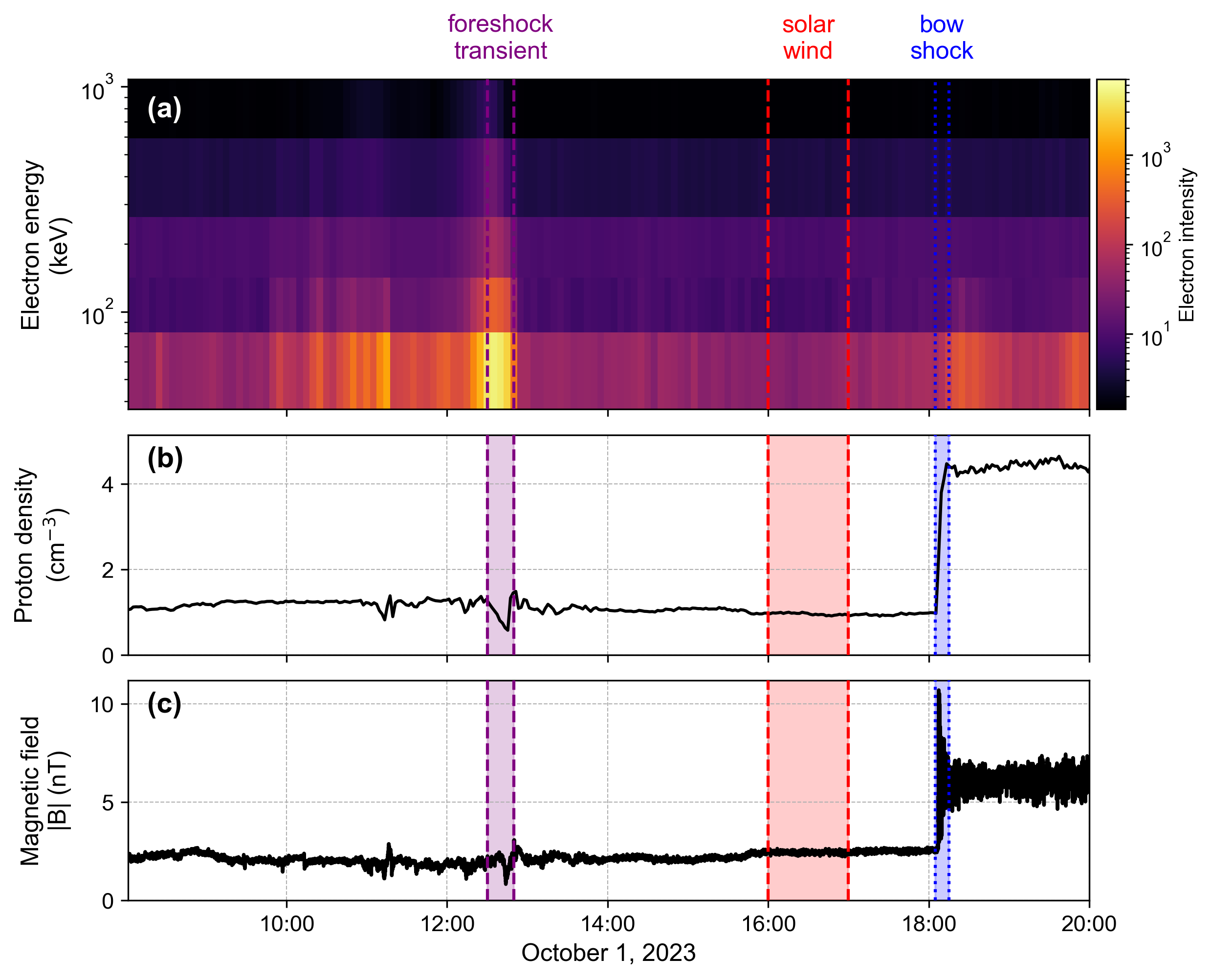
The structure was large, spanning several Jupiter radii (each radius being about 70,000 km, or nearly five times Earth’s diameter), and its energy spectrum was clean enough to fit a clear power law. This is direct evidence that the mechanism we identified at Earth also operates at Jupiter, at energies that have not previously been observed at a planetary shock.
A Shocking Result
Taken together with recent work at Earth, the Jovian observation points to something the standard picture of shock acceleration misses. The most efficient acceleration does not happen at the shock crossing itself. It happens in the extended region around the shock, upstream in the foreshock and downstream in the magnetosheath (the turbulent layer behind it), where localized transient structures form, evolve, and hold particles long enough to push them to relativistic energies.
At Jupiter, the electron flux inside the upstream transient was several times higher than at the adjacent bow shock crossing. That means that If we are looking for the strongest accelerator in a shock system, we should not stop at the shock front. The extended shock environment and its transients may carry all the action.
The Scaling Question
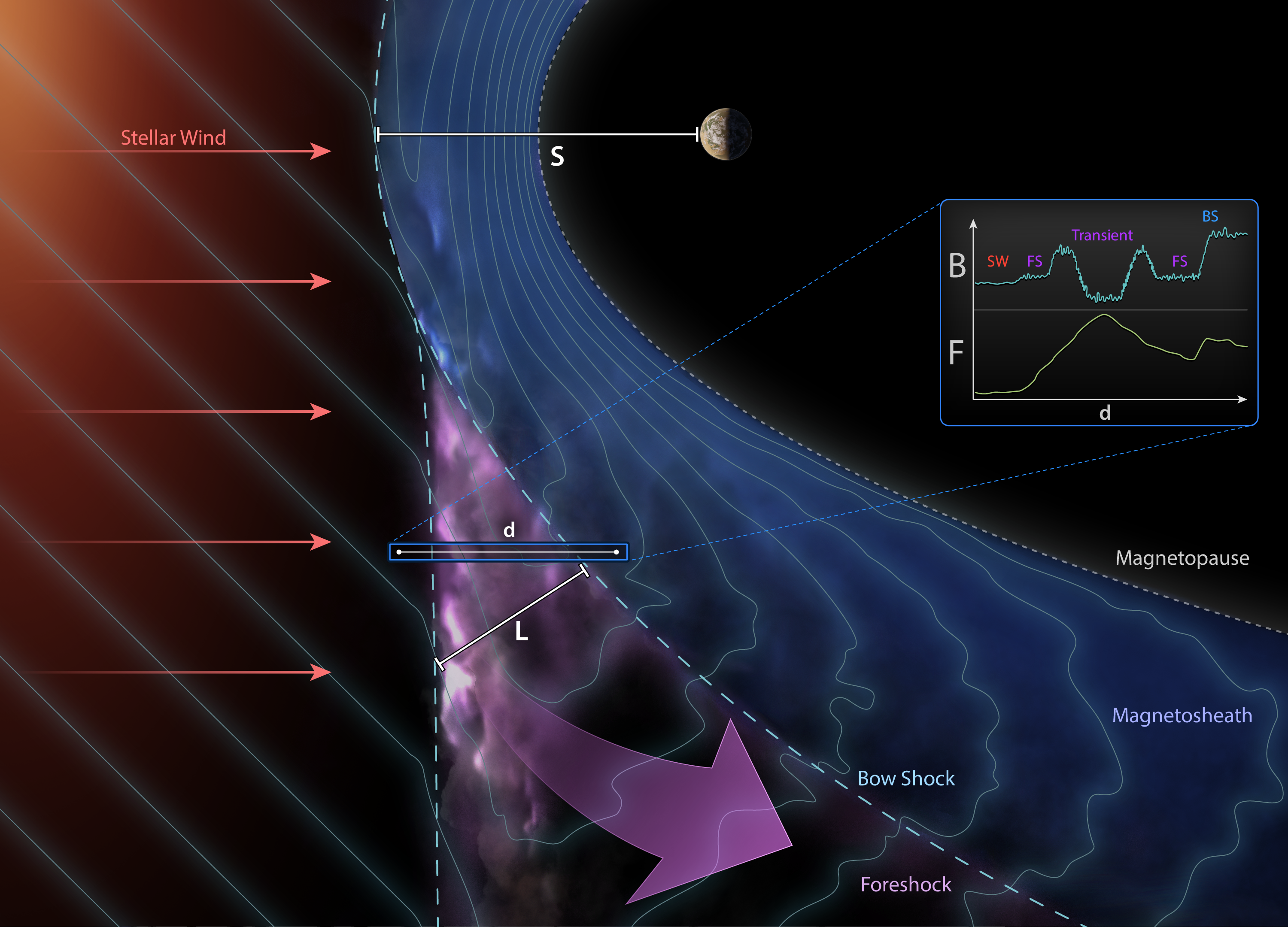
The natural next question was whether this is confined to our solar system or if it implies something more general. When we compared the size of the Jupiter transient to its counterparts at Earth, a pattern emerged. The acceleration region scales with the size of the host shock. We took this discussion to Damiano Caprioli and Colby Haggerty, experts in particle acceleration and high-energy astrophysical environments. The question was simple: could the same scaling extend outward, to systems where no spacecraft will ever go?
The Hillas criterion, which ties an accelerator's size (L) to the maximum energy a particle can reach (the bigger the accelerator, the higher the achievable energy), gave us the framework. Our planetary observations gave us the calibration. Bringing together data from Mercury, Venus, Earth, Mars, Saturn and Jupiter produced a simple empirical scaling law connecting a shock's global size (S) to a particle maximum obtainable energy (Figure 2).
Beyond the Solar System
We applied the scaling to three astrophysical systems. The first is HH 211, a protostellar jet: gas ejected at high speed from a young star. The other two are supernova remnants, the expanding debris of exploded stars: SN 1987A and SN 1006. Of these, SN 1006 served as the observational test. Its γ-ray emission already pins the maximum particle energy at around 100 TeV. Our model, generated using only on planetary data and extrapolated outward, returned similar numbers.
Broader Implications
What this work suggests is that the maximum particle energies at collisionless shocks may be set less by the shock front itself and more by the size of the foreshock and its transients that ride alongside it. If that is right, in-situ measurements upstream of collisionless shocks in our solar system become a powerful tool for studying accelerators light-years away.
The harder, longer question is how this kind of reinforced shock acceleration compares with the other processes producing high-energy particles: radiation belts, massive star clusters, blazars, binary star systems. Sorting out which contributes what to the cosmic ray flux is the kind of question no community can answer alone, and it will need coordinated efforts to do so.
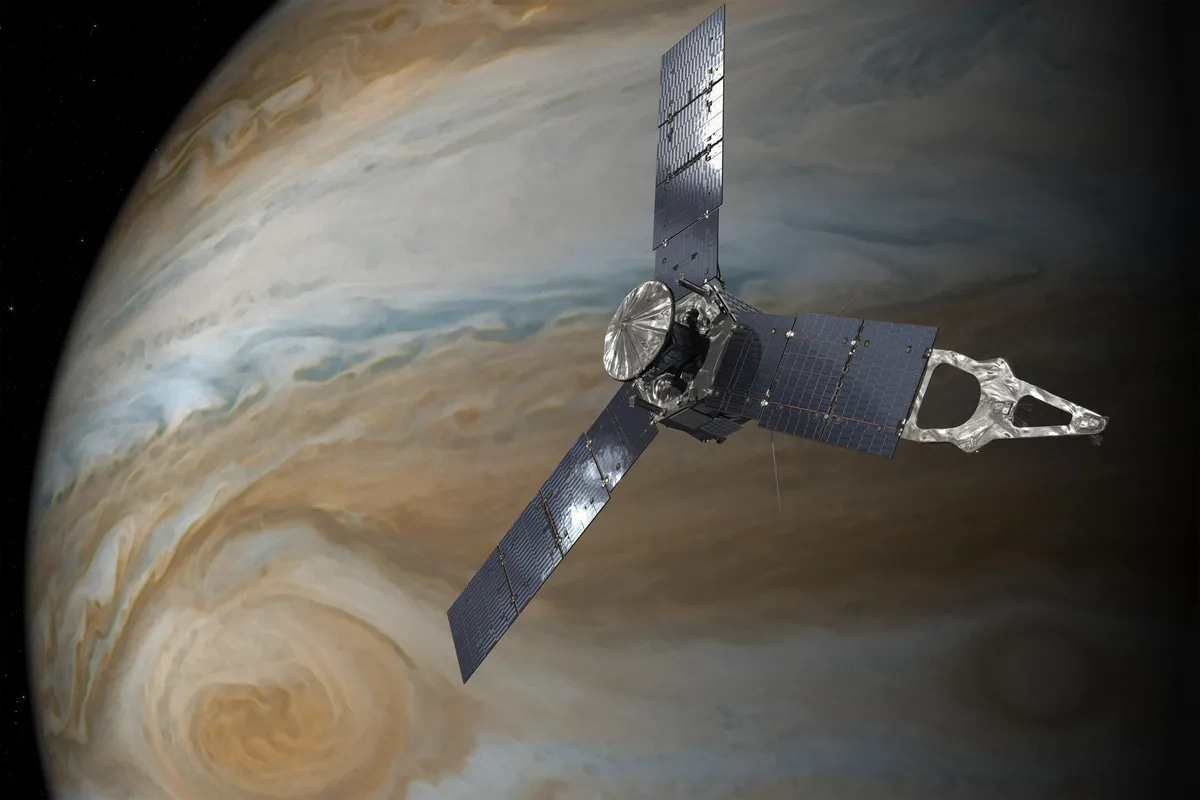
Poster image: NASA's Juno spacecraft during a flyby of Jupiter's Great Red Spot. Image credit: NASA/JPL-Caltech.

Researcher in Heliophysics, Plasma and Space Physics and Machine Learning Applications.
You can find my research on my website! https://savvasraptis.github.io/
Follow the Topic
-
Nature
A weekly international journal publishing the finest peer-reviewed research in all fields of science and technology on the basis of its originality, importance, interdisciplinary interest, timeliness, accessibility, elegance and surprising conclusions.

Related Collections
With Collections, you can get published faster and increase your visibility.
Carbon Dioxide Removal
Publishing Model: Hybrid
Deadline: Jan 16, 2027
Cancer Neuroscience: from mechanisms to therapy
Publishing Model: Hybrid
Deadline: Jan 30, 2027