When a borehole becomes a stress sensor
Published in Social Sciences, Earth & Environment, and Civil Engineering
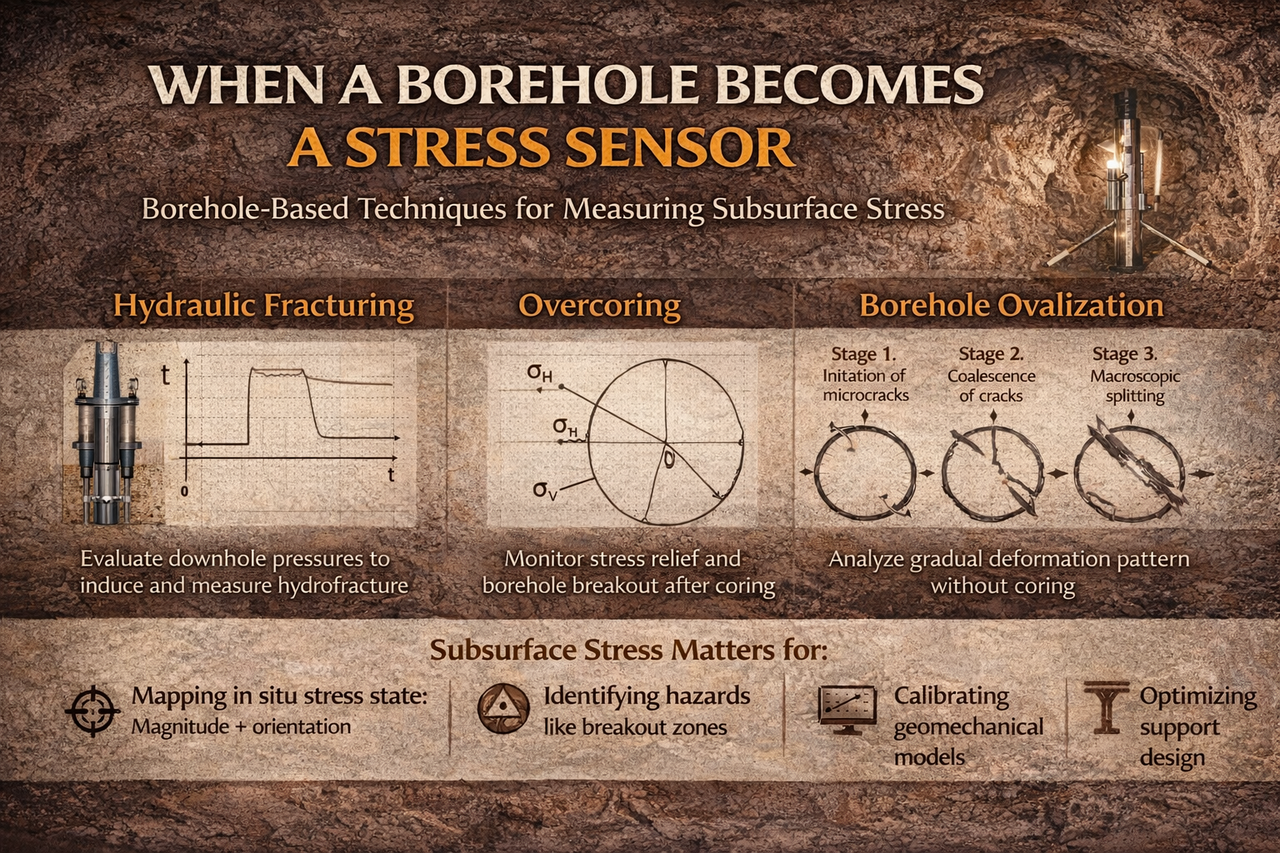

A simpler way to estimate in-situ stresses underground
Measuring the natural stress field underground is one of the most difficult and expensive tasks in geotechnical engineering. Yet every tunnel, shaft or deep excavation depends on knowing it.
Traditionally, the reference method has been hydraulic fracturing. It is direct and reliable, but also slow, costly, and operationally complex.
Our recent work explores a simpler question:
What if the borehole itself already contains the answer?
Full article:
https://doi.org/10.1007/s44290-024-00036-4
Reading stress from deformation
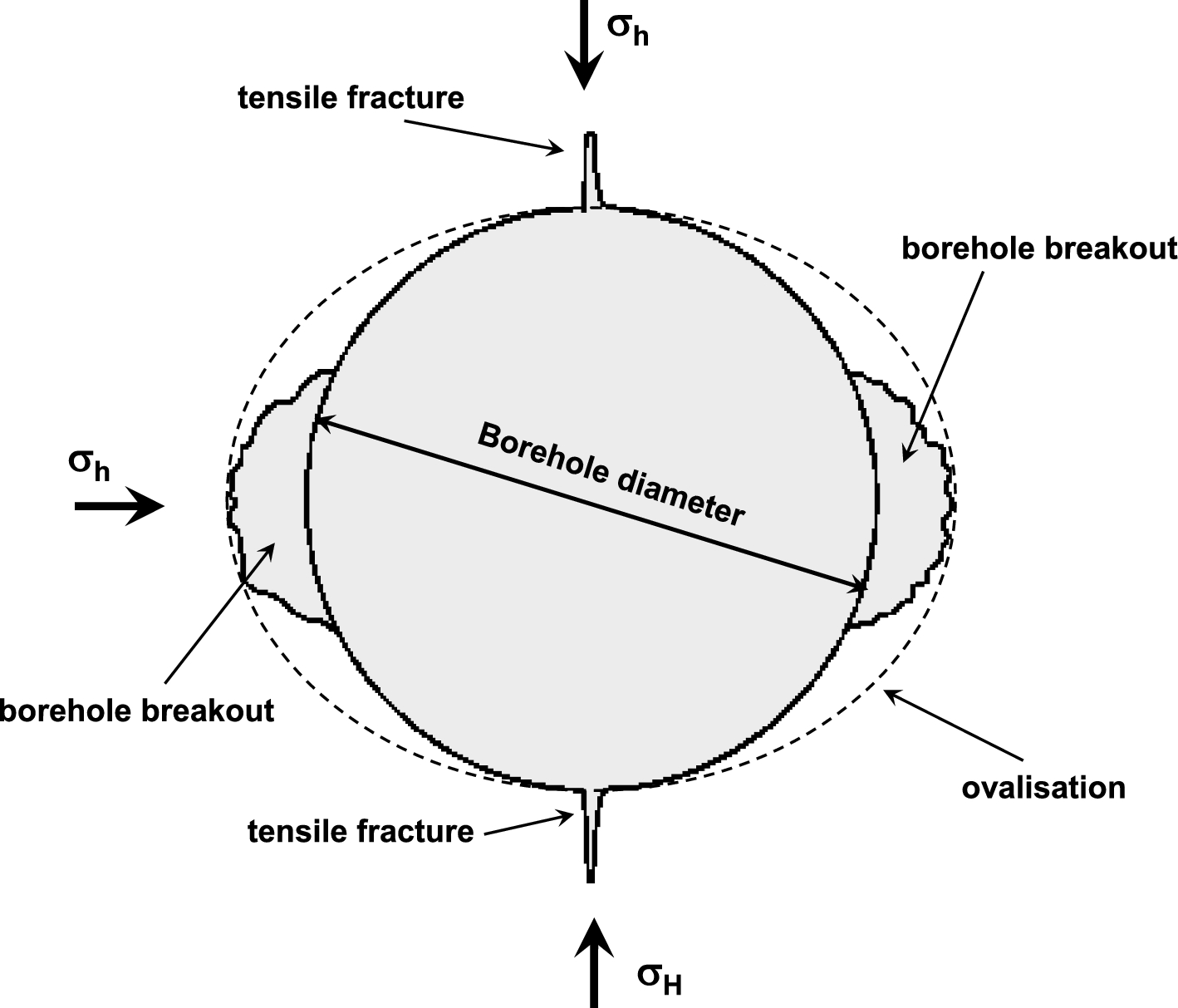
When stresses concentrate around a drilled hole, the circular section rarely stays circular. The borehole subtly flattens, developing breakouts and an oval shape aligned with the stress field.
This deformation is not random.
Decades of rock mechanics show that:
• elongation develops perpendicular to the minimum horizontal stress
• breakout width reflects stress concentration
• geometry encodes both orientation and magnitude
Instead of forcing the rock to fracture, we can simply measure this geometry.
Using six-arm calipers and televiewer logs, we reconstructed the borehole cross-sections and calculated:
• stress orientation
• σH/σh ratios
• horizontal stress magnitudes
All from shape alone.
Does it really work?
The key test was comparison with hydrofracturing profiles.
Across several argillaceous formations in Spain, the results showed:
• very close agreement in stress orientation
• consistent estimates of stress ratios
• reasonable magnitudes when cohesion is well constrained
In some cases, predicted directions differed by only a few degrees from hydrofrac measurements.
This is important.
Because hydraulic fracturing remains the gold standard, but it is also:
• expensive
• time-consuming
• dependent on fracture-free intervals
• difficult at depth
Ovalization analysis, by contrast, uses logging data already collected in most boreholes.
Where it performs best
The method is not universal.
Our results indicate it works best when:
• boreholes are deep enough for clear breakout development
• rock mass cohesion is known from laboratory tests
• multiple sections are analysed, not single intervals
• high-quality caliper or televiewer tools are used
Under those conditions, the borehole effectively becomes a passive stress sensor.
No injection. No packers. No induced fractures.
Just geometry.
Why this matters for engineering
For tunnels, mines and underground works, stress estimation is often limited by budget and logistics.
A method that is:
• faster
• cheaper
• minimally invasive
• and still reliable
can change practice.
Ovalization analysis will not replace hydrofracturing everywhere. But it can significantly reduce the number of tests required and provide continuous stress information along the borehole.
In many projects, that trade-off is decisive.
A broader perspective
There is also a conceptual lesson.
Sometimes the most useful measurements are already embedded in the system.
Instead of adding complexity, we can learn to interpret what the ground is already telling us.
In this case, a small deviation from circularity becomes a map of the underground stress field.
And a borehole becomes an instrument.

Follow the Topic
-
Discover Civil Engineering
This is a fully open access, peer-reviewed journal that supports multidisciplinary research and policy developments across the field of civil engineering.

Related Collections
With Collections, you can get published faster and increase your visibility.
New Trends in Additive Manufacturing for Sustainable Construction Materials
The market for 3D printing buildings is experiencing rapid growth worldwide. As reported by Straits Research, the global 3D printing construction market size was worth USD 1,10 billion in 2021 and it is expected to reach USD 585,84 billion by 2030, growing at an impressive CAGR during the upcoming period (2022-2030). Construction companies, technology providers, and architectural firms are actively exploring and investing in 3D printing technologies to enhance efficiency, reduce costs, and address sustainability concerns. In few words, the implementation of additive manufacturing in the construction industry is globally on the rise.
In this context, additive manufacturing has become a very attractive topic for researchers too, specifically for those working in the field of construction materials, design of structures and construction technologies. Current research aims to solve some gaps still currently present when designing, testing, assessing, and modeling 3D printed structures.
With this Topical Collection, entitled “New Trends in Additive Manufacturing for Sustainable Construction Materials”, we invite the scientific community to report on the most recent advances, novel insights, and case-studies on the following topics (but not limited to):
• Technologies for AM of construction materials;
• Development, optimization, testing eco-efficient printable materials;
• Durability, deterioration mechanisms, service life evaluation of 3D printed building materials;
• Artificial Intelligence applied to 3DP, material development and printing processes;
• Structural analysis, modelling, assessment and testing of additively manufactured materials and construction elements;
• Structural health monitoring of 3D-printed structures;
• Life cycle analysis (LCA), life cycle cost (LCC) and multi-criteria decision analysis (MCDA) of additively manufactured building materials and construction elements;
• Integration of AM into project management and building information modeling tools (BIM);
• Legal frameworks in the field of construction authorization practices for 3D-printed structures;
• Relevant case-studies (design, testing, field production).
Keywords: Additive manufacturing; sustainability; 3D printing; LCA; recycled materials; concrete; metals; earth-materials; geopolymers; digitalization.
Publishing Model: Open Access
Deadline: Aug 31, 2026
Reliability and Risk Analysis of Geotechnical Problems: A Contemporary Perspective
Geotechnical engineering, by its nature, deals with complex subsurface conditions and materials that exhibit significant spatial and temporal variability. Traditional deterministic approaches, while widely used, are often inadequate in fully capturing the uncertainties associated with soil and rock properties, groundwater behavior, and external loading conditions. In recent years, the geotechnical community has seen a shift toward probabilistic, reliability-based, and risk-informed methodologies, especially in the analysis and design of foundations, slopes, tunnels, retaining structures, and embankments.
This Collection aims to bring together state-of-the-art research and practice on uncertainty quantification, probabilistic modeling, and decision-making under uncertainty in geotechnical engineering. It seeks to highlight innovative tools such as Random Finite Element Methods (RFEM), Monte Carlo Simulation (MCS), Bayesian updating, stochastic optimization, and machine learning-based reliability assessment, with a focus on their practical applicability and societal relevance.
This Collection will include original research articles, comprehensive review papers, and case studies on (but not limited to):
• Probabilistic slope stability analysis and landslide risk assessment
• Reliability-based design of foundations and underground structures
• Random field modeling of spatial variability in geotechnical properties
• Application of RFEM, MCS, FORM/SORM, and subset simulation
• Bayesian back analysis of geotechnical failures
• Risk-based decision frameworks for geotechnical design and mitigation
• Integration of machine learning with probabilistic geotechnics
• Resilience assessment of geo-infrastructure under climate and seismic risks
• Case studies demonstrating real-world application of reliability method
This Collection supports and amplifies research related to: SDG 9.
Keywords: Probabilistic Risk Analysis, Monte Carlo Simulation, Subset Simulation, Response Surface Methods, FORM, FOSM, artificial intelligence
Publishing Model: Open Access
Deadline: May 11, 2026



Please sign in or register for FREE
If you are a registered user on Research Communities by Springer Nature, please sign in