When a Pediatric Mediastinal Mass Is Not Thymoma: Unmasking T-Cell Prolymphocytic Leukemia Through Diagnostic Re-evaluation
Published in Biomedical Research
Explore the Research
Pediatric mediastinal tumor unveiled as T-cell prolymphocytic leukemia: diagnostic pitfalls—a case report
When the first diagnosis is not the final diagnosis
Anterior mediastinal masses in children immediately raise a familiar differential diagnosis: lymphoma, germ cell tumors, and, far less commonly, thymoma. Yet occasionally a patient's clinical course refuses to fit the initial pathology, reminding us that medicine demands continual reassessment rather than diagnostic anchoring.
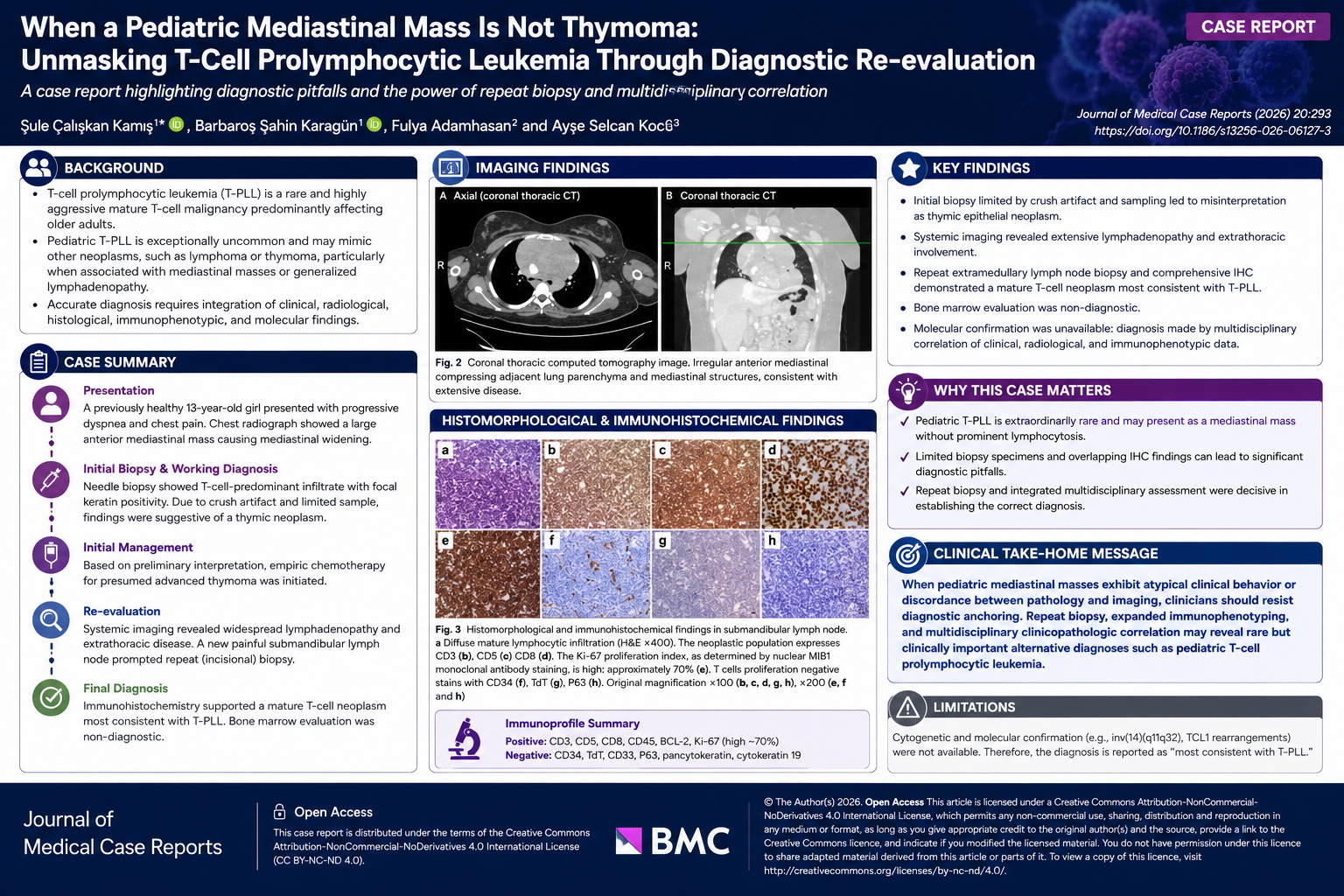
In this remarkable case report, Çalışkan Kamış and colleagues describe a 13-year-old girl who presented with severe respiratory distress caused by a large anterior mediastinal mass. Initial needle biopsy was compromised by crush artifact and demonstrated a T-cell-rich infiltrate with focal keratin positivity, findings interpreted as compatible with a thymic epithelial neoplasm. Because of her rapidly deteriorating condition, empiric chemotherapy was initiated for presumed advanced thymoma.
The clinical picture, however, continued to evolve.
Comprehensive imaging demonstrated extensive disease extending well beyond the mediastinum, including generalized lymphadenopathy, hepatic lesions, and skeletal involvement. The emergence of a new submandibular lymph node created an opportunity for repeat tissue sampling. This second biopsy fundamentally changed the diagnosis.
Immunohistochemistry demonstrated diffuse expression of CD3, CD5, CD8, CD45, and BCL-2 with a high Ki-67 proliferation index while lacking epithelial markers and markers of lymphoid immaturity. Collectively, these findings supported a mature T-cell neoplasm most consistent with T-cell prolymphocytic leukemia (T-PLL). Although molecular confirmation was unavailable, multidisciplinary integration of clinical presentation, imaging, pathology, and immunophenotyping established the diagnosis with reasonable confidence.
The rarity of this presentation cannot be overstated.
T-PLL is an uncommon, highly aggressive mature T-cell leukemia that almost exclusively affects older adults. Pediatric cases are extraordinarily rare, and presentation as a bulky anterior mediastinal mass without prominent lymphocytosis represents an exceptional diagnostic pitfall. The case illustrates how limited biopsy specimens, sampling error, and overlapping immunophenotypic findings may initially misdirect the diagnostic process.
Perhaps the greatest educational value lies not in the rarity of the disease itself but in the clinical reasoning it demonstrates. Diagnostic certainty should remain dynamic. When pathology, imaging, and clinical evolution fail to align, repeat biopsy and renewed multidisciplinary discussion become essential rather than optional.
The authors also acknowledge an important limitation. Cytogenetic and molecular confirmation, including characteristic chromosome 14 abnormalities or TCL1-related testing, was unavailable. Their careful discussion appropriately frames the diagnosis as "most consistent with T-PLL," illustrating commendable diagnostic transparency while remaining aligned with current WHO and International T-PLL Study Group recommendations.
For clinicians caring for pediatric patients with mediastinal tumors, this report reinforces a timeless lesson: the first biopsy does not always provide the final answer. Maintaining diagnostic flexibility can be lifesaving, particularly when clinical progression contradicts the presumed diagnosis.
Clinical Take-Home Message
When pediatric mediastinal masses exhibit atypical clinical behavior or discordance between pathology and imaging, clinicians should resist diagnostic anchoring. Repeat biopsy, expanded immunophenotyping, and multidisciplinary clinicopathologic correlation may reveal rare but clinically important alternative diagnoses such as pediatric T-cell prolymphocytic leukemia.
Journal of Medical Case Reports is the world's first international, PubMed-listed medical journal devoted to publishing case reports from all medical disciplines and will consider any original case report that expands the field of general medical knowledge, and original research relating to case reports. The journal is open access and strongly endorses the CARE guidelines for case reports, requiring authors to submit populated CARE checklists with submissions to improve transparency in reporting.

Richard Alan Rison is the interim Editor-in-Chief of Journal of Medical Case reports. He is also an associate neurology editor (editorial board) for BMC Neurology, and the former lead editor for case reports of BMC Research Notes (currently on the editorial board). His scholarly work focuses on medical case reporting, reporting standards, and editorial methodology. Dr. Rison participated in the development and dissemination of the CARE guidelines for clinical case reporting and has authored numerous publications addressing both neurological disorders and the role of case reports in advancing medical knowledge. Dr. Rison practices general neurology and served as the founding medical director of the PIH Health Hospital-Whittier Stroke Program and the PIH Health Hospital-Whittier Non-Invasive Vascular Laboratory, is a clinical assistant professor of neurology at the University of Southern California Keck School of Medicine and Los Angeles County Medical Center, and is a Fellow of the American Academy of Neurology, the American Neurological Association, and the American Association of Neuromuscular and Electrodiagnostic Medicine. Dr Rison is board-certified by the American Board of Psychiatry and Neurology in neurology and vascular neurology, and neurocritical care and neuroimaging by the United Council of Neurologic Subspecialties. He is also board-certified by the American Board of Electrodiagnostic Medicine in electrodiagnostic medicine. Dr. Rison is a former president of the Los Angeles Neurological Society.
Follow the Topic
-
Journal of Medical Case Reports
This journal will consider any original case report that expands the field of general medical knowledge, and original research relating to case reports.



Please sign in or register for FREE
If you are a registered user on Research Communities by Springer Nature, please sign in