Behind the Paper: How Future Offshore Wind Farms Could Influence Coastal Rainfall in Northwest Europe
Published in Social Sciences and Earth & Environment



Why We Started This Research
When people think about offshore wind farms, they usually think about renewable energy, climate mitigation, and the transition to a sustainable future. As climate scientists, we are interested in understanding how large-scale offshore wind developments interact with the atmosphere and whether these interactions can influence local and regional weather patterns.
Offshore wind energy is expanding rapidly across Europe, particularly in the North Sea, where hundreds of gigawatts of capacity are planned over the coming decades. While these developments are essential for achieving climate and energy goals, they also raise important scientific questions. Wind turbines extract kinetic energy from the atmosphere and modify wind speeds and turbulence. Although these effects are generally small compared with natural weather variability, their cumulative impact may become significant when wind farms are deployed over very large areas.
When we began this research, most studies focused on one or a few wind farms and relatively short time periods. While valuable, these studies could not fully address the scale of future offshore wind expansion planned across the North Sea. We realized that understanding future impacts required a broader perspective.
Over the years, our research group has investigated how offshore wind farms influence both energy production and the regional climate, including potential mitigation strategies through different turbine designs. One question continued to attract our attention:
How do offshore wind farms influence precipitation patterns?
Answering this question is challenging because precipitation depends on a complex interplay of atmospheric processes, including moisture transport, atmospheric stability, temperature, and large-scale weather systems. Understanding possible changes therefore required us to move beyond individual wind farms and investigate large-scale future deployment scenarios.
The Challenge
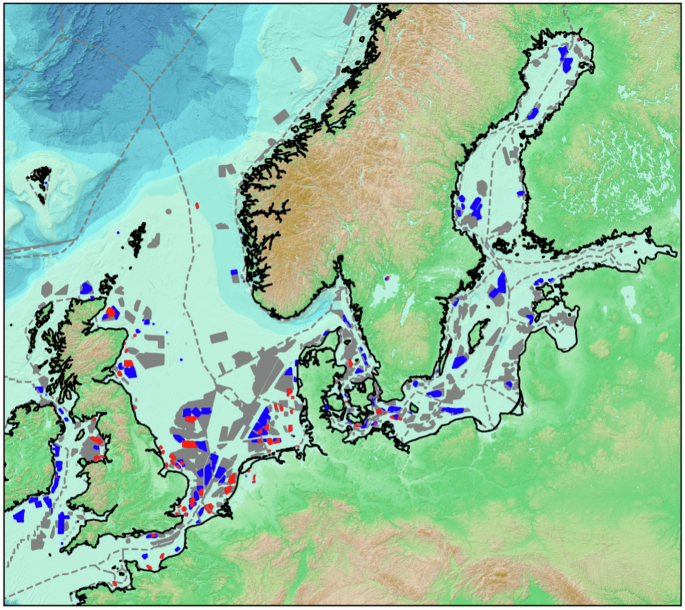
To address this question, we developed a modelling framework capable of representing large-scale offshore wind farm deployment across the Northwest European shelf seas. Rather than simulating individual wind farms, we investigated future scenarios in which large offshore wind clusters operate simultaneously across the North Sea. Because atmospheric conditions vary substantially from year to year, we performed simulations spanning an entire decade. We considered offshore wind development scenarios representing conditions in 2023, 2030, and 2050 while also accounting for advances in turbine technology.
Studying future offshore wind impacts presents a unique challenge because many planned wind farms have not yet been built. By incorporating these future developments into a state-of-the-art regional climate model, we were able to investigate how the atmosphere might respond under different deployment pathways.
The simulations were computationally demanding. Running high-resolution climate simulations over a ten-year period for multiple scenarios required substantial computing resources, extensive testing, and rigorous validation to ensure that the projected changes reflected genuine atmospheric responses rather than modelling artefacts.
What We Found
The atmosphere over the North Sea is highly dynamic, and offshore wind farms can influence turbulent mixing, moisture transport, and cloud formation. Building on our previous work, we investigated whether these local changes could affect regional precipitation patterns.
One of the most striking findings was that the large-scale offshore wind deployment envisioned for 2050 including all the development zones could reduce precipitation in some coastal regions of Northwest Europe by approximately 10-15%.
Rather than asking whether offshore wind farms change the weather everywhere, we focused on where impacts might emerge, under what conditions they occur, and how large they are compared with natural climate variability.
Our results suggest that large-scale future offshore wind developments have the potential to influence coastal precipitation patterns, particularly in regions adjacent to the North Sea. The effects were not uniform across all locations or seasons but depended on atmospheric conditions and regional circulation patterns.
These findings contribute to a growing body of research examining the interactions between renewable energy infrastructure and the climate system and highlight the importance of considering atmospheric and hydrological effects in future offshore wind planning.
A Collaborative Effort
Like many scientific studies, this work relied on the combined expertise of researchers in atmospheric science, climate modelling, renewable energy, and computational analysis. The project benefited from access to the high-performance computing facilities of the German Climate Computing Centre (DKRZ), which made these extensive simulations possible. Along the way, numerous discussions, model improvements, and validation exercises helped strengthen our confidence in the results. As often happens in science, some findings answered longstanding questions, while others raised entirely new ones.
Why This Matters
Offshore wind energy will play a crucial role in the transition to a low-carbon future. At the same time, sustainable development requires a thorough understanding of how large-scale energy systems interact with the environment.
Studies such as ours help provide that understanding by offering evidence-based assessments of potential atmospheric impacts. Our goal is to encourage further research and support informed decision-making as offshore wind deployment continues to expand across Europe and beyond.
Improving our understanding of atmosphere-wind farm interactions can help ensure that future energy systems are both effective and environmentally sustainable.
What Comes Next?
Many questions remain unanswered.
In this study, we examined offshore wind scenarios extending beyond 2050. A natural next step is to assess how the European Union's planned 300 GW offshore wind expansion may affect the magnitude and spatial distribution of precipitation across neighbouring coastal regions.
Future research should also focus on coupling atmospheric, ocean, and ecosystem models to better understand how atmospheric changes associated with offshore wind development may influence marine ecosystems and ocean processes.
For us, this study represents one step in an ongoing scientific journey. Every answer generates new questions waiting to be explored.
Interpreting the Results in the Context of Renewable Energy
One challenge in presenting these results was ensuring that they are interpreted in the proper context. Based on our previous experience, we are aware that scientific findings highlighting environmental impacts can sometimes be misrepresented as arguments against renewable energy development. This is not our intention.
Offshore wind farms, like any large-scale infrastructure, interact with their environment, and understanding these interactions is an important part of sustainable development. While our results suggest that future large-scale offshore wind deployment could influence regional precipitation patterns, these impacts should be considered alongside the much larger and well-established environmental consequences of fossil fuel-based energy production, including greenhouse gas emissions and climate change.
Our findings should therefore be viewed as contributing to a more comprehensive understanding of offshore wind energy and supporting efforts to optimize its deployment while maintaining its central role in the transition to a low-carbon energy system.

exploring the impact of offshore wind farms on regional climate and power generation
Follow the Topic
-
Communications Earth & Environment
An open access journal from Nature Portfolio that publishes high-quality research, reviews and commentary in the Earth, environmental and planetary sciences.

Related Collections
With Collections, you can get published faster and increase your visibility.
Hazards in Mountain Regions
Publishing Model: Open Access
Deadline: Nov 02, 2026
Carbon Dioxide Removal
Publishing Model: Hybrid
Deadline: Jan 16, 2027




Please sign in or register for FREE
If you are a registered user on Research Communities by Springer Nature, please sign in