When air pollution changed the rains of the Sahel
Published in Social Sciences, Earth & Environment, and Mathematics





For millions of people living across the Sahel — the semi-arid belt stretching across Africa just south of the Sahara Desert — rainfall is everything. The annual rainfall comes from just a few months of summer rains. A good rainy season means food security, water availability, and economic stability. A bad one can bring devastating drought, crop failure, and humanitarian crises.
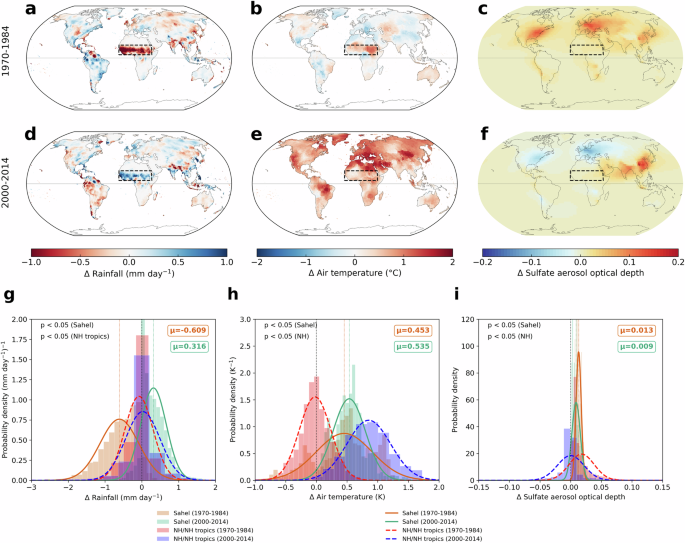
During the 1970s and 1980s, the Sahel experienced one of the most severe droughts in recorded history. And then, somewhat unexpectedly, rainfall began to recover in the 1990s and 2000s. For decades, scientists have debated what caused these dramatic swings.
Our newly published paper in Communications Earth & Environment (https://doi.org/10.1038/s43247-026-03474-3) provides a surprising answer: air pollution — specifically anthropogenic aerosols from far away Europe and North America.
Pollution moves the rain
You might wonder how air pollution in Europe and North America could cause drought in Africa. It comes down to shifts in atmospheric circulation.
During the peak of aerosol emissions in the Northern Hemisphere, high levels of sulfate aerosols acted like a mirror, reflecting sunlight back into space. This cooled the Northern Hemisphere relative to the tropics. This temperature imbalance slowed down the Hadley Cell—the massive atmospheric engine that drives tropical rainfall—effectively pushing the rains away from the Sahel.
As Western nations implemented clean air policies, aerosol levels plummeted. The Northern Hemisphere warmed rapidly, restoring the temperature balance needed to pull the monsoon rains back north into the Sahel.
It’s not about concentration
The most crucial discovery of our work is that it isn't just the concentration of aerosols that matters. It is the delicate balance in temperature that drives circulation of the atmosphere and drought or rainfall in the Sahel.
Aerosol concentrations over the Sahel itself were relatively low. It was changes in distant regions — particularly Europe and North America — that strongly influenced Sahel rainfall.
The climate system is highly interconnected. The atmosphere doesn't care about borders. Pollution in one region affects rainfall thousands of kilometres away.
Aerosols more important?
When we talk about climate change, the conversation usually centres on the greenhouse gases—especially carbon dioxide. There's a profound lesson here. Greenhouse gases are global and long-lived, they mix evenly throughout the atmosphere.
On the hand, aerosols are regional and short-lived. They stay near their sources, decrease from there, and create gradients. These gradients drive shifts in the atmosphere in ways we're only beginning to appreciate.
Climate change projections for the Sahel—and indeed all monsoon regions around the world—can no longer assume that the future is predictable by greenhouse gases. Where aerosols are rising or falling is probably more important.
Humans of the Sahel
Writing this paper was a journey through decades of climate history. Behind every map and every model ensemble in our paper are real people. Farmers watched their fields turn to dust. The droughts that killed thousands in Africa were ccaused by smoke from countries that most never visited.
Families have seen floods from severe storms kill loved ones and devastate their communities in recent years. The clean air policies, initially designed to protect health and ecosystems in wealthy nations, had far-reaching consequences for the global climate system. They inadvertently helped restore rains and exacerbated devasting storms in one of the world's most vulnerable regions. That's a remarkable connection. It raises difficult questions about justice and climate intervention.

Follow the Topic
-
Communications Earth & Environment
An open access journal from Nature Portfolio that publishes high-quality research, reviews and commentary in the Earth, environmental and planetary sciences.

Related Collections
With Collections, you can get published faster and increase your visibility.
Ecological resistance and resilience under global change
Publishing Model: Open Access
Deadline: Apr 07, 2027
Hazards in Mountain Regions
Publishing Model: Open Access
Deadline: Nov 02, 2026