When Sport Is Not About Stress: Rethinking Why Chilean Youth Move
Published in Social Sciences, Earth & Environment, and Public Health

Ask most people why children should play organized sport, and "to manage stress" will appear near the top of the list. It is an intuitive answer, supported by decades of evidence linking physical activity to better mental health. But intuitions deserve to be tested, and when we examined nationally representative data from Chile, the picture that emerged was more nuanced — and, we believe, more interesting.
Our study, "Association between organized sport participation and stress-related motivation for physical activity among Chilean children and adolescents", published in Discover Public Health, began with a question that has received surprisingly little attention in Latin America: do young people who participate in organized sport actually report stress relief as their motivation for being physically active?
An unexpected pattern
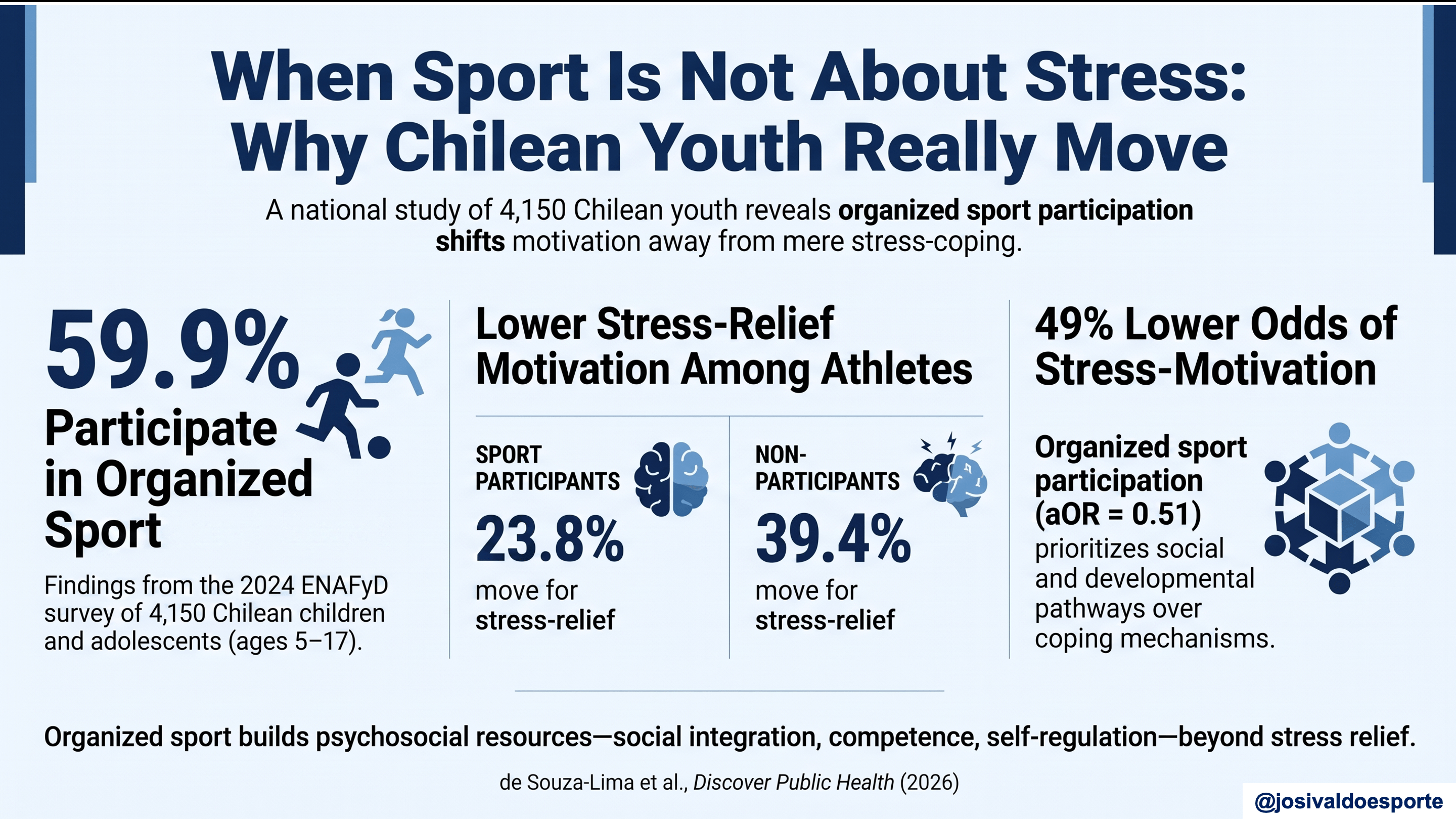
Using data from 4,150 participants aged 5–17 years in the 2024 Chilean National Physical Activity and Sport Survey (ENAFyD), we found that children and adolescents engaged in organized sport were substantially less likely to endorse stress relief as a primary motivation for physical activity. After adjusting for sex, age, socioeconomic status, and area of residence, participants in organized sport had 49% lower odds of reporting stress-related motivation than non-participants.
At first glance, this might seem to contradict the well-documented mental health benefits of sport. We would argue the opposite. The finding suggests what we describe as a motivational displacement: organized sport appears to operate through alternative psychosocial pathways — social integration, competence development, and the building of self-regulatory skills — that may reduce the need to use exercise as an immediate coping "escape valve". Those who exercise outside structured settings, by contrast, may be turning to physical activity precisely because they are seeking relief from stress.
Self-Determination Theory offered us a valuable lens here. When basic psychological needs — autonomy, competence, and relatedness — are satisfied within sport contexts, motivation tends to become more autonomous and sustainable, oriented toward enjoyment and mastery rather than symptom management.
The question behind the question
Working with these data also confronted us with a persistent public health concern: access. Organized sport participation in our sample was higher among urban residents and higher socioeconomic groups, echoing international evidence of stratified access to youth sport. If organized sport indeed cultivates deeper psychosocial resources, then unequal access to it is not merely a sporting inequity — it is a mental health inequity.
This is where we believe the study speaks most directly to policy. Chile, like many countries in the region, has made important efforts to promote youth physical activity. Our findings suggest two complementary priorities: reducing socioeconomic and urban–rural disparities in access to organized sport, and intentionally integrating mental health–promoting components into youth sport programs rather than assuming they occur by default. The motivational climate created by coaches matters; environments emphasizing encouragement, effort, and enjoyment promote psychological safety, whereas performance-pressured climates may do the opposite.
Interpreting with humility
As with any cross-sectional analysis, we interpret these associations with caution. Our design cannot disentangle selection effects from true program effects, and all measures were self-reported. We conducted sensitivity analyses under alternative outcome codings, and the association remained consistent in direction and magnitude — but the deeper causal questions remain open. Longitudinal designs and objective measures in Latin American populations are, in our view, the natural next step.
This humility is not a weakness of the study; it is part of how we understand science. Findings that complicate a simple narrative are often the ones that teach us the most.
A collaborative effort
This work reflects the collaboration of colleagues across nine institutions in Chile, Ecuador, and Spain, and would not have been possible without the Chilean Undersecretariat of Sport granting access to the ENAFyD 2024 data. Behind the tables and odds ratios lie many conversations about what motivation means for a ten-year-old kicking a ball after school — conversations that continually reminded us why we do this work.
We hope this study contributes to a more textured understanding of why young people move, and we welcome dialogue with researchers, practitioners, and policymakers interested in youth sport, motivation, and mental health across Latin America and beyond.
Read the full open access article: https://rdcu.be/fsdp8

Follow the Topic
-
Discover Public Health
This is an open access journal publishing research from all fields relevant to public health.

Related Collections
With Collections, you can get published faster and increase your visibility.
The Economics of Longevity: Health Expenditure and Societal Implications for Public Health Systems
The relationship between health investment and life expectancy has long been a focal point in public health research and policy. As nations grapple with rising healthcare costs and varying health outcomes, understanding how financial allocations influence population health becomes increasingly critical. Numerous studies have illustrated that increased spending on health services often correlates with improvements in life expectancy; however, the complexities of this relationship are not fully understood. Factors such as socioeconomic status, healthcare accessibility, and the efficiency of health systems play significant roles in determining how investments translate into health outcomes.
At the national level, health investments primarily encompass government expenditure on healthcare systems, public health initiatives, and health infrastructure. Nations that allocate substantial resources toward healthcare often experience better health outcomes and increased life expectancy among their populations. For instance, countries with robust healthcare funding tend to provide more comprehensive services, including preventive care, chronic disease management, and health promotion programs, all of which contribute to enhanced population health. However, it is crucial to consider how these investments are distributed across different segments of the population. Inequities in health spending can exacerbate existing disparities, leading to significant differences in life expectancy among various demographic groups. Effective health investment strategies must address these disparities to ensure that improvements in life expectancy are equitable and inclusive.
The motivation for this Collection arises from the urgent need to bridge the gap between health expenditures and tangible improvements in life expectancy. Recent global health crises and ongoing disparities in health outcomes across different populations have underscored the necessity for a deeper exploration of how resource allocation affects health dynamics. This Collection seeks to provide a platform for researchers and practitioners to discuss empirical evidence, theoretical frameworks, and innovative approaches to understanding these critical interactions. By fostering dialogue around effective health investment strategies, we aim to contribute to the development of more equitable and efficient health systems worldwide.
The purpose of this Collection is to gather comprehensive research that elucidates the dynamics between health investment and life expectancy across diverse contexts. We welcome contributions that analyze historical trends, comparative studies, and policy evaluations, as well as those that explore the implications of financial investments on health equity. By highlighting interdisciplinary perspectives and fostering collaboration, this Collection aspires to advance the discourse on optimizing health investments for improved population health outcomes.
Topics of interest include, but are not limited to:
- Economic evaluations of health interventions
- Policy impacts on health spending and life expectancy
- Health equity and investment disparities
- Longitudinal studies on health expenditures and population health
This Collection supports and amplifies research related to SDG 3.
Keywords: health expenditure; healthcare economics; life expectancy; economic evaluation; population health; health investment; health policy
Publishing Model: Open Access
Deadline: Dec 31, 2026
Improving Maternal and Infant Health: The Key for Future Wellness
Optimizing health across the life course begins with ensuring equitable, high-quality care during pregnancy, childbirth, and early infancy. Evidence increasingly demonstrates that early-life exposures and experiences are critical determinants of long-term health, shaping risks for chronic disease, developmental outcomes, and overall well-being. Despite progress, disparities in maternal and infant health outcomes persist globally, underscoring the need for innovative, scalable, and evidence-based public health interventions.
This Collection aims to highlight interdisciplinary research and practice-based efforts that advance maternal and infant health from a public health perspective. We welcome contributions that examine population-level strategies, health systems strengthening, community-based interventions, and policy approaches designed to improve care during pregnancy, the birth hospitalization, and early infancy.
Submissions may include original research, implementation studies, and quality improvement initiatives that address prevention, access, equity, and health outcomes across diverse settings. By emphasizing early prevention and system-level improvements, this Collection seeks to contribute to reducing the burden of chronic disease and improving health trajectories across the lifespan.
Topics of interest include, but are not limited to:
--Public health initiatives to improve maternal and pregnancy outcomes
--Community- and population-level strategies to enhance infant health and early development
--Health system and quality improvement interventions in maternal and neonatal care
--Educational and behavioral interventions targeting pregnant individuals, families, and caregivers
--Policies and programs addressing disparities in maternal and infant health
--Preventive approaches to improve early-life health and long-term outcomes
This Collection supports and amplifies research related to SDG 3: Good health and Well-Being.
Keywords: Maternal health; Infant health; Safer motherhood; Early-life health; Health services; Healthcare system; Public health
Publishing Model: Open Access
Deadline: Mar 17, 2027