When the Ocean Gets Too Hot for Earth's Most Abundant Photosynthetic Organism
Published in Earth & Environment





For over 150 million years, a microscopic organism smaller than a red blood cell has quietly dominated Earth's oceans. Prochlorococcus may be invisible to the naked eye, but it's responsible for producing roughly 20% of the oxygen we breathe and forms the foundation of marine food webs across 75% of the world's sunlit surface waters. Despite its ecological importance, we've had surprisingly little data on how this keystone species responds to the warming temperatures predicted for our oceans.
Most predictions about marine microbes and climate change rely heavily on laboratory studies using cultured organisms - essentially studying these creatures in artificial conditions that can't replicate the complexity of their natural ocean environment. This gap in our understanding is particularly concerning given that tropical ocean temperatures are projected to regularly exceed 30°C by 2100, pushing well beyond the range these organisms have experienced for millions of years.
Taking the ocean's temperature at the cellular level
Over the past decade, my colleagues and I deployed a continuous flow cytometer called SeaFlow on 90 research cruises across the Pacific Ocean. This instrument allowed us to measure individual cell properties, like size and chlorophyll content, for approximately 800 billion phytoplankton cells across 200,000 kilometers of ocean. Think of it as taking a continuous census of ocean life at the microscopic level.
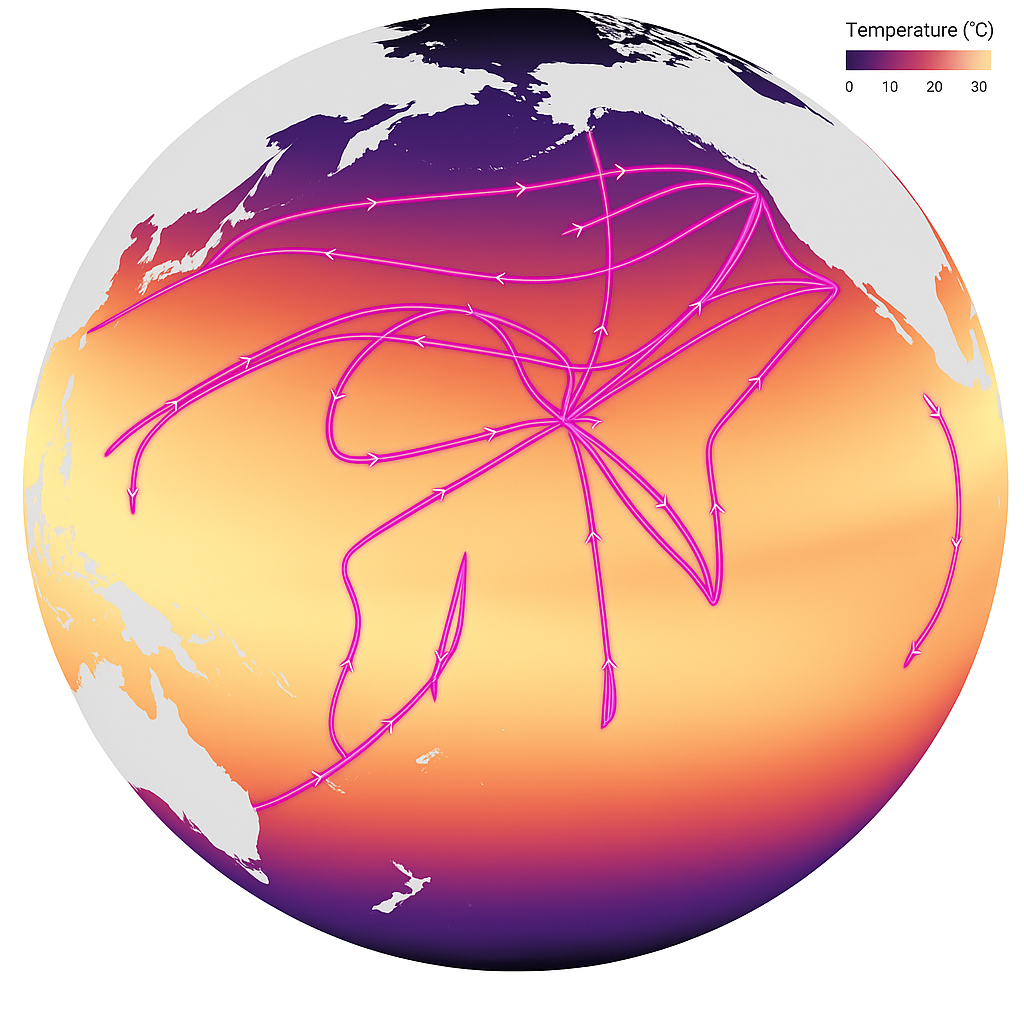
We built statistical models to track how cell size distributions changed over day-night cycles, allowing us to calculate division rates for natural Prochlorococcus populations without disturbing them. This approach revealed something unexpected: while division rates initially increased with temperature as expected, they peaked around 28°C and then declined sharply at higher temperatures.
This thermal "sweet spot" was remarkably consistent across different ocean regions and methodologies. We found that division rates dropped nearly threefold by 31°C, a temperature that many tropical regions will experience regularly by century's end. Even more striking, when we examined cell abundance data from over 18,000 measurements, we saw the same pattern: Prochlorococcus populations were systematically reduced in the warmest waters.
To understand future implications, we integrated these thermal responses into a global ocean ecosystem model. The results were sobering. Under moderate warming scenarios, Prochlorococcus production in tropical regions could decline by 17-34%. Under high warming scenarios, some regions like the Western Pacific Warm Pool could see near-complete collapse of these populations.
Beyond one species: ecosystem-wide consequences
These findings challenge the conventional wisdom that small marine organisms like Prochlorococcus will thrive in warming oceans. Instead, they reveal a fundamental vulnerability that could trigger cascading effects throughout marine ecosystems.
The projected decline of Prochlorococcus populations represents more than just one species struggling with heat. These organisms occupy a unique ecological niche with limited functional redundancy, there simply aren't other organisms that can fully replace their role in marine ecosystems. While our models predict some compensation from related cyanobacteria like Synechococcus, the overall shift would likely cascade through the marine food webs. It’s like changing our diet from rice to wheat, both are grains, but their effects on our system is different.
This transition could disrupt relationships with other organisms and ultimately affect fish populations and the communities that depend on them. The interconnected nature of marine ecosystems means that changes at the microscopic level can ripple upward through the entire food chain.
The evolutionary trap
More fundamentally, our study highlights how thermal constraints, not just nutrient limitation or other factors, will shape marine ecosystem responses to climate change. The streamlined genome that allowed Prochlorococcus to dominate nutrient-poor tropical waters for millions of years may now limit its ability to rapidly adapt to warming oceans.
Even when we modeled hypothetical warm-adapted strains with increased thermal tolerance, significant declines still occurred in the warmest regions under high warming scenarios. This suggests that while evolution might provide some buffer, it may not be fast enough to prevent major ecosystem disruption given the rapid pace of anthropogenic climate change.
The implications extend beyond marine biology to global biogeochemical cycles and climate feedbacks. Changes in ocean productivity patterns could affect the ocean's capacity to absorb carbon dioxide, potentially accelerating climate change through feedback loops we're only beginning to understand.
I am a biological oceanographer at the University of Washington, Seattle. My research group studies phytoplankton, microscopic organisms that fuel ocean food webs and regulate Earth’s carbon cycling. We use SeaFlow, our custom-built flow cytometer, to track these cells in real time during research cruises, collecting high-resolution data across the global ocean. By combining these measurements with statistical models, we study how environmental change influence phytoplankton growth and community dynamics, and how these tiny organisms help regulate the health of marine ecosystems and the planet’s climate.



Please sign in or register for FREE
If you are a registered user on Research Communities by Springer Nature, please sign in