Why do males and females sometimes differ in recognizing others?
Published in Biomedical Research
Explore the Research
 Nature
Social valence dictates sex differences in identity recognition - Translational Psychiatry
Translational Psychiatry - Social valence dictates sex differences in identity recognition
https://www.nature.com/articles/s41398-026-03854-5
Recognizing and distinguishing individual conspecifics is essential for adaptive social behavior. While sex differences in social cognition are well documented, the mechanisms underlying these differences in identity recognition remain poorly understood. In this study, we investigated how the emotional valence of social interactions influences identity recognition in males and females.
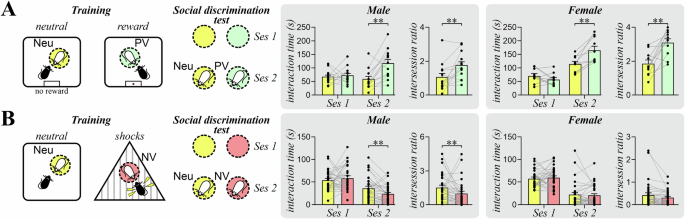
Using behavioral paradigms that selectively manipulate social valence, we demonstrate that identity recognition is strongly shaped by the affective context in which social information is acquired. Males and females exhibit distinct patterns of identity recognition depending on whether prior social experiences are positive, neutral, or negative. These sex differences are not evident under neutral or positive conditions but emerge robustly when social interactions carry negative valence, indicating that emotional context is a critical determinant of social memory performance. Using a miniature microscope to image calcium signals in neurons within the dorsal hippocampus, a brain region that plays an important role in social cognition, we further identified sex differences in the neural decoding of negatively valenced social information.
Together, our findings reveal that sex differences in identity recognition are not fixed, but are dynamically gated by social valence. This work provides new insight into the organization of social memory systems and highlights the importance of considering emotional context and sex as interacting variables in studies of social cognition. These results have implications for understanding sex-biased vulnerability to neuropsychiatric disorders characterized by social recognition deficits.

Dr. Tak Pan Wong moved to Montreal from Hong Kong in 1995 to pursue his PhD study under the supervision of Dr. Claudio Cuello and Dr. Yves De Koninck at McGill University. His postdoctoral training in the laboratory of Dr. Yu Tian Wang at University of British Columbia examined the molecular mechanism of synaptic plasticity. Since 2006, he has established his research laboratory at Douglas Research Centre (Affiliated with McGill University) to investigate the contribution of synaptic plasticity to rodent behavioral changes that are related to psychopathology of psychiatric disorders.
Follow the Topic
-
Translational Psychiatry
This journal focuses on papers that directly study psychiatric disorders and bring new discovery into clinical practice.

Related Collections
With Collections, you can get published faster and increase your visibility.
Moving Towards Mechanism, Causality and Novel Therapeutic Interventions in Translational Psychiatry: Focus on the Microbiome-Gut-Brain Axis
Publishing Model: Open Access
Deadline: Nov 15, 2026