


%20saline%E2%80%93desert%20shrubs.jpg)
As the Earth appears to be greening, a deeper question has emerged: can this trend persist?
For many years, Earth system science has generally held that rising atmospheric carbon dioxide (CO2) concentrations promote plant growth and enhance vegetation carbon uptake. This view is not wrong, but it is conditional.
The research team led by Fei Li at the Institute of Grassland Research, Chinese Academy of Agricultural Sciences, began to focus on a challenging question: if CO2 continues to rise, why does vegetation growth in many regions appear to be slowing down, or even leading to plant mortality? Perhaps more importantly, where is this slowdown primarily coming from?
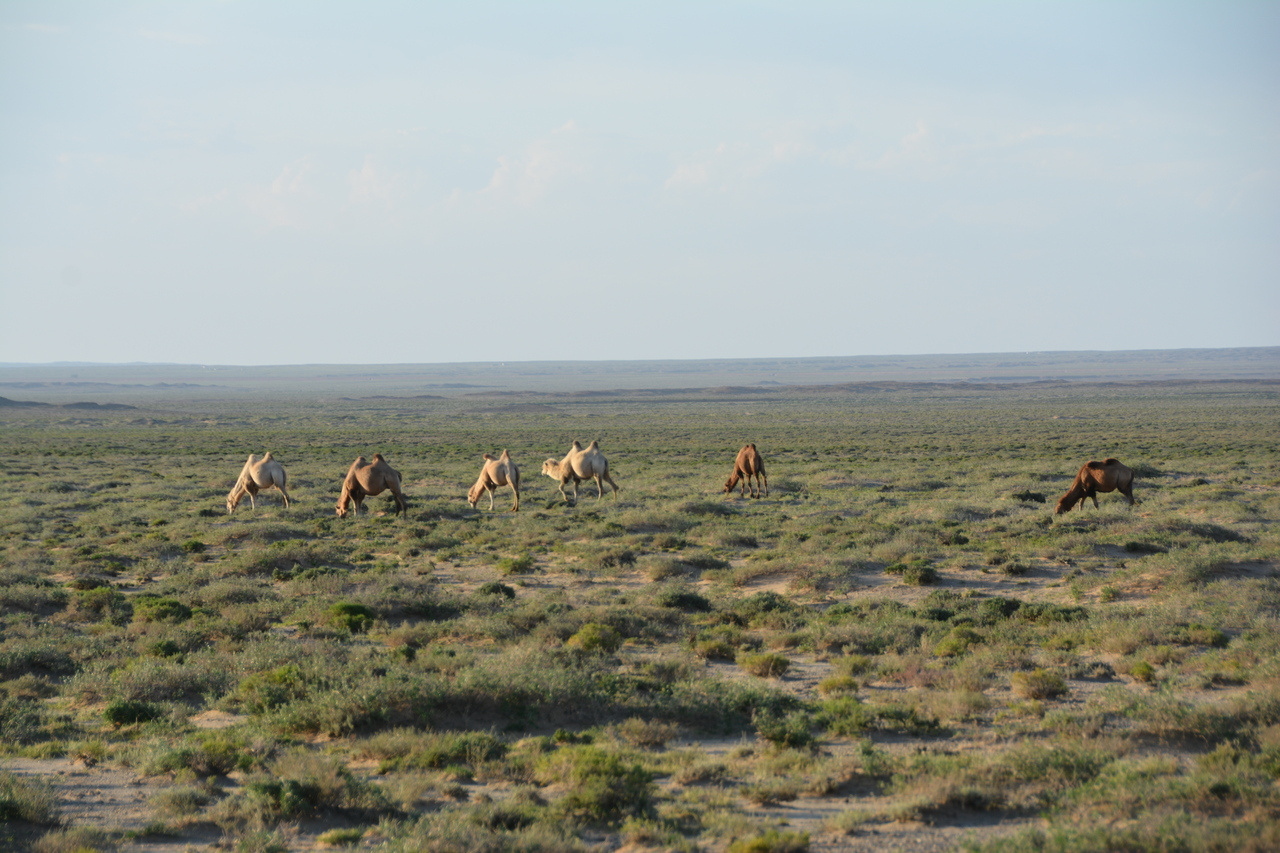
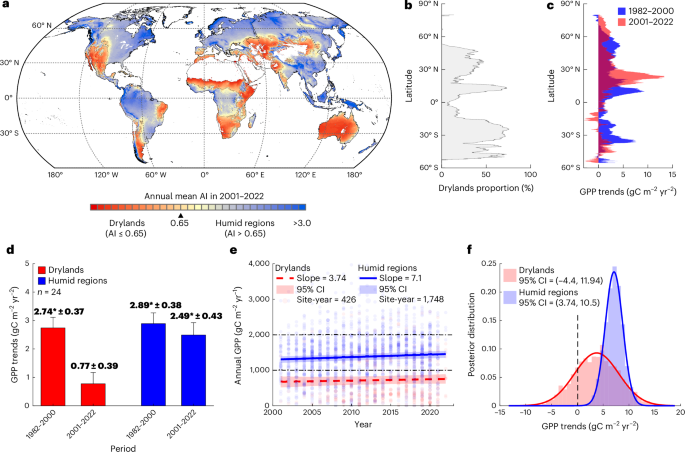
In the recent study, Dryland dominance in the slowdown of global vegetation carbon uptake, published in Nature Geoscience, the authors show that drylands play a dominant role in the slowdown of global vegetation carbon uptake. This finding is highly significant because drylands account for more than 40% of the global land surface, sustain unique biodiversity, and support the survival and development of about one-quarter of the world’s population, many of whom depend on livestock-based production systems for their livelihoods.
At first glance, the expectation seems straightforward: more CO2 should stimulate photosynthesis and enable vegetation to absorb more carbon. But ecosystems do not respond to carbon dioxide alone. Plants also respond to temperature, atmospheric dryness, soil moisture, radiation, nutrient supply, and various disturbances, including heatwaves, drought, and, especially in grassland ecosystems, grazing disturbance.
In water-limited regions, the analyses repeatedly pointed to one key variable: vapor pressure deficit (VPD), an indicator of the atmosphere’s “thirst” for water. As the air becomes drier, plants face a difficult trade-off: opening stomata to take up CO2 also increases water loss, whereas closing stomata to conserve water restricts carbon uptake.
This physiological trade-off has long been recognized. What remained unclear was the extent to which it governs long-term, large-scale changes in terrestrial vegetation carbon uptake, and whether it could help explain why the expected CO2 fertilization effect has not translated into sustained increases in vegetation carbon uptake across all regions.
To address this question, the research team combined the strengths of different approaches and developed a framework integrating global FLUXNET site observations, satellite-derived spatiotemporal variables, and machine learning to reconstruct long-term, large-scale carbon-water exchange dynamics. This was far from a simple plug-and-play exercise. Much of the work lay in ensuring that the identified processes were methodologically robust across scales.
In many respects, the most critical part of the study was not spatial mapping or trend detection, but the establishment of a logically coherent interpretive framework that could scientifically explain these patterns. Multiple analyses converged on the same conclusion: the slowdown in the growth of global vegetation carbon uptake is not evenly distributed, but is instead disproportionately concentrated in drylands.
This does not mean that the CO2 fertilization effect has disappeared. Rather, its realized effect is becoming increasingly constrained by water availability, with drylands emerging as the regions where this limitation appears first and most strongly.
In discussions of the global carbon cycle, drylands are often regarded as marginal regions. In reality, however, they are of particular importance from both ecological and societal perspectives.
Drylands account for a major share of the interannual variability in the terrestrial carbon sink and are highly sensitive to climate fluctuations. Even small changes in precipitation can translate into large fluctuations in productivity and carbon exchange. At the same time, drylands encompass vast grasslands that support livestock production and pastoral livelihoods.
This study carries important implications for climate policy. We should be cautious about the earlier assumption that the CO2 fertilization effect will enable terrestrial ecosystems to continue offsetting anthropogenic carbon emissions. That assumption conflicts with water-related physiological constraints on plants. Unfortunately, the Earth System Models widely used to project climate change appear to substantially underestimate these emerging water constraints.
From the perspective of ecosystem management, the findings once again highlight the importance of adaptive strategies in pastoral systems. Climate warming and grazing pressure may interact to amplify ecosystem instability, thereby adversely affecting livestock production.
This study answers a systemic question about climate-environment interactions, but it also raises a number of new challenges.
For example:
How can livestock production in drylands dominated by grassland ecosystems adapt to increasingly strong interannual fluctuations in ecosystem productivity?
Under continued climate warming, could drylands enter a new state that goes “beyond water constraint”?
Under continued warming and suppressed productivity, how should ecological and environmental governance in drylands adapt to these emerging changes?
These issues go far beyond academic discussion. They are directly relevant to how we assess the future potential of terrestrial carbon sinks and how we formulate adaptive strategies for the socioeconomic development of drylands in a world already facing land degradation, desertification, and overgrazing.
This research is the product of international, cross-disciplinary, and cross-scale collaboration, integrating ecology, plant physiology, satellite remote sensing, eddy-covariance flux observations, and machine learning modeling. Understanding ecosystem change at broad scales requires both integration and collaboration: integration, because no single dataset is sufficient to answer all questions; and collaboration, because ecosystem change itself is inherently diverse and complex.
In summary, the carbon sink potential of terrestrial ecosystems is not determined solely by rising atmospheric CO2 concentrations. It is increasingly constrained by water availability, especially in drylands. As our understanding of carbon-water coupling in terrestrial ecosystems continues to deepen, drylands may ultimately prove to be not peripheral regions, but a key determinant of the stability of the terrestrial carbon cycle.
Full article: https://www.nature.com/articles/s41561-026-01957-8
Follow the Topic
-
Nature Geoscience

A monthly multi-disciplinary journal aimed at bringing together top-quality research across the entire spectrum of the Earth Sciences along with relevant work in related areas.
Related Collections
With Collections, you can get published faster and increase your visibility.
Urban fires around the globe
Publishing Model: Hybrid
Deadline: May 31, 2026
Atmospheric rivers
Publishing Model: Hybrid
Deadline: May 31, 2026




Please sign in or register for FREE
If you are a registered user on Research Communities by Springer Nature, please sign in