Why the world’s enclosed seas are on the frontline of climate change
Published in Earth & Environment



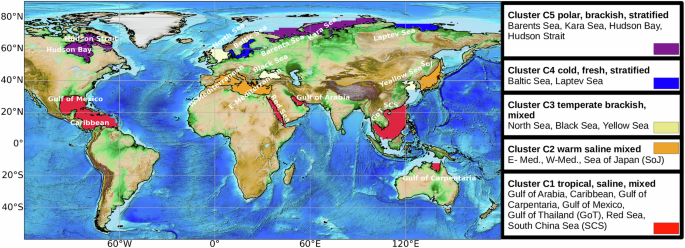

When we began this study, we were motivated by a simple but surprisingly overlooked question: how will the world’s enclosed seas respond to climate change—and how fast?
These seas—such as the Mediterranean, the Baltic Sea, or the Gulf of Mexico—are among the most valuable marine environments on Earth. They support fisheries, tourism, and biodiversity, and they provide essential ecosystem services to hundreds of millions of people. Yet despite their importance, they are often missing from global climate assessments, which tend to focus on the open ocean.
This gap mattered to us. Because many oceanographers and climate scientists believe that smaller, more enclosed systems often respond more rapidly—and more dramatically—to climate warming.
Why are enclosed seas particularly vulnerable?
Enclosed marginal seas sit at the boundary between land and ocean. This makes them extraordinary productive—but also highly exposed.
They are already under pressure from pollution, nutrient runoff, overfishing, and coastal development. Climate change adds another layer of stress, particularly through the emergence of marine heatwaves—periods of unusually high temperatures that can last for days, weeks, or even months.
What makes these seas especially vulnerable is their geography. Unlike the open ocean, they have limited exchange with surrounding waters. This means that heat can build up more easily, and entire ecosystems can be affected at once.
We suspected that many of these regions might be “hotspots” of climate change. But until now, there had been no comprehensive, global assessment to confirm this.
Building a global picture
To address this problem, we brought together climate model simulations and observational data to analyze 19 enclosed seas around the world. Our aim was to understand not just how much they will warm, but how fast—and what that means for marine ecosystems. We were looking paricularly at two types of thermal stressors.
The first is the rate of warming. This matters because marine life can more easily adapt to gradual change—but rapid change can overwhelm their ability to cope.
The second is the emergence of marine heatwaves. which can cause sudden and widespread damage, such as coral bleaching or fish mortality.These waves are not only the result of ongoing warming but can likewise caused by natural variations in these the seas.
To capture both aspects, we used a large ensemble of climate model simulations. This allowed us to separate long-term trends driven by greenhouse gases from the natural variability —a crucial step when studying extreme events.
A surprising turning point
One of the most striking findings emerged when we looked at recent decades.
We found that many enclosed seas have already entered an unprecedented phase of warming. In fact, the rate of warming peaked around the year 2000—higher than anything seen before in the historical record.
At first, this result seemed counterintuitive. Why would warming accelerate so sharply at that time?
The answer lies in air pollution. During the 20th century, industrial emissions released aerosols into the atmosphere, which had a cooling effect by reflecting sunlight. As air quality regulations improved—especially in Europe and North America—these aerosols declined. This “unmasking” of greenhouse warming led to a rapid increase in temperatures.
In other words, part of the warming we are experiencing today was previously hidden.
Looking into the future
When we turned to future projections, the picture became even more concerning at least under high-emission scenarios. In that case many enclosed seas are projected to warm by several degrees by the end of the century—often more than the global ocean average. Even more striking, the rate of warming in some regions could exceed anything observed in the past by a factor of three or four.
This is critical, because it is not just how much temperatures rise, but how quickly. Rapid warming leaves little time for species to adapt, increasing the risk of ecosystem disruption.
In many seas, conditions could shift toward what we describe as “near-permanent heatwaves”—where extreme temperatures persist over most of the year. While short interruptions due to weather variability may still occur, the overall state of the system would be one of almost continuous marine heatwave compared to the pre-industrial baseline state.
Under the most extreme scenarios, this becomes highly likely in the majority of enclosed seas by the end of the century.
The role of climate mitigation
There is, however, an important and hopeful message in our results.
If global warming is limited in line with the Paris Agreement—keeping global warming well below 2 °C — the most extreme consequences can largely be avoided. In particular, the risk of entering near-permanent heatwave states drops dramatically.
But—and this is crucial—even under these optimistic scenarios, the changes do not disappear.
Most enclosed seas would still experience substantial warming compared to pre-industrial levels. Marine heatwaves would become much more frequent, and in many regions, they would affect a large fraction of the sea area each year.
Consequently, mitigation reduces the severity of the problem—but it does not eliminate it.
What this means for ecosystems and society
The implications of these findings go far beyond temperature statistics.
Marine ecosystems are highly sensitive to thermal conditions. Changes in temperature can shift species distributions, alter food webs, and reduce biodiversity. Fisheries—on which many communities depend—may decline or relocate. Coral reefs and other vulnerable habitats may undergo irreversible damage. In enclosed seas, these impacts can be particularly severe because entire ecosystems can be affected simultaneously. For societies, this translates into upcoming challenges for coastal management.
A need for adaptation
One of the key messages from our study is that climate mitigation alone is not enough.
Even in the best-case scenarios, significant changes have already happened due to past emissions. Hence, adaptation will be essential. This could include reducing other human pressures, protecting key habitats, or developing early warning systems for marine heatwaves. In some cases, restoration efforts may help ecosystems recover or become more resilient. Importantly, these actions need to be tailored to individual regions. While our study provides a global overview, local conditions vary, and effective solutions will require region-specific knowledge.
Looking ahead
By providing a global perspective on enclosed seas, we hope to draw attention to regions that have often been overlooked in climate research. At the same time, our findings highlight the need for more detailed, high-resolution studies that can inform local decision-making.
Perhaps the most important takeaway is this: enclosed seas are not just passive indicators of climate change—they are key environments where its impacts become more and more visible.
Understanding their future is not only a scientific challenge, but a societal necessity as the changes happening in these seas will ultimately affect the people and communities who depend on them.

Follow the Topic
-
Communications Earth & Environment
An open access journal from Nature Portfolio that publishes high-quality research, reviews and commentary in the Earth, environmental and planetary sciences.

Related Collections
With Collections, you can get published faster and increase your visibility.
Ecological resistance and resilience under global change
Publishing Model: Open Access
Deadline: Apr 07, 2027
Hazards in Mountain Regions
Publishing Model: Open Access
Deadline: Nov 02, 2026