Developmental organization of sensory and sympathetic ganglia
Published in Cell & Molecular Biology and Genetics & Genomics
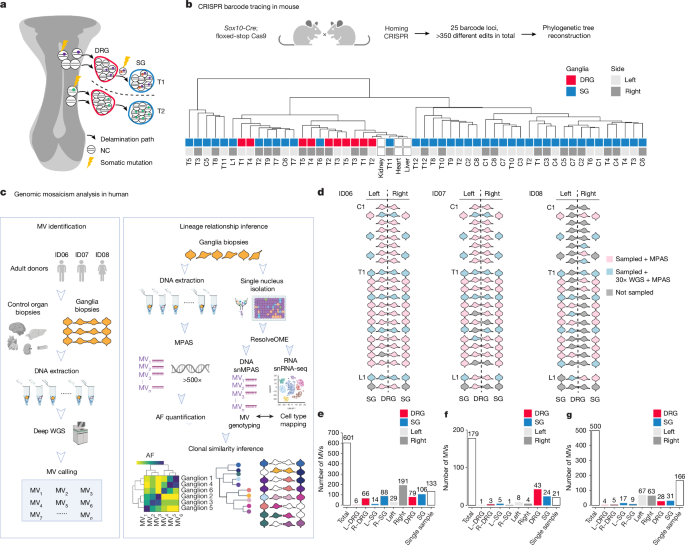

The neural crest generates a broad spectrum of cell types that migrate across the body plan to populate multiple tissues. However, the relationship between lineages of neural crest derivatives remains unclear, and the extent to which neural crest cells delaminated from the neural tube have specified fates remains debated. Here, leveraging CRISPR barcoding in mice and mosaic variant barcode analysis in humans, Dr. Keng Ioi (Harry) Vong and Dr. Joseph G Gleeson from the University of California, San Diego, Dr. Xiaoxu Yang from the University of Utah and collaborators demonstrate robust bilateral progenitor clonal spread of neural crest progenitors along the rostrocaudal axis but limited clonal overlap between sensory and sympathetic lineages. Computational modelling of mosaic variants suggests that most neural crest cells show strong fate restriction before delamination. Real-time imaging of quail embryos further shows a fibroblast growth factor (FGF)-dependent rostrocaudal dispersion of neural crest cells across multiple axial levels. These findings support a model in which neural crest fate bias predominantly emerges within the neural tube, with only a minor subset of delaminated progenitors retaining multipotency to generate both sensory and sympathetic derivatives.

Dr. Yang is an Assistant Professor at the Department of Human Genetics, University of Utah. Received training in Information Science and Technology and a Bachelor's degree in BioSciences from Beijing Normal University, PhD in Bioinformatics from Peking University, and postdoctoral research in Neurosciences at the University of California, San Diego. The Yang laboratory combines computational and experimental expertise and sits in the interdisciplinary zone. Dr. Yang's research interests include computational and experimental methodology development for genomic mosaicism, and using genomic mosaicism to understand human health, development, disease, and transmission genetic risks.
Follow the Topic
-
Nature
A weekly international journal publishing the finest peer-reviewed research in all fields of science and technology on the basis of its originality, importance, interdisciplinary interest, timeliness, accessibility, elegance and surprising conclusions.

Related Collections
With Collections, you can get published faster and increase your visibility.
Carbon Dioxide Removal
Publishing Model: Hybrid
Deadline: Jan 16, 2027
Cancer Neuroscience: from mechanisms to therapy
Publishing Model: Hybrid
Deadline: Jan 30, 2027