
Holographic projection can be used in the fields such as near-eye display, encryption and measurement, which has important research significance. The traditional holographic projection uses spatial light modulator to modulate the wavefront information, and uses the lens to focus the imaging, which directly leads to a huge and complex system. In addition, there is a contradiction between zoom and miniaturization. The emerging metasurface provides a unique opportunity for holographic projection due to the highly integrated sub-wavelength structures that can arbitrarily control the properties of light and realize a larger viewing angle. However, existing meta-holography-based projection technology is largely constrained by static, 2D projection, with small and non-adjustable image size. Therefore, achieving large image size, significant depth, and zoom functionality in 3D meta-holography with an integrated and miniaturized system is a pressing need.
In this work, we propose a 3D meta-holographic zoom micro-projector, as shown in Figure 1. By integrating a high-resolution metasurface with a tailored liquid lens into a single cavity, we have achieved the world’s smallest 3D zoom micro-projector with system volume of only 0.18 cm3. The projector achieves 3D zoom projection, with the size and projection distance of the meta-holographic image extending to the decimeter scale, a feat unattainable by previous meta-holographic projection. This flexible and miniaturized 3D fingertip zoom micro-projector is anticipated to have broad applications in portable and wearable devices as well as biomedical apparatus.
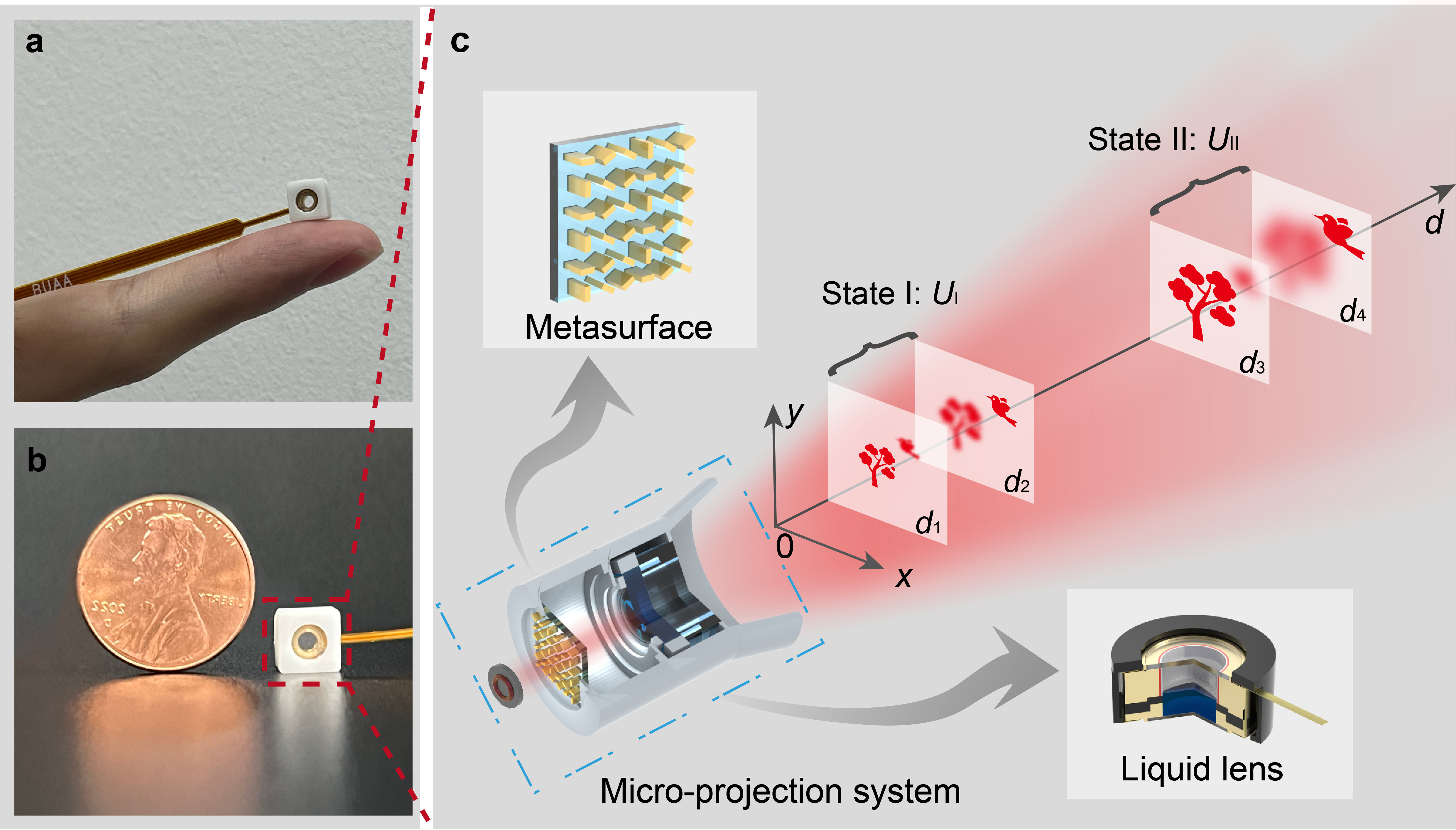
Figure 1 Concept of the proposed zoom micro-projector. a The fabricated projector on a fingertip. b The projector in comparison to a penny. c Illustration of the internal optical design and principle of the 3D micro-projector. When the driving voltage of the liquid lens is UI and UII, there are two different projection states, and the 3D scene is reconstructed in different positions d with different sizes.
The proposed meta-holography-based zoom micro-projector consists of a laser, a transmissive metasurface, and a specially designed electrowetting liquid lens, as shown in Figure 1c. In the design process of the metasurface, a 3D Fourier meta-hologram generation method based on FRFT is proposed to generate the 3D meta-hologram, and then the 3D meta-hologram is encoded on the sub-wavelength structures. The liquid lens is positioned behind the metasurface. Unlike traditional liquid lenses, a lightweight electrowetting liquid lens with an effective optical aperture of 2 mm is developed. This lens features an extremely compact cavity size, enabling fingertip micro-projection in conjunction with the metasurface. To achieve system miniaturization, the metasurface and liquid lens are integrated into a single cavity, as shown in Figures 1a and 1b. When the laser irradiates the metasurface, the holographic diffraction image passes through the liquid lens. By changing the driving voltage of the liquid lens, 3D images can be projected at different positions, with their sizes adjustable as desired.
The designed liquid lens consists of a transparent conductive liquid and an insulating liquid encapsulated between the upper and lower electrodes, as shown in Figure 2a. Under the effect of interfacial tension, a liquid interface is formed between the conductive liquid and the insulating liquid. Based on the electrowetting effect, the contact angle of the conductive liquid can be changed with driving voltage, and the focal length control can be achieved through voltage control. To ensure that the liquid lens has a high ratio of optical aperture to mechanical diameter, a straight cylindrical cavity is designed to replace the typical sloping cavity. This design reduces the thickness of the liquid lens cavity, enhancing the compactness of the meta-holographic 3D zoom projector. Additionally, to guarantee a sufficient range of optical power variation and good stability, a biphasic liquid composed of a conductive liquid without aqueous solution and an insulating liquid with low surface tension is developed. So, the proposed liquid lens offers a wide operating voltage range and a great variation in optical power.
In the metasurface design process, a 3D Fourier meta-hologram generation method based on FRFT is proposed, as shown in Figure 2b. The 3D object is layered according to the depth information. The Fractional Fourier transform and inverse Fractional Fourier transform are introduced into the algorithm, with iterative constraints added in the fractional domain and spatial domain, respectively, to obtain a convergent final phase distribution and generate a 3D meta-hologram. By encoding the 3D meta-hologram on the sub-wavelength structures, a metasurface is designed and fabricated based on the Pancharatnam-Berry geometric phase principle. Different from the traditional metasurface-based holographic algorithm, the proposed 3D Fourier transform algorithm achieves 3D meta-holographic reconstruction through a transformation order. Meanwhile, the position and depth of the reconstructed images are closely related to the focal length of the liquid lens, enabling efficient 3D zoom projection by adjusting the driving voltage of the liquid lens.
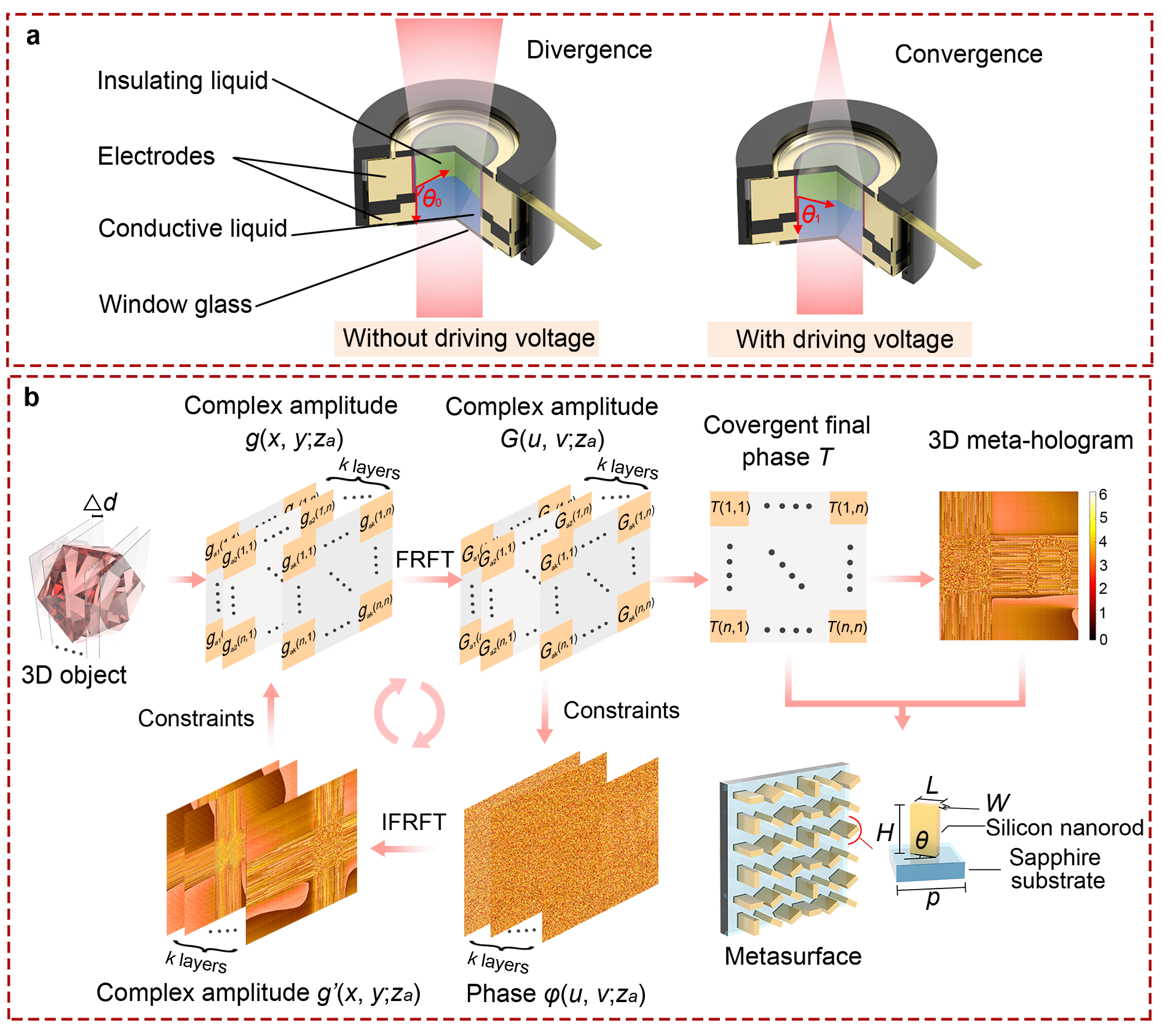
Figure 2 Core components and mechanism of the proposed micro-projector. a Structure of the proposed liquid lens. b Computational strategy of the meta-hologram.
Overall, we demonstrate a meta-holography-based zoom micro-projector capable of achieving 3D zoom projection with large and zoomable size and distance. The micro-projector, primarily composed of a high resolution metasurface and a specially designed liquid lens has an overall system with the volume of only 0.18 cm3. Such a high-resolution, large projection depth range, and flexible zoom micro-projector opens up broad applications for meta-holography, including high-security encryption, AR/VR, wearable and biomedical devices, automotive displays and so on.