Holographic capture and projection system of real object based on tunable zoom lens
Published in Physics

With the rapid development of the information age, people’s demand for information display is increasing gradually. Holographic projectors have higher light efficiency and the feasibility of reconstructing real 3D objects, which have attracted much attention in military, medical and other fields. However, the real-time acquisition of the real 3D scenes is a crucial challenge in holographic technology. At the same time, the size of the reconstructed images is relatively small and both the size and depth are difficult to adjust flexibly. To enhance the application of holographic projector, it is essential to overcome these difficulties.
In this work, a holographic capture and projection system of real object based on tunable zoom lens is proposed. Based on liquid lenses, a tunable zoom camera is produced to capture the real objects with a fast response speed. Real objects can be captured and the details can be optically magnified by adjusting the focal length of the zoom camera. Moreover, by loading the phase of the conical lens on the spatial light modulator (SLM) and adjusting the focal length of the corresponding colors, color holographic projection of the real object can be realized without chromatic aberration. Unlike the conventional systems using liquid lens or digital lens for reconstruction, the size and position of the reconstructed image can be changed easily without any optical components.
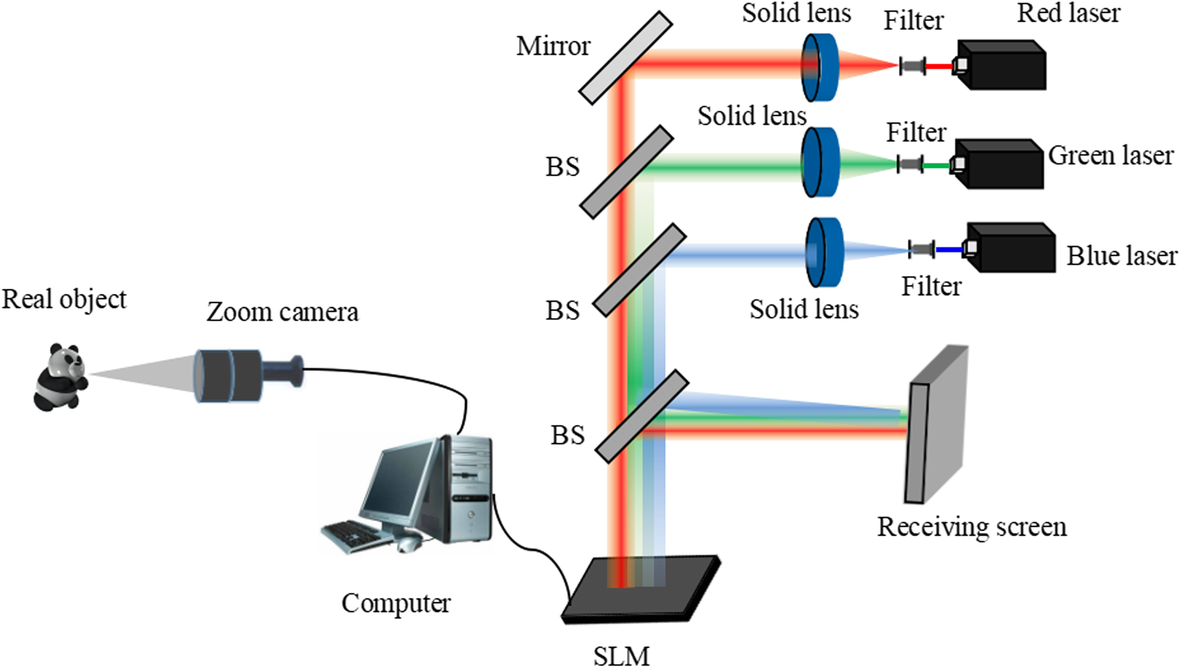
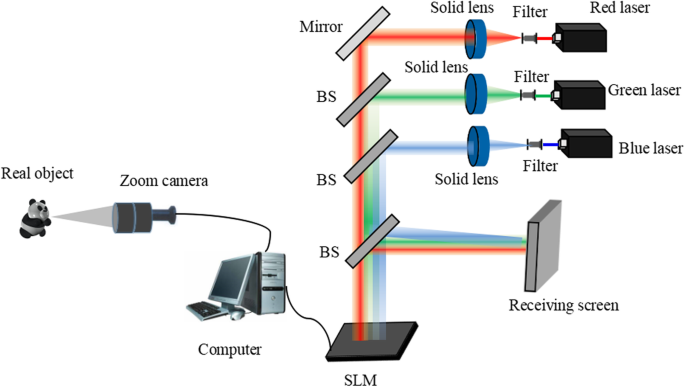
The structure of the proposed system is simplified to a great extent, as shown in Figure 1. The proposed system consists of a zoom camera, three lasers, three filters, three solid lenses, a mirror, three beam splitters (BSs), an SLM, a computer and a receiving screen. In the process of acquiring images, the zoom camera is used to capture the image of the real object. The zoom camera is connected to the computer, then the information of the real object can be transferred to the computer. The hologram of the object can be generated through the computer. The lasers, filters and solid lenses are used to generate the collimated light. The mirror and the BSs are used to adjust the angle of light so that the collimated light can illuminate the SLM. When the hologram is loaded on the SLM, the diffracted light is reflected by the BS. Finally, the reconstructed image can be seen on the receiving screen.
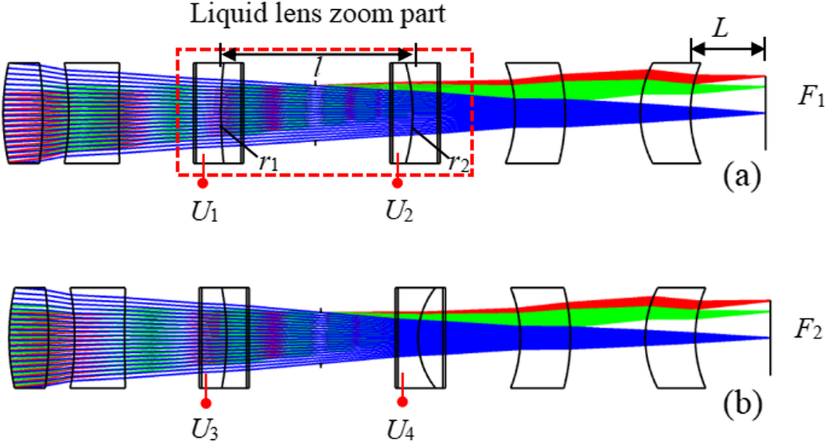
The liquid lens-based zoom camera is a key to reach the function of holographic capture. It consists of two electrowetting liquid lenses and four solid lenses, as shown in Figure 2. The two liquid lenses can not only play a role of zoom part, but also keep the image plane fixed during the zoom process. The two liquid lenses are both actuated by electrowetting and the focal length of the liquid lens is changed by tuning the liquid-liquid interface due to the electrowetting effect. The liquid lens is electrically driven, so the zoom camera has a fast response speed and light weight.
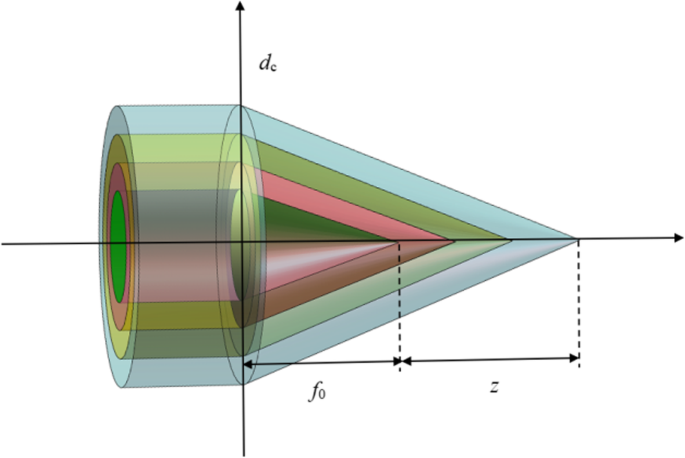
The digital conical lens with a large focal depth is a key to reach the function of holographic projection. The principle of the conical lens is shown in Figure 3. The focal depth z of conical lens is used to compensate for the difference between the focal lengths of the three color images in order to keep the position of three colors reconstructed images in the same position.
In the hologram generation process, the holograms of the recorded object for three colors can be generated by the iterative Fourier transform algorithm, and the digital conical lens is generated by setting the corresponding parameters. The final hologram can be generated by adding the phase of the digital conical lens to the that of the recorded object, as shown in Figure 4. In this way, three color reconstructed images can coincide in the same position without axial chromatic aberration. Moreover, by changing the focal length of the digital conical lens, the size and the position of the image can be changed easily.
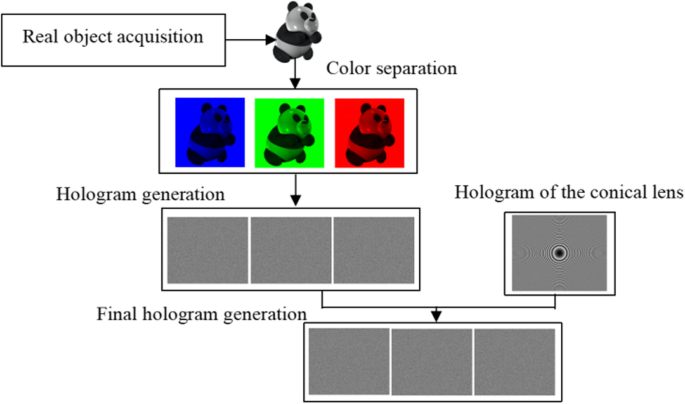
To sum up, we have overcome two major challenges in the current holographic technology, namely the difficulty of capturing real 3D scenes with a fast speed and the difficulty of achieving adaptive projection. Moreover, our proposed holographic capture and projection system is low-cost and simple-structured. We believe that the emergence of the holographic capture and projection system will further promote the development of real-time acquisition and reproduction of 3D objects, thus further advancing the application of holography.
Follow the Topic
-
PhotoniX
PhotoniX aims to present brave endeavors in promoting X-disciplinary research, latest progress of engineering applications and breakthroughs in scientific discoveries, all enabled by photonics. Original scientific letters, articles, reviews, and technology progress reports are equally welcome.

Related Collections
With Collections, you can get published faster and increase your visibility.
Photonics X Metaverse
Metaverse is a comprehensive concept because it is not a single technology, but an expansive, interconnected framework composed of multiple disciplines. Therefore, to fully realize the metaverse, it is necessary to integrate expertise from traditionally siloed fields. Photonics, among them, is acting as a powerful catalyst, driving waves of innovation across all layers of the metaverse hardware ecosystem. This special Issue aims to highlight the latest breakthroughs and insights at the intersection of metaverse and photonics and to foster continuous, cross-disciplinary dialogue and collaboration.
Scope:
Topic 1: Photonics-powered near-eye displays (magnifiers, birdbaths, waveguides, etc.)
Topic 2: Photonics-powered microdisplays (Micro LED, Micro OLED, LCoS, DMD, laser, etc.)
Topic 3: Photonics-powered three-dimensional displays (holography, light field, etc.)
Topic 4: Nanophotonics-powered lenses (freeform lenses, Fresnel lenses, pancake lenses, metalenses, contact lenses, etc.)
Topic 5: Biophotonics-powered bionics (bionic eyes, retinal implants, etc.)
Publishing Model: Open Access
Deadline: Dec 31, 2026
Solar Light-Matter Interactions: Energy Regulation, Conversion and Its Interdisciplinary Applications
The interaction between Solar Light and Matter constitutes a core foundational topic, covering interdisciplinary fields such as optics, energy science, materials science, environmental engineering, and biomedicine science. More critically, it serves as a pivotal technological breakthrough to address the pressing global energy crisis and mitigate climate change. Spanning from large-scale solar energy utilization (such as photovoltaic and photothermal conversion) to micro/nano-scale photon manipulation and interfacial energy transfer, research in this field has steadfastly embraced the multiple mission of "decoding the inherent laws governing natural energy exchange and empowering human sustainable development and health security." Driven by the rapid advancement of micro/nanofabrication technologies, metamaterial design, photonics theories, and biosensing technology, human understanding of solar light-matter interactions has evolved beyond traditional macro-phenomenon observation to the precise regulation of mechanisms at the atomic, quantum and biomolecular levels. This paradigm shift has spawned a series of transformative advances, including plasmonic enhancement effects, metamaterial-based spectral selective control, directional interfacial energy transfer and cross-scale photobio regulation—innovations that have opened up entirely new technical pathways for high-efficiency solar energy utilization, radiative cooling, environmental remediation, and related fields. Nevertheless, the field still grapples with numerous critical scientific challenges and technical bottlenecks: the multi-physics coupling mechanisms governing underlying solar radiation and energy transfer at the micro/nano scale remain incompletely elucidated; the large-scale fabrication, long-term stability and biocompatibility of high-efficiency energy conversion devices are insufficient to meet practical application demands; and the depth and breadth of interdisciplinary technological integration require further enhancement. This Special Issue aims to systematically synthesize cutting-edge theoretical achievements and technological breakthroughs in this domain, construct a robust bridge between basic research and engineering applications, and assemble top-tier global researchers to collectively tackle core challenges. By providing academic support for technological innovation in key areas such as high-efficiency solar energy utilization, radiative cooling, environmental governance and life and health, it will contribute to green and low-carbon development under the "dual carbon" goals, which holds significant academic value and profound practical implications.
Scope:
Topic 1: Fundamental physical and chemical mechanisms underlying solar light-matter interactions
Topic 2: Design, fabrication, and solar radiation regulation performance of micro/nanostructures (e.g., metamaterials, plasmonic materials, porous materials)
Topic 3: High-efficiency solar photothermal/photovoltaic conversion devices and systems
Topic 4: Daytime radiative cooling materials, devices, and their engineering applications
Topic 5: Applications of solar energy conversion technologies in water treatment, environmental remediation, building energy efficiency, and other related fields
Topic 6: Research on the photothermal dynamic regulation mechanisms between solar light and organisms (including humans and other mammals, etc.)
Publishing Model: Open Access
Deadline: Ongoing