A medicinal tradition still full of discoveries

Interviews with 29 healers and herbal practitioners in Batna documented 87 plant species, uncovered three first records for Algerian ethnobotany, and revealed previously unreported therapeutic applications for 56 taxa
A medicinal tradition still full of discoveries
Like

Share this post

Choose a social network to share with, or copy the URL to share elsewhere

This is a representation of how your post may appear on social media. The actual post will vary between social networks

Explore the Research

Springer International Publishing
Springer International Publishing Springer International Publishing

Medicinal Plant Knowledge of Healers and Herbalists in Batna, Algeria: Therapeutic Patterns, Healer Consensus, and Novel Ethnomedicinal Uses

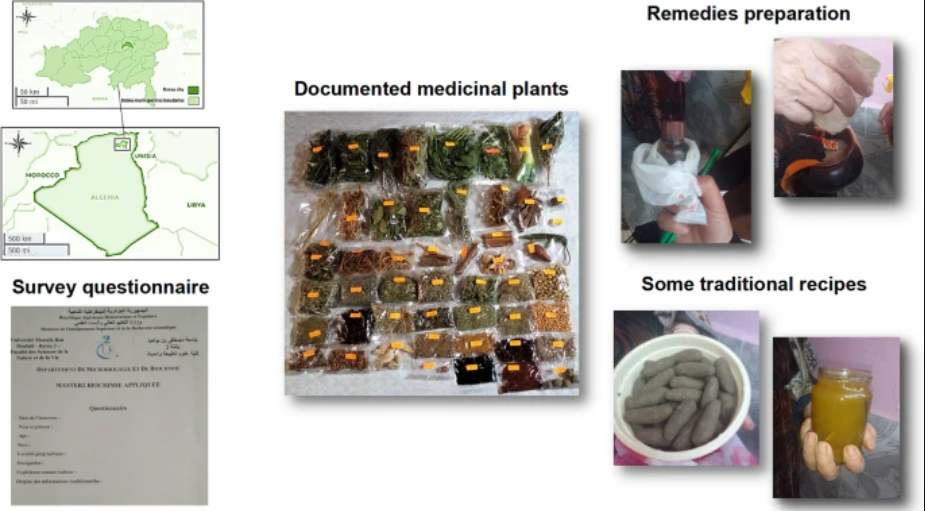
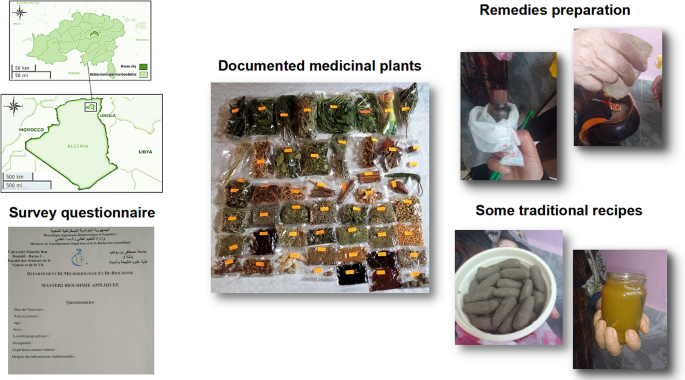
Medicinal plants remain central to the healthcare practices of local communities, reflecting centuries of accumulated indigenous knowledge. In the municipality of Batna (northeastern Algeria), professional healers maintain a rich body of ethnomedicinal knowledge that remains insufficiently documented, particularly regarding therapeutic consensus, knowledge distribution, and rarely reported medicinal uses. This study aimed to document the diversity of medicinal plants used by healers in Batna, identify the main therapeutic categories, analyse patterns of healer consensus and plant-use distribution, and highlight newly documented species and novel therapeutic applications in the Algerian ethnobotanical literature. Ethnobotanical data was collected through semi-structured interviews with 29 professional healers and herbal practitioners. Data analysis focused on frequency of citation, use reports per species and therapeutic category, and descriptive assessment of variability in healer practices. A total of 87 medicinal plant species belonging to 79 genera and 39 families were recorded. Lamiaceae was the most represented family (12 species, 13.79%). Medicinal plants were primarily used to treat digestive disorders (46 species), followed by respiratory (27 species) and neurological ailments (25 species). Leaves were the most frequently used plant part (37.86%), and decoction was the predominant preparation method (29.73%). The distribution of medicinal plant knowledge revealed a structured core-periphery pattern, with a limited group of frequently cited species, notably Punica granatum, Artemisia herba-alba, and Olea europaea, forming the core therapeutic repertoire, while less frequently cited species reflected specialised and context-dependent knowledge. Comparative analysis with previous Algerian ethnobotanical studies revealed substantial novelty, including three medicinal species documented for the first time in Algeria (Fragaria × ananassa, Saponaria officinalis, and Umbilicus horizontalis) and 56 species with previously unreported therapeutic applications. These findings demonstrate the richness, diversity, and adaptive nature of healer knowledge in Batna and provide valuable leads for future phytochemical, pharmacological, and conservation-oriented research. Graphical Abstract

When ethnobotanical studies are discussed, attention often gravitates toward individual medicinal plants. But there is another question that can be just as revealing: how much of this knowledge is actually shared among practitioners, and how much remains in the hands of a few specialists?

A recent study published in Revista Brasileira de Farmacognosia explored this question by interviewing 29 professional healers and herbal practitioners in Batna, northeastern Algeria. The result was an impressive snapshot of local medicinal plant knowledge: 87 species belonging to 39 botanical families, used to address 120 different health conditions. 

What makes the study particularly interesting is that the authors looked beyond simple species inventories. Their analyses revealed a clear "core" of medicinal plants that appeared repeatedly across interviews. Species such as Punica granatum (pomegranate), Artemisia herba-alba (white wormwood or desert wormwood), and Olea europaea (olive tree) were consistently cited by practitioners, suggesting that they occupy a central place in the region's therapeutic traditions. 

Digestive issues
The data also paint a picture of remarkable therapeutic diversity. Digestive disorders accounted for the largest number of use reports and the strongest agreement among healers, followed by respiratory and endocrine conditions. Some species were notable for the breadth of their reported applications. Artemisia herba-alba, for example, was used for 24 ailments spanning nine disease categories, while Punica granatum and Olea europaea were associated with 20 and 14 ailments, respectively. 

Yet the most widely recognized plants tell only part of the story. Alongside these frequently cited species, the researchers found many plants that were mentioned only occasionally. Rather than viewing these as marginal, the authors interpret them as part of a rich body of specialized knowledge, reflecting individual expertise, local experience, and therapeutic practices that may be at risk of disappearing if not documented.

Perhaps the most surprising finding emerged when the dataset was compared with previous ethnobotanical literature from Algeria. The study documented three medicinal plant species not previously reported in Algerian ethnobotanical surveys and identified previously unreported therapeutic applications for 56 species. Together, these results highlight that traditional medicinal knowledge is far from static. It continues to evolve, expand, and adapt, even in an urban setting with access to modern healthcare. 

Author's note: I used Microsoft Copilot to assist in creating this post.

Please sign in or register for FREE

If you are a registered user on Research Communities by Springer Nature, please sign in

Follow the Topic

Pharmacology
Life Sciences > Health Sciences > Biomedical Research > Pharmacology
Health Care
Life Sciences > Health Sciences > Health Care
SDG 3: Good Health & Wellbeing
Research Communities > Community > Sustainability > UN Sustainable Development Goals (SDG) > SDG 3: Good Health & Wellbeing