
Explore the Research

 Nature
A neural network assisted 171Yb+ quantum magnetometer - npj Quantum Information
npj Quantum Information - A neural network assisted 171Yb+ quantum magnetometer
Quantum sensing and quantum metrology have experienced a significant progress, placing themselves at the forefront of quantum technologies harnessing quantum effects. Among them, atomic-sized sensors encoded in $^171$Yb$^+$ ions provide high sensitivity for the detection of external fields. Beyond fundamental research in quantum metrology, $^171$Yb$^+$-based detectors would find relevant technological applications as they could be incorporated, for instance, at the reading stage of current NMR spectrometers to characterise tiny magnetic fields that emanate from their coils with high sensitivity as well as with a large spatial resolution. However, considering the narrow working regime of atomic sensors and the fact that a departure from this regime distorts the sensor response, one must face the challenge of efficiently estimating target parameters of external fields.
Machine learning has already shown their success in a lot of aspects of classical data analysis. Moreover, artificial neural networks (NNs) are incorporated to address distinct problems in modern quantum technologies. Specifically, NNs bridge input data into output results by encoding the function that relates them, thus suggesting a plethora of applications in quantum technologies. Among them, quantum sensing manifests itself as the natural playground to incorporate NNs.
In our paper A Neural Network Assisted $^{171}$Yb$^{+}$ Quantum Magnetometer [DOI: 10.1038/s41534-022-00669-2], we demonstrate that the deep imbrication between quantum detectors and NNs which will push forward the field of quantum sensing and broaden the application of NNs in quantum technologies. We experimentally illustrate that the incorporation of NNs into atomic sensors enables the characterization of target fields in several challenging scenarios, as shown in Figure 1.
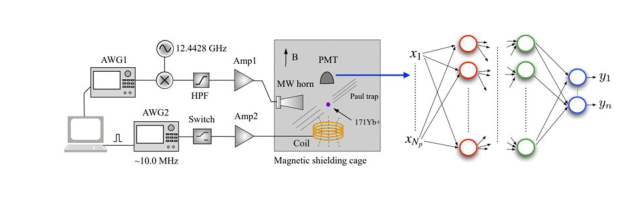
Figure 1. Schematic configuration of the experimental setup for the 171Yb+ atomic sensor combined with a NN.
The advantages that result from combining quantum sensors and NNs can be steadily characterized in several challenging regimes, thus significantly extending the operating capacities of atomic detectors. We focused on different regimes such as: (i) Those with a large shot noise. We even deal with the case of the target field characterization via unique measurements, i.e., continuous sensor interrogation via single shot measurements. (ii) In regimes that significantly depart from the standard harmonic response of the sensors. Our protocol is experimentally demonstrated to characterize targets with high accuracy using minimal knowledge of the underlying physical model.
Our results indicate the benefits to integrate NNs at the data processing stage of general quantum sensing tasks to decipher the information contained in the sensor responses. This is a strategy that can be easily extended to other quantum platforms such as, nitrogen vacancy (NV) centers in diamond, to decode complex NV responses emerging from dense nuclear samples comprising nuclear spins which are strongly coupled to the sensor and/or among them. In this manner, we expect that our research will largely drive the application of NNs in quantum sensing and quantum technologies.
Follow the Topic
-
npj Quantum Information
The scope of this journal spans across all relevant disciplines, fields, approaches and levels and so considers outstanding work ranging from fundamental research to applications and technologies.

Related Collections
With Collections, you can get published faster and increase your visibility.
Foundations and Advances in HPC/AI-Quantum Co-Design
Publishing Model: Open Access
Deadline: Dec 20, 2026
Quantum-Enabled Bioimaging
Publishing Model: Open Access
Deadline: Nov 04, 2026