A New Rhizospheric Paradigm? Projecting the Metabolic Complementarity Between Raoultella ornithinolytica and Helianthus annuus as a Potential Strategy Against Cadmium and Arsenic in Colombia's Coffee-Growing Region
Published in Bioengineering & Biotechnology, Earth & Environment, and Ecology & Evolution


Carlos Mauricio Pérez1, Grisel Fierros-Romero2
1 Universidad Nacional Abierta Y a Distancia, Colombia
2 Instituto Tecnológico Superior de Ciudad Hidalgo, TecNM, México
The Invisible Threat Beneath Our Feet
Imagine a farmer standing in a lush green field, with leaves swaying gently in the breeze. Beneath the surface, however, the soil tells a different story: it is silently contaminated with heavy metals such as cadmium (Cd), lead (Pb), arsenic (As), copper (Cu), and others. These toxins accumulate over time, seep into crops, enter the food chain, and ultimately pose serious risks to human health. This invisible crisis affects millions of hectares of agricultural land worldwide, demanding urgent, sustainable solutions.
Traditional remediation methods—such as excavating and chemically treating contaminated soil—are costly, environmentally disruptive, and often impractical at large scales. Nature, however, may already hold the key.
The Unexpected Hero: The Sunflower
Helianthus annuus, the common sunflower, is far more than a cheerful summer bloom. It stands out as a highly effective phytoremediator thanks to its rapid growth, substantial biomass production, and strong capacity to absorb and accumulate heavy metals like Cd, Pb, Cu, and As. The plant primarily sequesters these metals in its root system but can also translocate them to aerial tissues, supporting both phytoextraction and phytostabilization processes.
Its efficiency depends on factors such as metal bioavailability, soil pH, biomass yield, and the plant’s physiological tolerance to oxidative stress induced by heavy metals.
Yet sunflowers have limits. In highly polluted soils, heavy metal toxicity causes oxidative damage that can impair growth and reduce remediation performance. To unlock the plant’s full potential, it needs support. Here, we propose providing this support through the rhizosphere bacterium R. ornithinolytica, establishing an augmented phytoremediation system specifically tailored for the bioremediation of agricultural soils co-contaminated with cadmium and arsenic in the Eje Cafetero region of Colombia.
The Microbial Superstar: Raoultella ornithinolytica
Genomic studies have revealed Raoultella ornithinolytica as a remarkably resilient bacterium well-suited for harsh, metal-contaminated environments. Originally isolated from Los Azufres, Mexico, this strain harbors a genome that encodes a comprehensive suite of resistance and detoxification systems, including:
- The ars operon (arsR-arsB-arsC-arsA-arsD) for arsenic resistance.
- merA and merR genes involved in mercury reduction.
- zntA-zntR for zinc and cadmium homeostasis.
- copA, cueO, and cusA for copper resistance.
- The nikABCDE-nikR system for nickel transport and regulation.
Additional mechanisms, such as the cad operon (cadC, cadB, cadA) for acid stress response and genes like pcaD for degrading aromatic compounds, further enhance its survival under multiple environmental stresses.
These efflux, transport, and enzymatic reduction systems enable the bacterium to maintain cellular homeostasis even in the presence of high heavy metal concentrations, making it a promising candidate for bioremediation.
A Symbiotic Alliance in the Rhizosphere
Many strains of R. ornithinolytica, including the TNT strain, exhibit key traits of Plant Growth-Promoting Rhizobacteria (PGPR). These include:
- Biosynthesis of auxins (growth hormones).
- Production of acetoin.
- ACC deaminase activity, which reduces plant stress by lowering ethylene levels.
- Siderophore synthesis for improved iron (and other nutrient) acquisition.
- Phosphate solubilization.
- Chemotaxis mechanisms.
This creates a powerful synergistic partnership:
- The Plant Pays the Rent: Sunflower roots release exudates—sugars and other organic compounds—that nourish and attract the bacteria in the rhizosphere.
- The Bacteria Returns the Favor: In exchange, R. ornithinolytica detoxifies heavy metals, produces growth-promoting metabolites, enhances nutrient availability, and mitigates oxidative stress, thereby boosting root development and overall plant vigor.
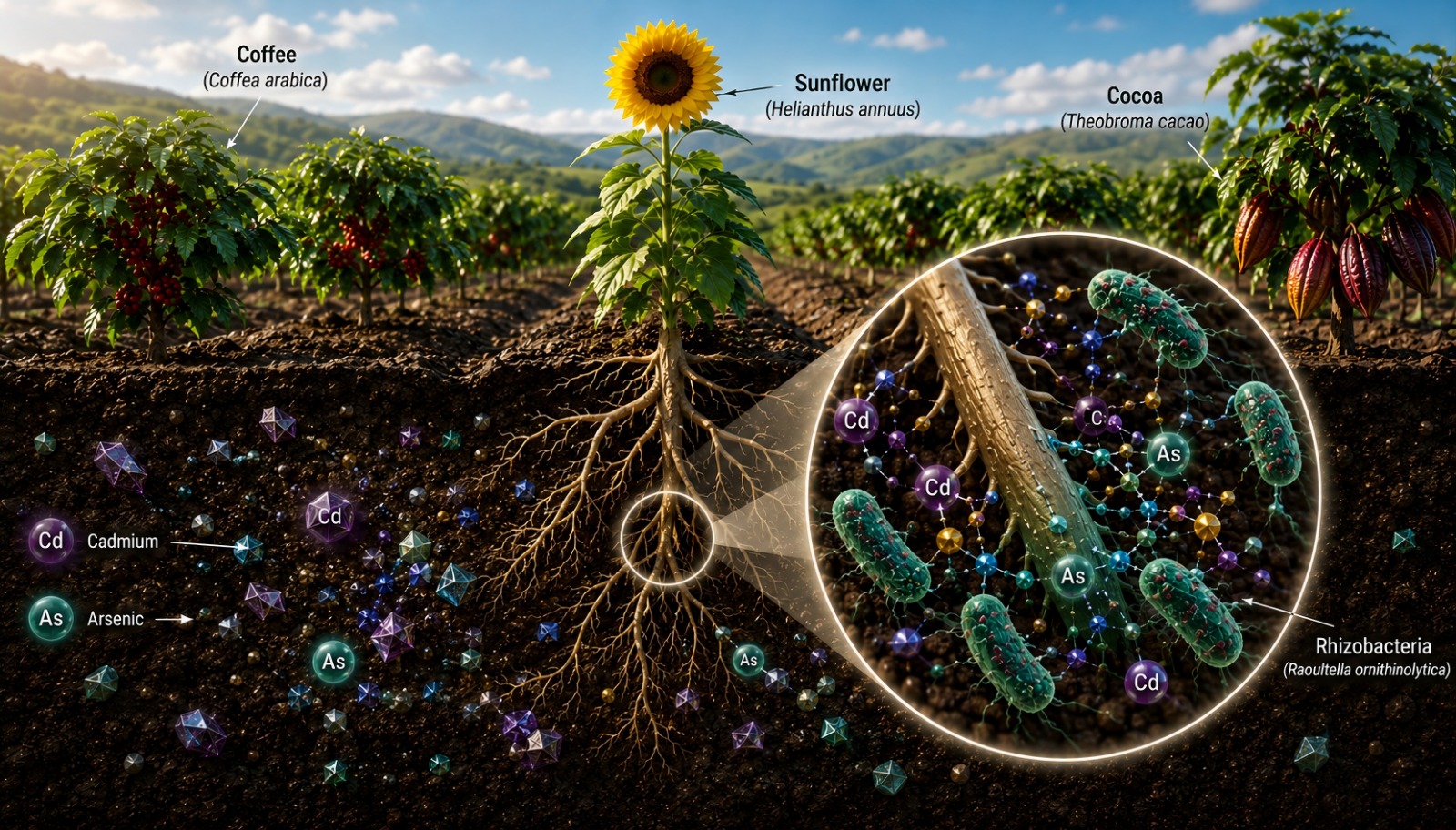
Figure 1. Proposed phytoremediation system augmented with the bacterium R. ornithinolytica in the rhizosphere, designed for the Eje Cafetero region of Colombia. Featured species: Coffea arabica (coffee), Helianthus annuus (sunflower), and Theobroma cacao (cocoa).
Why This Matters
The combination of Helianthus annuus and Raoultella ornithinolytica offers complementary advantages that surpass the performance of either organism alone. The bacterium reduces metal-induced stress, while the plant provides a habitat and nutrients, resulting in greater biomass production, enhanced metal uptake or stabilization, and higher overall phytoremediation efficiency in soils contaminated with heavy metals.
This nature-based approach is scalable, eco-friendly, and economically viable. It transforms contaminated land into productive areas, supporting safer food production and healthier ecosystems without the drawbacks of conventional methods.
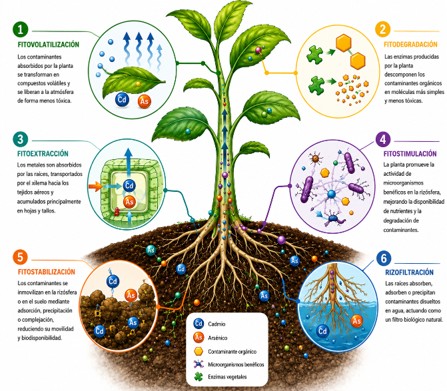
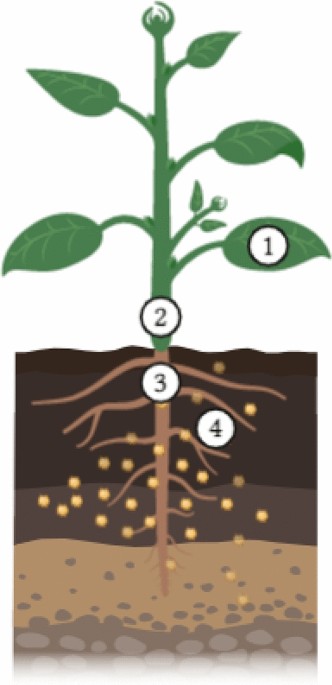
Figure 2. Some phytoremediation mechanisms that could be utilized by sunflower: phytovolatilization, phytodegradation, phytoextraction (Cd, As), phytostimulation (beneficial microbes), phytostabilization, and rhizofiltration – involving plant enzymes and root-driven pollutant removal.
Looking Ahead
Field trials across diverse soil types, climates, and metal mixtures are essential to validate and optimize this partnership. Nevertheless, the genomic and physiological evidence strongly supports H. annuus and R. ornithinolytica as a robust, integrated solution for one of agriculture’s most persistent challenges.
Sometimes the most advanced technology isn’t engineered in a lab—it grows in the soil, powered by an ancient alliance between plants and their microbial partners.
References
Benavides-Bolaños, J. A., Escobar Carreño, M. A., & Méndez Velasco, H. S. (2025). Experimento con girasol y cal dolomítica para modificar la concentración de cadmio en el cacao. Ciencia E Ingeniería Neogranadina, 35(2), 87–103.
Fierros-Romero, G., Chávez‑Avilés, M.N., Hoflack-Culebro, M. et al. Adaptive Genomic Features of Raoultella ornithinolytica LAM1 from the Geothermal Site of Los Azufres Reveal Potential for Heavy-Metal Bioremediation. Curr Microbiol 82, 532 (2025). https://doi.org/10.1007/s00284-025-04507-4
Huaranga Moreno, Félix, Méndez García, Eduardo, Quilcat León, Vito, Bernui Paredes, Feliciano, Costilla Sánchez, Noé, & Huaranga Arévalo, Félix. (2022). Cuantificación de Cu, Pb, A s y Cd absorbidos por el “girasol” Helianthus annus L. (Asteraceae) presentes en suelos agrícolas contaminados por relaves mineros. Arnaldoa, 29(1), 119-136. Epub 00 de septiembre de 2022.https://doi.org/10.22497/arnaldoa.291.29107
Thijs, S., Van Hamme, J., Gkorezis, P., Rineau, F., Weyens, N., & Vangronsveld, J. (2014). Draft Genome Sequence of Raoultella ornithinolytica TNT, a Trinitrotoluene-Denitrating and Plant Growth-Promoting Strain Isolated from Explosive-Contaminated Soil. Genome announcements, 2(3), e00491-14. https://doi.org/10.1128/genomeA.00491-14
Valdiviezo Freire, E. W. ., Verdezoto Vargas, V. H. ., & Ortiz Veloz , H. Y. . (2024). Uso de la planta de girasol (Helianthus annuus L.), con adiciones de ácido húmico y zinc en la fitorremediación de suelos cacaoteros con cadmio. Reincisol., 3(5), 1899–1912. https://doi.org/10.59282/reincisol.V3(5)1899-1912
Follow the Topic
-
Discover Applied Sciences
This is a multi-disciplinary, peer-reviewed journal for the disciplines of Applied Life Sciences, Chemistry, Earth and Environmental Sciences, Engineering, Materials Science and Physics, fostering sound scientific discovery to solve practical problems.

Related Collections
With Collections, you can get published faster and increase your visibility.
Engineering: Intelligent Manufacturing: IoT, AI/ML, Robotics, and Smart Materials in Industry 4.0/5.0
This collection aims to drive transformative innovation in the field of advanced manufacturing by exploring the powerful convergence of emerging technologies such as the Internet of Things (IoT), Artificial Intelligence and Machine Learning (AI/ML), Additive Manufacturing (AM), Shape Memory Alloys (SMAs), and next-generation Robotics. These technologies are reshaping the industrial landscape by enabling intelligent decision making, adaptive production strategies, human–machine collaboration, and seamless connectivity in manufacturing environments.
The objective of the collection is to examine how smart and data-driven manufacturing ecosystems can accelerate product development, enhance customization, improve sustainability, and enable rapid reconfiguration from conceptual design to fully functional product deployment. Emphasis is placed on intelligent materials, cyber-physical production systems, real-time monitoring, predictive maintenance, automated assembly, and closed-loop process optimization.
This collection welcomes high-quality original research articles, case studies, and comprehensive reviews that highlight cutting-edge advancements, practical implementations, and future opportunities in:
Smart factories and Industry 4.0/5.0 manufacturing practices
AI/ML-driven process control, design optimization, and defect analysis
Additive manufacturing innovations, including novel materials and hybrid systems
Application of SMAs and responsive materials in adaptive structures
IoT-enabled sensing, monitoring, and supply chain connectivity
Robotics and automation solutions for efficiency, quality, and human–machine integration
Submissions relevant to sustainable, energy-efficient, and environmentally responsible manufacturing are highly encouraged. Through this interdisciplinary focus, the collection seeks to advance the state of knowledge and support the development of intelligent, scalable, and resilient future manufacturing systems.
This Collection supports and amplifies research related to SDG 6, SDG 7, SDG 8, SDG 9, SDG 11and SDG 12.
Keywords: Advanced Manufacturin; Smart Materials; Internet of Things (IoT); Artificial Intelligence; Machine Learning; Additive Manufacturing; Shape Memory Alloys; Industry 4.0; Smart Factories; Cyber Physical Systems; Predictive Maintenance; Robotics and Automation; Sustainable Manufacturing; Digital Twin Technology; Intelligent Process Optimization
Publishing Model: Open Access
Deadline: Feb 21, 2027
Engineering: Machine Learning, AI, and Deep Learning Applications in Microwave Engineering: Devices and Communication
This Collection is dedicated to highlighting the application of Machine Learning (ML), Artificial Intelligence (AI) and Deep Learning (DL) in the field of Microwave Engineering: Devices and Communication. It will concentrate on AI/ML/DL approaches in Microwave Engineering, which includes new breakthroughs, design and performance techniques of various Microwave Devices like Antennas, Filters, Couplers etc. Starting with single/multiband antennas, this topical collection will showcase the application of AI/ML/DL in the design and/or performance features of wideband to super wideband antennas including Multiple-Input-Multiple-Output (MIMO) antenna structures suited for wireless communication.
It will also focus on the use of AI/ML/DL in various aspects of Terrestrial and/or Satellite-based Microwave Communication: Processes, Algorithms and Protocols.
Publishing Model: Open Access
Deadline: Dec 31, 2026