Explore the Research
 Nature
A news-based climate policy uncertainty index for China - Scientific Data
Scientific Data - A news-based climate policy uncertainty index for China
Realizing the critical importance and urgency to address climate change, countries worldwide have actively participated in global climate governance by formulating and implementing a series of policies. These policies and the associated actions can, however, generate significant uncertainties to the society, leading to a new source of risk that can affect investment decisions, financial stability, and economic development. Measurement of such uncertainties is needed for policymakers and academia to understand the general conditions and investigation potential impacts. As policies may be introduced in different time and across various areas, it is difficult to observe the policy uncertainties directly, therefore, making the accurate measure of such uncertainties difficult.
The recent development of textual analysis and deep-learning technics offer an alternative way to resolve this problem. Following the literature on measuring economic policy uncertainty (EPU), initiated by Scott R. Baker, Nicholas Bloom and Steven J. Davis, textual analysis on newspaper articles has shown to be a useful approach to examining policy uncertainties. Its success has been extended by Gavriilidis (2021) to study the US climate policy uncertainty (CPU). In that paper, eight leading US newspapers are used to construct CPU index for the US. The index has been extensively used in the literature and become a main indicator for understanding the interactions between CPUs and other economic/financial factors in the US.
Being the largest emitter of greenhouse gases and the second largest economy, China’s actions against climate change have un-neglectable impacts on the global outcome. The policies adopted by the Chinese authorities and the associated uncertainties can have equally or perhaps more important implications than the US CPUs. Meanwhile, the demands for a Chinese version of CPU, or CCPU, have been increasing for researchers and policy makers. Despite a few recent attempts to construct the CCPU using for example, social media information, a comprehensive and scientific measure remains unavailable.
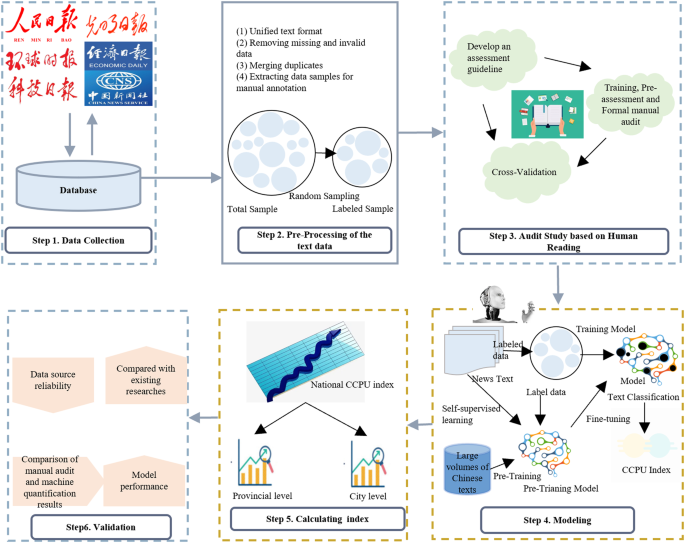
To fill in this gap, our team adopts the similar methodology used by Gavriilidis (2021) to construct a Chinese version of CPU, named as CCPU index. The CCPU index is based on 1,755,826 news articles from six main newspapers in China, namely, the People’s Daily, Guangming Daily, Economic Daily, Global Times, Science and Technology Daily, and the China News Service. These newspapers are normally considered the main official media outlets in China, offering extended official information to the public. Figure 1 provides a general illustration of our research framework, which contains six main steps from data collection, pre-processing, manual auditing, modelling, index construction, and finally to validation.
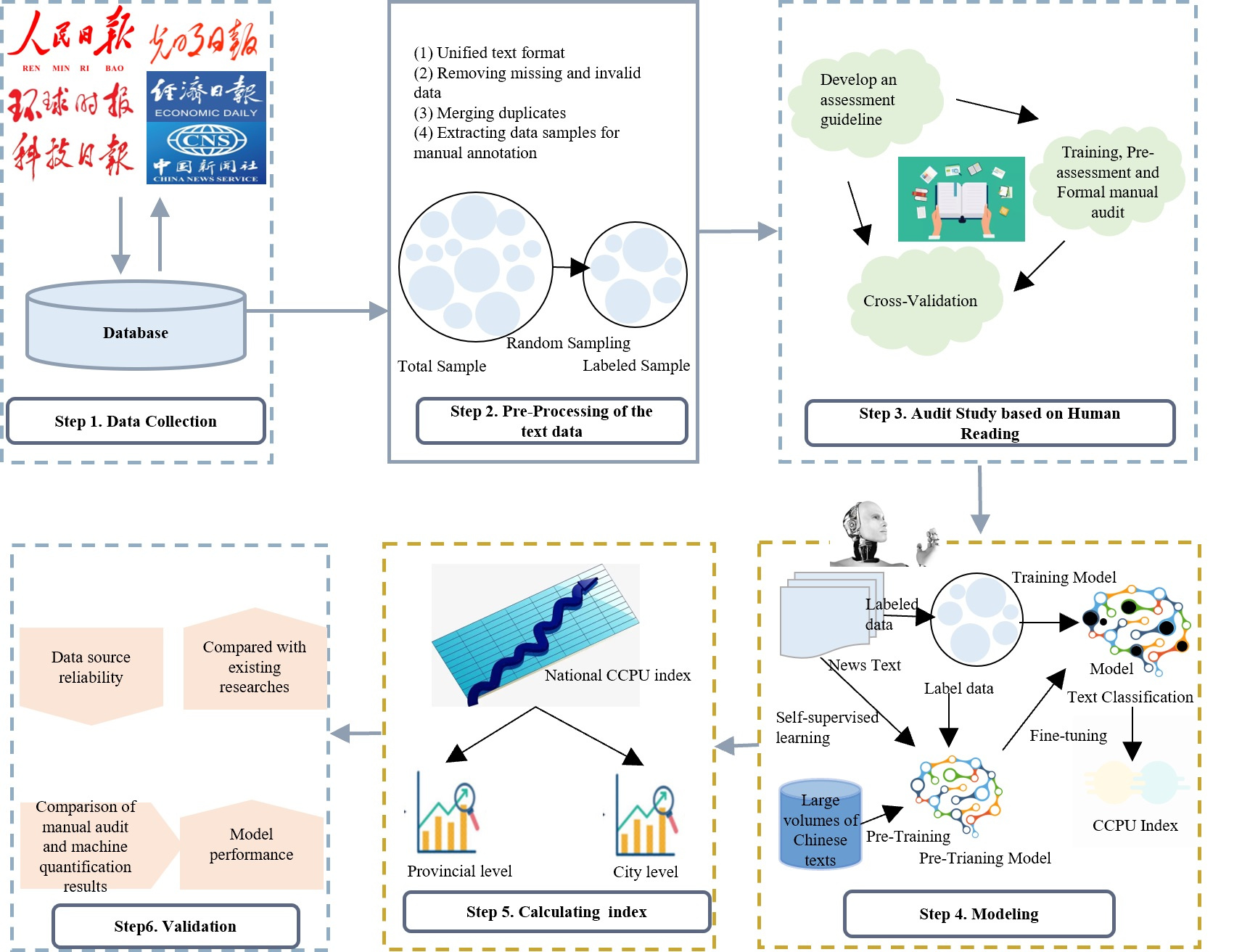
Figure 1. Research framework
One of the main obstacles for the textual analysis is the choice of dictionary. This is especially difficult as the Chinese terms are often more complicated than the English terms, which means direct translation may not be applicable. In other words, using the existing dictionary such as that in Gavriilidis (2011) could be inappropriate in the Chines context, and that is also one of the main problems of the existing attempts. Here in this research, our team combines manual auditing with the MacBERT deep-learning model to solve the problem. The MacBERT model does not depend on existing knowledge or dictionary, instead, it can effectively extract general linguistic patterns and features through deep learning of a large volume of Chinese texts. Together with several rounds of manual auditing by a team of postgraduate students in the field of economics and finance, this CCPU dataset has passed a series validation tests, and thus offers an accurate and reliable measure for relevant studies. Figure 2 plots the national-level CCPU in China. Interestingly, it shows a clear increasing trend of uncertainties, especially in the recent few years.
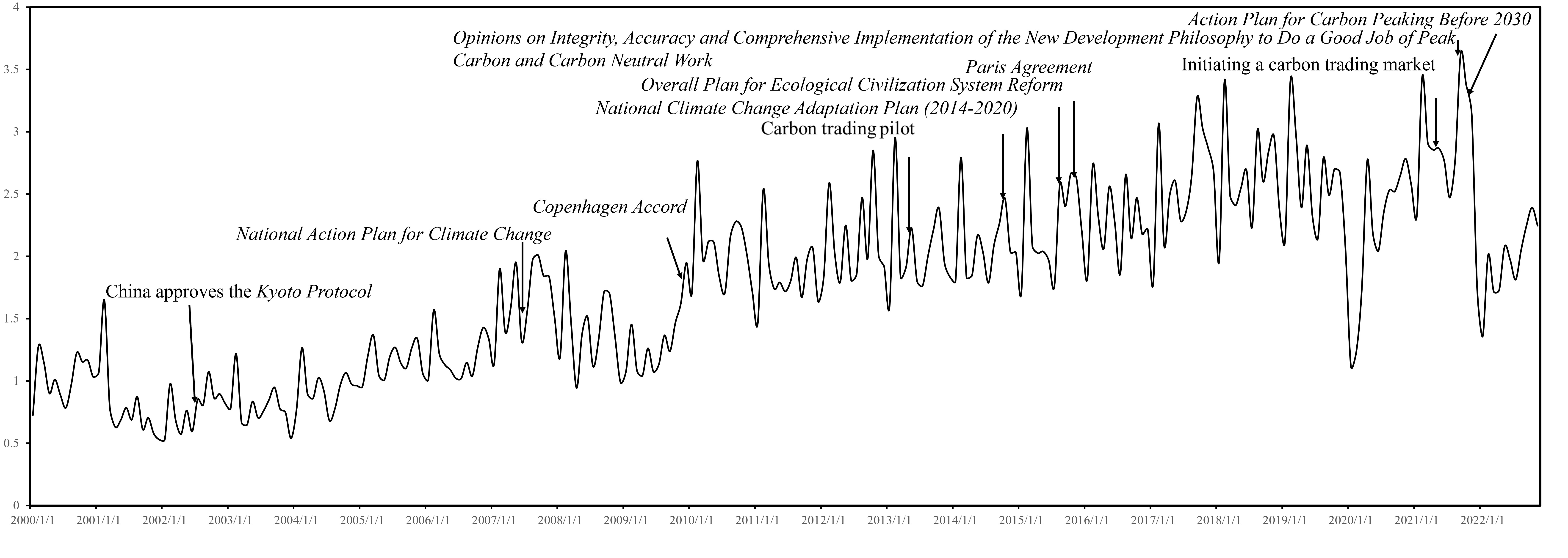
Figure 2. CCPU index at the national level.
Recognizing that climate policies and their associated uncertainties can have significant regional heterogeneity in China, CPU could differ across provinces/cities. In fact, many policies are applied in provincial or city level, for example, the pilot emission trading schemes and green financial policy pilots are applied in a sample of cities/provinces. Significant differences on economic development across provinces and cities in China also give rise to the needs to investigate issues at the regional level. Therefore, our team expands the national-level CCPU index to the provincial and city levels (Figure 3), allowing people to study regional impacts of CPUs.
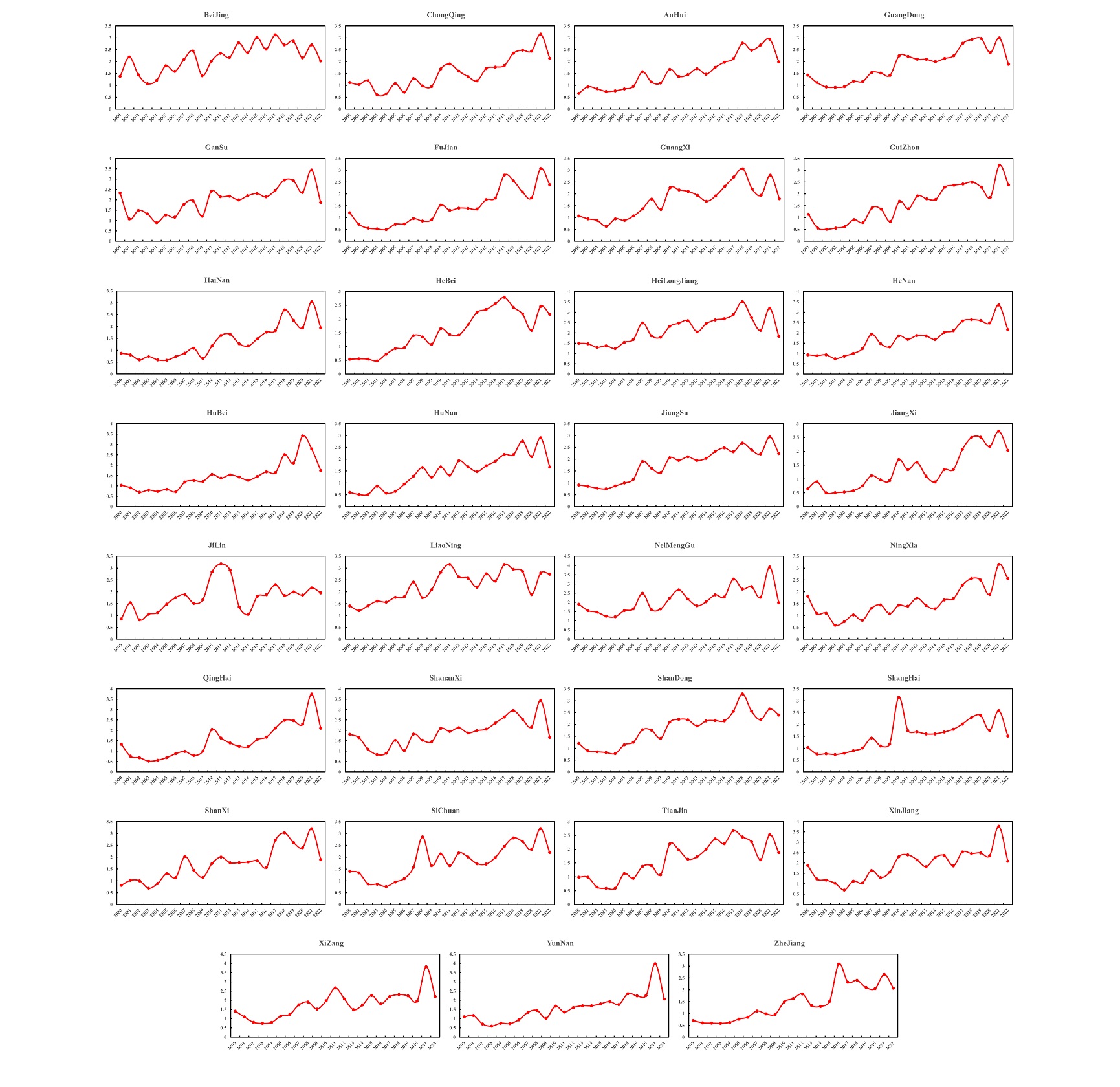
Figure 3. CCPU index at the provincial level.
The CCPU dataset is part of our continuous efforts to explore climate-related issues. We have established the Carbon Neutral and Climate Finance Lab (CNCF), a multi-lateral entity to allow broader collaborations among Chinese institutions and partners from international organizations. One of the main objectives of this lab is to create a open-source database publicly available for studies on climate risks and climate exposures. In addition to the CCPUs, measurements of climate physical risks, and firm-level climate exposures in China, our team also attempts to expand our study to other countries. We also welcome contributors to work together. Please contact us through (jqwxnjq@163.com) for additional information.
Qiang Ji is executive director of the support center for discipline research in Institutes of Science and Development, Chinese Academy of Sciences (ISDCAS). He presides the program supported by Excellent Young Scientists Fund of National Natural Science Foundation of China and is granted the Excellent Member by Youth Innovation Promotion Association of CAS. He has been engaged in research work in the fields of energy strategic management, energy and climate finance, energy forecasting and risk management for a long time. He is the co-founder of China Energy Finance Network, vice president of International Society for Energy Transition Studies and Society for the Studies of Climate Finance. He is a founding editor of Journal of Climate Finance and serves as senior editors and associate editors for over ten energy and financial journals, such as Energy Economics, Finance Research Letters and International Review of Financial Analysis. He has published more than 150 SCI/SSCI indexed articles in peer-reviewed journals and been named in the global “Highly Cited Researchers” lists in year 2021-2023 released by Clarivate Analytics, and “World’s Top 2% Scientists” lists released by Stanford University in year 2020-2023.
Follow the Topic
-
Scientific Data
A peer-reviewed, open-access journal for descriptions of datasets, and research that advances the sharing and reuse of scientific data.

Related Collections
With Collections, you can get published faster and increase your visibility.
10 years of the FAIR principles
Publishing Model: Open Access
Deadline: Nov 14, 2026
Data to support cancer treatment, diagnosis, and disease understanding
Publishing Model: Open Access
Deadline: Jan 02, 2027