A Tale of Three Cities: How an Idea Sparked Across Continents Became a Predictive Model for Protecting Pollination from Air Pollution
Published in Earth & Environment, Plant Science, and Agricultural & Food Science

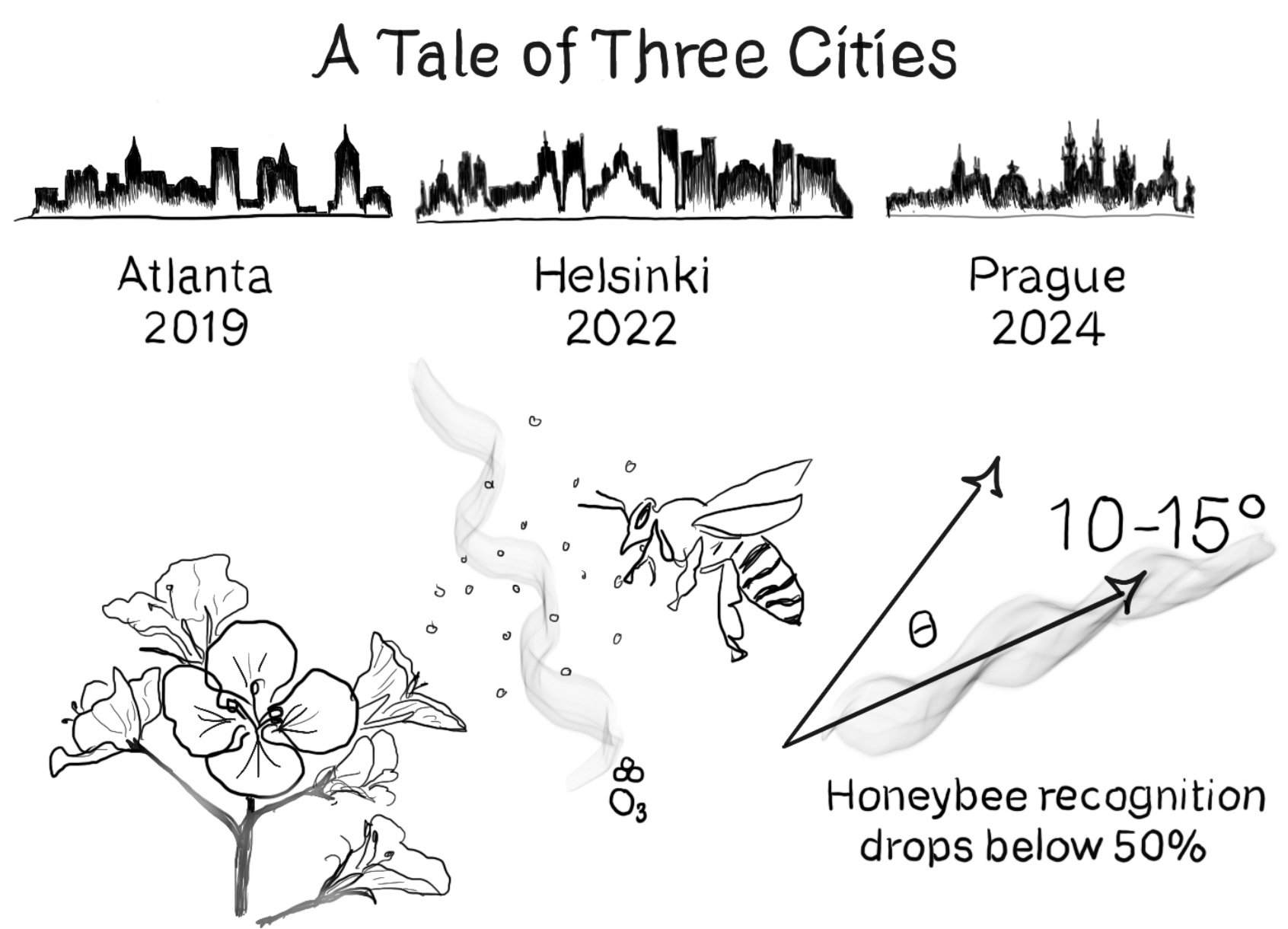
The concept for the paper first emerged in Atlanta in 2019 at the International Society of Chemical Ecology meeting, when Blande, Girling, and Sprayberry first met. There Sprayberry presented work on the Compounds Without Borders (CWB) odour-quantification method; a geometric framework that represents odours in a space defined by the molecular features insects actually encode (carbon chain length, functional groups and cyclic structures). This led to discussions with Girling and Blande exploring whether this perceptual approach could be used to quantify how air pollutants such as ozone degrade floral scents by changing their blends of volatile organic compounds (VOCs) before the scent-signals reach a bee. The atmospheric-chemistry literature documented differential reaction rates between VOCs and pollutants, while behavioural studies showed variable honeybee responses; however, no receiver-focused metric had bridged the two fields.
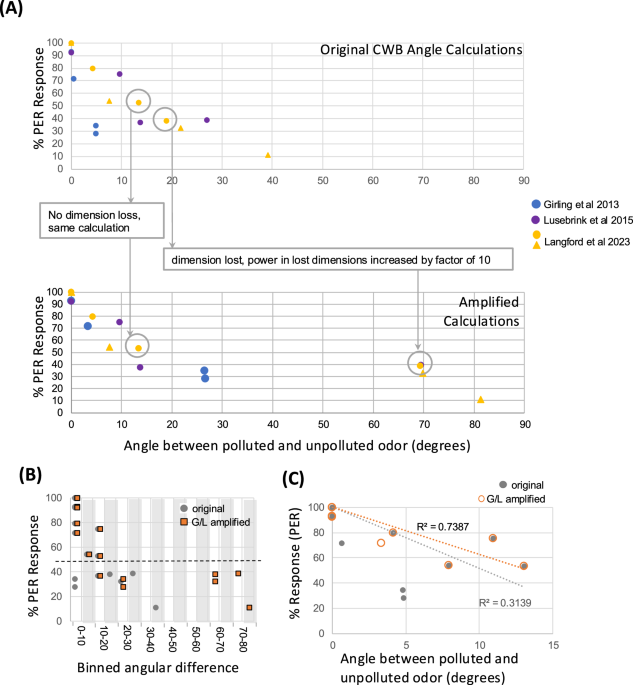
Momentum developed in Helsinki in 2022 at the International Congress of Entomology. Sprayberry, Girling, Ryalls and Blande met in person as a group for the first time and moved the project from theoretical potential to a concrete plan. The group decided to focus the approach on analysing their three published honeybee proboscis-extension datasets containing recreated polluted odours, for which they were able to identify a robust set of reaction-rate constants for the common floral VOCs from the atmospheric chemistry literature, and combine these components for analysis using the CWB framework.
The final development phase occurred at the 2024 International Society of Chemical Ecology meeting in Prague. When Girling and Sprayberry met in person again, the intermittent efforts crystalized into a detailed execution plan. Following that meeting the team held extended remote working sessions across four time zones, inviting Langford (a long time collaborator with Girling and Ryalls) for his expertise in atmospheric chemistry, to refine the CWB-method for honeybees . The honeybee antennal lobe relies heavily on lateral inhibition, so the loss or gain of any molecular-feature dimension exerts a stronger influence than simple ratio changes. The team therefore introduced gain/loss amplification (CWB_GLA), increasing the power of any newly absent or added dimension by an order of magnitude before calculating the angular distance between vectors. Re-analysis of the three independent datasets produced a clear, consistent result: when the perceptual angular shift exceeds approximately 10–15°, honeybee recognition (measured by proboscis-extension response) falls below 50 % and does not recover. A single, reproducible disruption threshold emerged across studies, pollutants and odour blends.
The honeybee-model was then applied to the floral VOC profiles of four major honeybee-pollinated crops using published ozone and hydroxyl-radical reaction rates. Outcomes were distinctly crop-specific:
- Canola (Brassica napus) crossed the 15° threshold within minutes at moderate pollution levels, rendering its scent effectively undetectable in perceptual space downwind.
- White mustard (another member of the Brassicacae) followed a similar rapid trajectory.
- Strawberry and white mustard diverged in an instructive way: conventional VOC-ratio analysis indicated faster change in strawberry, yet CWB_GLA showed mustard reaching the perceptual threshold first because its lost molecules occupied more distinct feature dimensions.
- Apple remained highly stable even under elevated ozone concentrations.
The resulting framework offers a practical forecasting tool. Identifying which crops may face the greatest risk allows commensurate identification of locations where mitigation measures (such as buffer zones, low-emission corridors or cultivar selection) could deliver the largest benefit to pollination services. This framework could be simply expanded to other crops just by recording the composition of their floral scents.
This paper exists because five researchers from five countries and three continents maintained a shared idea across time zones, conferences and a global pandemic. It exists because atmospheric chemists, chemical ecologists and neuroethologists collaborated across disciplinary boundaries. The three cities supplied the foundation; subsequent development now rests with the broader scientific community through application and extension to additional crops, pollinators, nocturnal systems and combined stressors.
Code and full datasets have been released openly in the supplementary materials to enable others to test and adapt the approach. Researchers engaged in odour-plume dynamics, sensory ecology or air-quality impacts on ecosystems are encouraged to explore the model’s performance in their own systems.

Follow the Topic
-
Communications Earth & Environment
An open access journal from Nature Portfolio that publishes high-quality research, reviews and commentary in the Earth, environmental and planetary sciences.

Related Collections
With Collections, you can get published faster and increase your visibility.
Ecological resistance and resilience under global change
Publishing Model: Open Access
Deadline: Apr 07, 2027
Hazards in Mountain Regions
Publishing Model: Open Access
Deadline: Nov 02, 2026