Adaptive constraints by morphological operations for single-shot digital holography
Published in Physics

Introduction
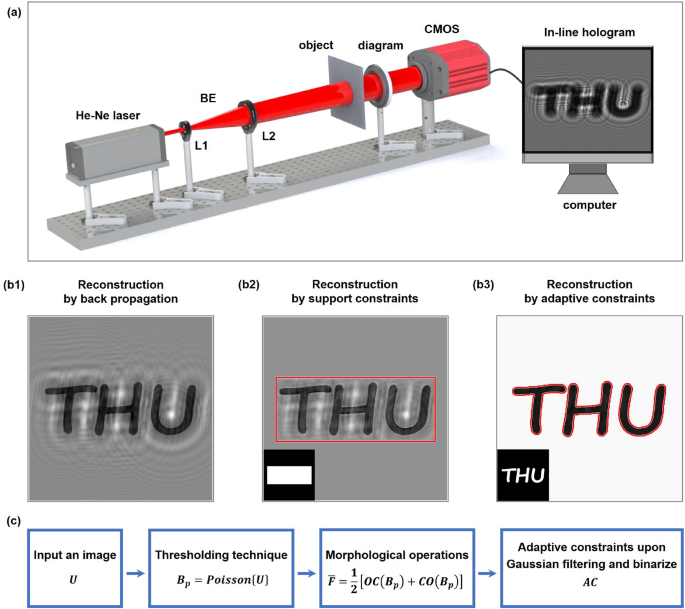
Digital holography refers to digital record of holograms and numerical reconstruction by means of diffraction theory, providing access to quantitative measurement of the entire complex field. Based on Gabor’s holography, the in-line digital holography has emerged as an attractive holographic configuration, where the axes of the diffracted object wave and the reference wave are parallel [1]. Although the in-line setup (Figure. 1) endows with full bandwidth utilization and high phase sensitivity, the quality of reconstructed images is susceptible to the overlapping out-of-focus twin-image artifact (Figure. 2a) [2]. As a key ingredient of in-line digital holography, the emerging iterative phase retrieval approach enables to recover a complex-valued signal only from the given holograms and physical constraints [3].
The GS-based phase retrieval algorithms are commonly used for digital holographic reconstruction, which exploit back-and-forth propagation between different planes and embed physical constraints like support [4] into iteration to avoid local convergence during iteration. However, objects with complex morphological structures may cause a less than perfect estimation of the support. Another iterative phase retrieval method utilizes multiple captured holograms serving as amplitude constraints to generate well-behaved reconstructions. Unfortunately, the achievable of a stable and accurate reconstruction is strongly enslaved to high-precision controllable devices, slow convergence rate, great quantities of holographic data and iterations.
In this work, we propose an advanced iterative phase retrieval framework with single-shot in-line hologram. Such framework provides an efficient and appropriative estimation of the object support, which is embedded into the iterative process as adaptive constraints to improve the reconstruction quality and accelerate the convergence speed.
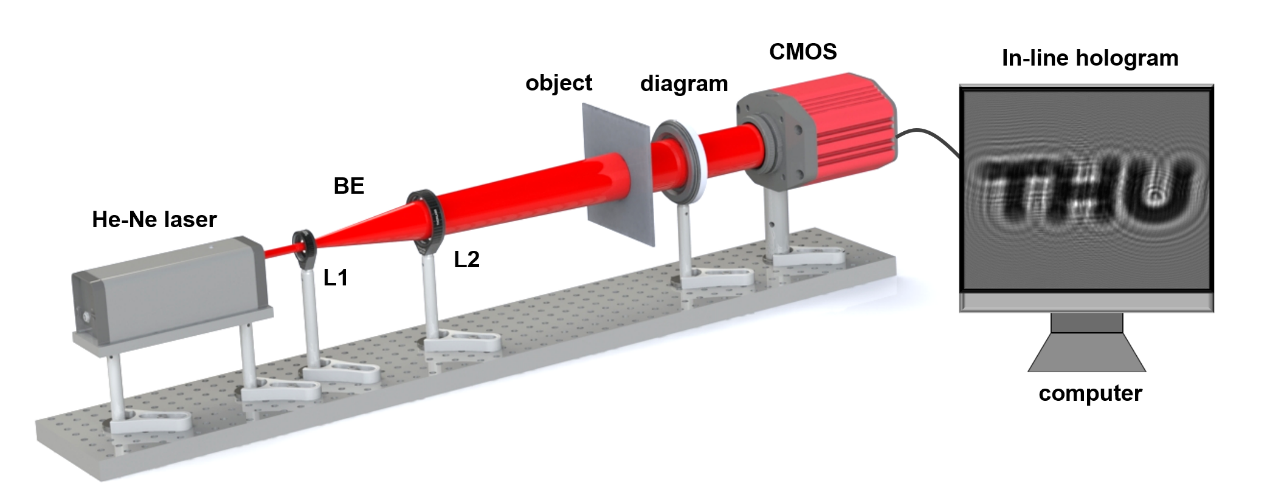
Figure 1 Optical configuration of an in-line holographic imaging system. BE, beam expander; L1-L2, lenses.
Methods
In our proposed scheme, an in-line digital holographic imaging configuration characterized by portability, low cost and high space-bandwidth product is considered to capture an intensity pattern. Adaptive constraints are generated according to the image on the object plane obtained by back-propagating from the captured hologram, adopting the Poisson distribution-based thresholding technique [5] and morphological operations including erosion and dilation. In conjunction with morphological operations which can extract the object structure while eliminating the irrelevant part such as artifacts and noise, adaptive constraints allow the support region to be accurately estimated and automatically updated at each iteration. The wave field propagating in the free space during the iteration process between the sensor plane and the object plane is calculated by the angular spectrum method [6]. The square root of a single captured intensity pattern is used to update the modulus of the diffracted wave field in the sensor plane, and the adaptive constraint updated iteratively is applied to confine the object wave field. Reconstruction by support constraints (Figure. 2b) enables to suppress artifacts outside the boundaries, but artifacts distributed within the support region still preserve, which significantly obfuscates the reconstruction. By contrast, reconstruction by adaptive constraints (Figure. 2c) obviously enhances the accuracy and efficiency of extracting the relevant image structures, and completely removes disturbance of twin-image artifacts.

Numerical calculation
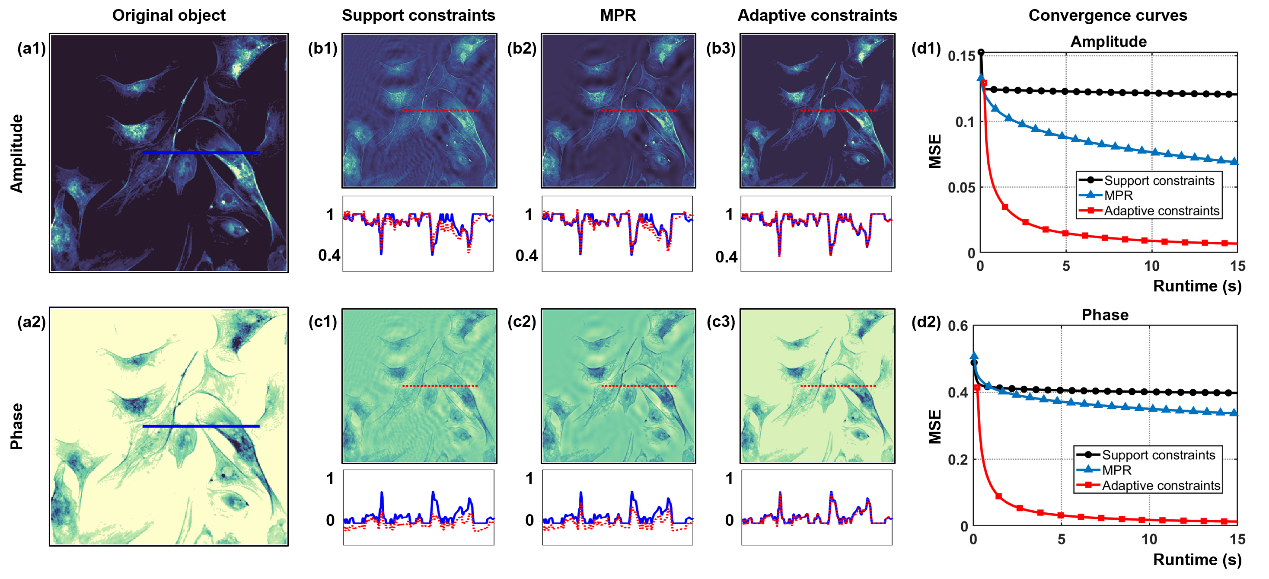
For the purpose of verifying the improvement effect of employing adaptive constraints in the iterative phase retrieval, we investigate the comparison of reconstruction quality and convergence behavior with multi-distance phase retrieval (MPR), support and adaptive constraints (Figure. 3). The convergence behavior of reconstruction is described by the mean square errors (MSEs). It is demonstrated that incorporating adaptive constrains into the iterative phase retrieval exhibits optimized convergence behavior, high-fidelity and twin-image-free reconstruction. In addition, white Gaussian noises under different signal to noise ratio (SNR) are added to the simulated hologram to evaluate the noise immunity of applying adaptive constraints. It is confirmed that enforcing adaptive constrains on the object plane has a better noise tolerance.
Experimental demonstration
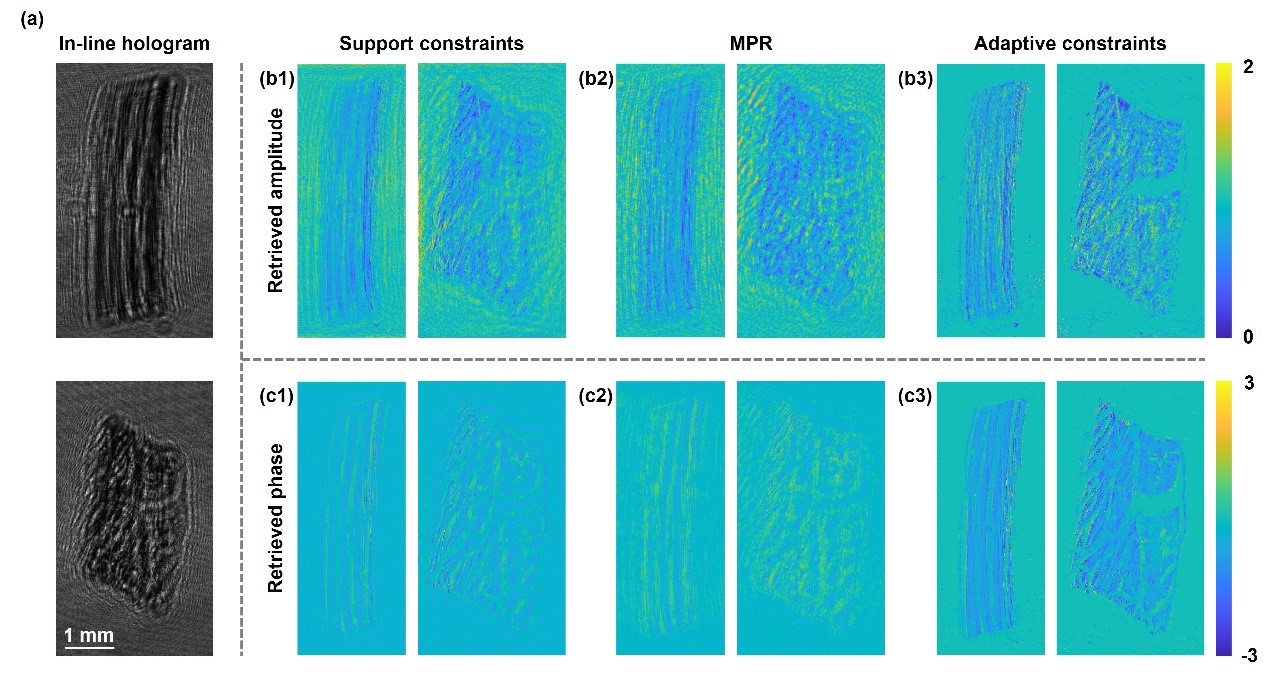
We go further to experimentally confirm the improved reconstruction performance of our proposed method by imaging the skeletal muscle cells sandwiched between glass plates (Figure. 4). By comparison, we can notice that imposing adaptive constraints enables to bring out a more distinguishable structure from an overwhelming incident light background, resulting in a better image contrast.
Perspectives
The proposed advanced iterative phase retrieval framework for single-shot in-line holographic imaging that incorporates adaptive constraints is demonstrated numerically and experimentally, which achieves high-fidelity reconstruction and optimizes convergence performance. Such flexible and versatile framework may better facilitate applications in biomedicine, X-ray coherent diffractive imaging and wavefront sensing.
References
[1] Schnars, U. & Jüptner, W. P. O. Digital recording and numerical reconstruction of holograms. Meas. Sci. Technol. 13, R85–R101 (2002).
[2] Latychevskaia, T. & Fink, H.-W. Solution to the twin image problem in holography. Phys. Rev. Lett. 98, 233901 (2007).
[3] Latychevskaia, T. Iterative phase retrieval for digital holography: tutorial. J. Opt. Soc. Am. A 36, D31–D40 (2019).
[4] Fienup, J. R. Reconstruction of a complex-valued object from the modulus of its Fourier transform using a support constraint. J. Opt. Soc. Am. A 4, 118-123 (1987).
[5] Al-Kofahi, Y., Lassoued, W., Lee, W. & Roysam, B. Improved automaticdetection and segmentation of cell nuclei in histopathology images. IEEE Trans Biomed Eng. 57, 841–852 (2010).
[6] Goodman, J. W. Introduction to Fourier Optics. 3rd Edition (Greenwoood Village: Roberts and Company Publishers, 2005).

Follow the Topic
-
Scientific Reports
An open access journal publishing original research from across all areas of the natural sciences, psychology, medicine and engineering.

Related Collections
With Collections, you can get published faster and increase your visibility.
Cancer Prevention and Control
Publishing Model: Hybrid
Deadline: Feb 19, 2027
Healthy Aging
Publishing Model: Open Access
Deadline: Dec 31, 2026