Advanced Synthesis of Trimethylene Carbonate: a High-yield Green Route
Published in Bioengineering & Biotechnology, Chemistry, and Sustainability


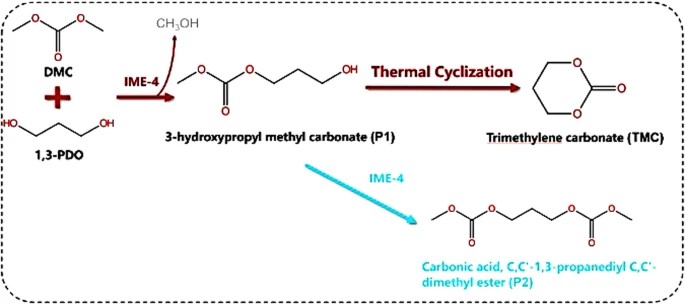
Trimethylene carbonate (TMC) is an innovative modifier for polylactic acid and a promising biodegradable polymer monomer with broad application potential. However, industrial production of TMC faces challenges such as high catalyst costs, safety issues, and environmental impacts. Enzymatic catalysis offers a potential alternative, but its low product yields have hindered progress. In this study, we introduce a novel synthesis route for TMC using bio-based 1,3-propanediol (1,3-PDO) and dimethyl carbonate (DMC) as substrates. This process involves lipase-catalyzed formation of the intermediate 3-hydroxypropyl methyl carbonate (P1), which is then cyclized to produce TMC. Notably, the by-product, C,C’-1,3-propanediyl C,C’-dimethyl ester (P2), reacts with 1,3-PDO to regenerate P1, further enhancing the overall TMC yield. The mechanism exploration reveals that 1,3-PDO acts as both a reactant and an acid catalyst, initiating a nucleophilic substitution reaction on P2 to produce P1. Under optimized conditions, we achieved a total TMC yield of 88%, the highest reported to date.This study provides a novel green synthesis route for TMC that holds great promise for industrial application, given its safer conditions and competitive yields.
Cite this article: Ning Z, Li Y, Dai L, Liu D, Du W. Advancing the synthesis of trimethylene carbonate: a high-yield green synthesis route. Bioresour. Bioprocess. 12, 38 (2025). https://doi.org/10.1186/s40643-025-00877-6

Follow the Topic
-
Bioresources and Bioprocessing

This journal aims at providing an international academic platform for exchanging views on and promoting research to support bioresource development, processing and utilization in a sustainable manner.
What are SDG Topics?
An introduction to Sustainable Development Goals (SDGs) Topics and their role in highlighting sustainable development research.
Continue reading announcement
Please sign in or register for FREE
If you are a registered user on Research Communities by Springer Nature, please sign in