Association Between NOS1 Gene Polymorphisms and Schizophrenia in Asian and Caucasian Populations: A Meta-Analysis

Schizophrenia is a chronic psychiatric disease characterized by cognitive impairments with delusions and hallucinations. Both genetic and environmental factors play a crucial role. Several investigations have focused on determining the association between NOS1 and the risk of schizophrenia.
Association Between NOS1 Gene Polymorphisms and Schizophrenia in Asian and Caucasian Populations: A Meta-Analysis
Like

Share this post

Choose a social network to share with, or copy the URL to share elsewhere

This is a representation of how your post may appear on social media. The actual post will vary between social networks

Explore the Research

SpringerLink
SpringerLink SpringerLink

Association Between NOS1 Gene Polymorphisms and Schizophrenia in Asian and Caucasian Populations: A Meta-Analysis - NeuroMolecular Medicine

Schizophrenia is a complex psychiatric disorder characterized by memory impairments with delusions and hallucinations. Several investigations have focused on determining the association between NOS1 (nitric oxide synthase-1) polymorphisms and risk of schizophrenia (SZ). However, the association of rs2682826, rs3782206, rs499776, rs3782219, rs41279104, rs3782221, rs1879417, rs4767540, rs561712, and rs6490121 polymorphisms with schizophrenia remains inconclusive. We performed a systematic meta-analysis for each polymorphism to determine its association with SZ by calculating their pooled odds ratio and 95% confidence intervals. The heterogeneity between studies was evaluated using Cochran’s Q test to adopt random effects or fixed effects model. Based on our analysis, the rs3782206 polymorphism showed a strongest association with schizophrenia in allelic OR 1.15 (95% CI [1.05–1.25]), homozygote OR 1.35 (95% CI [1.09–1.66]), dominant OR 1.16 (95% CI [1.04–1.29]), and recessive OR 1.29 (95% CI [1.05–1.58]) models in Asian population. Similarly, in Caucasian population, the rs499776 polymorphism attributes risk association in homozygote OR 0.70 (95% CI [0.50–0.98]), dominant OR 3.57 (95% CI [2.34–5.27]), and recessive models OR 0.68 (95% CI [0.50–0.93]) with schizophrenia. Further, the sensitivity analysis was carried out based on leave-one-out method to confirm the reliability of the analysis. Overall, our meta-analysis demonstrates the significance of NOS1 genetic variants that are functionally associated with cognitive and neuropsychiatric symptoms of schizophrenia.

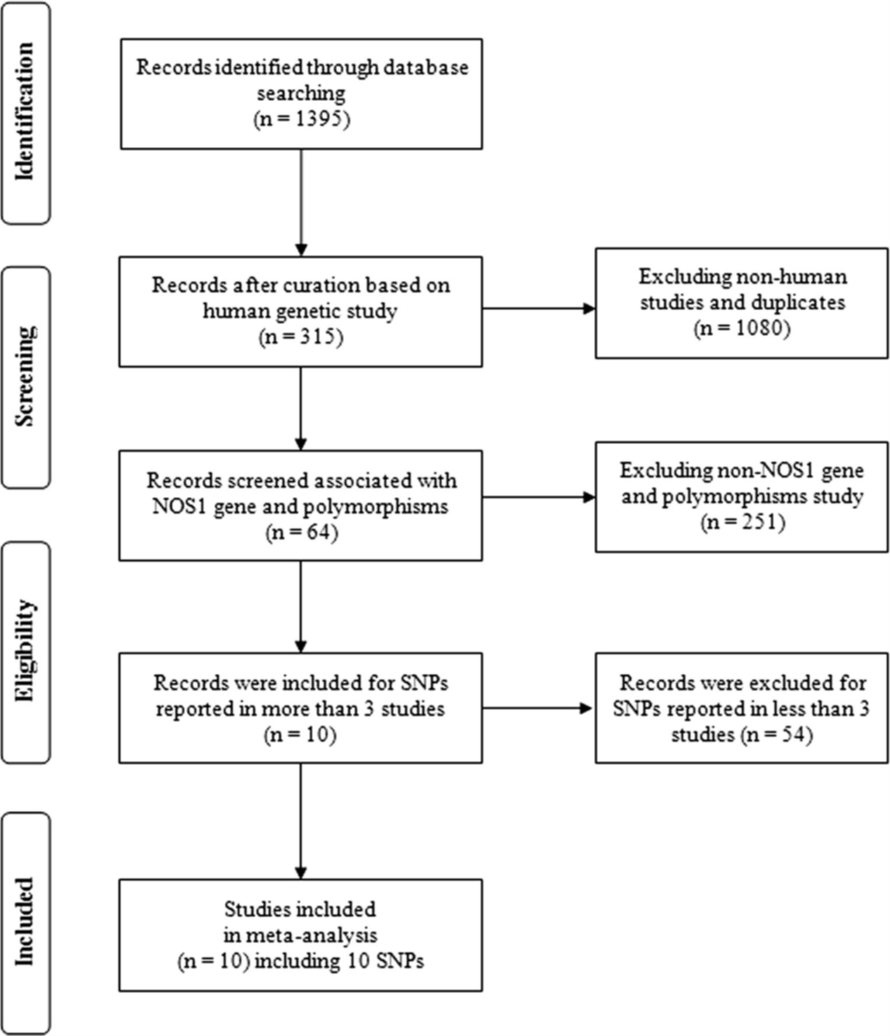
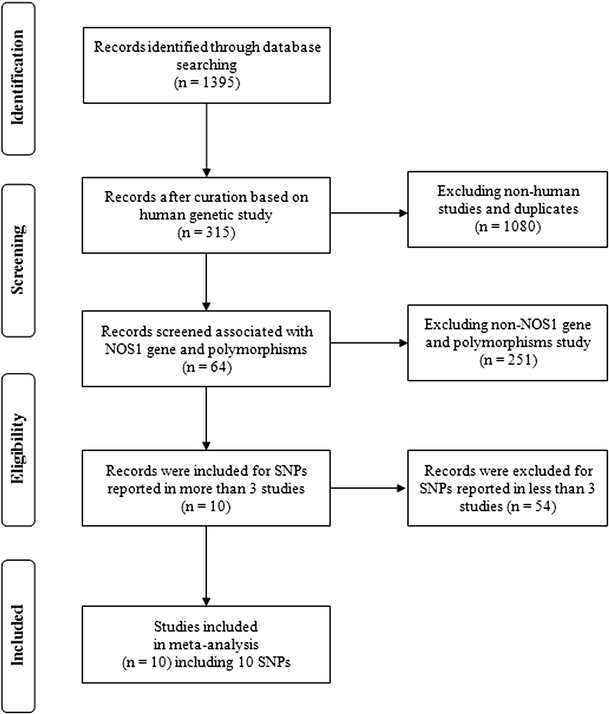
In this meta-analysis, we have collected the literature related to the 10 polymorphisms of the NOS1 gene to demonstrate its potential links with the risk of schizophrenia. Our analysis suggested that the rs41279104, rs3782206, rs3782221, rs499776, and rs6490121 polymorphisms confer susceptibility to schizophrenia, which may help in the screening of high-risk individuals. Further, stratification based on the ethnic group of rs3782206 polymorphism showed a significant risk association in the Asian population, whereas rs499776 polymorphism was found to be associated with increased risk of schizophrenia in the Caucasian population. Further, larger cohorts with well-designed case–control studies are required to overcome limitations and to validate our conclusion.