Asymmetric Side‑Group Engineering of Nonfused Ring Electron Acceptors for High‑Efficiency Thick‑Film Organic Solar Cells
Published in Bioengineering & Biotechnology, Chemistry, and Materials
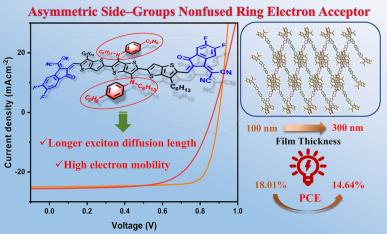

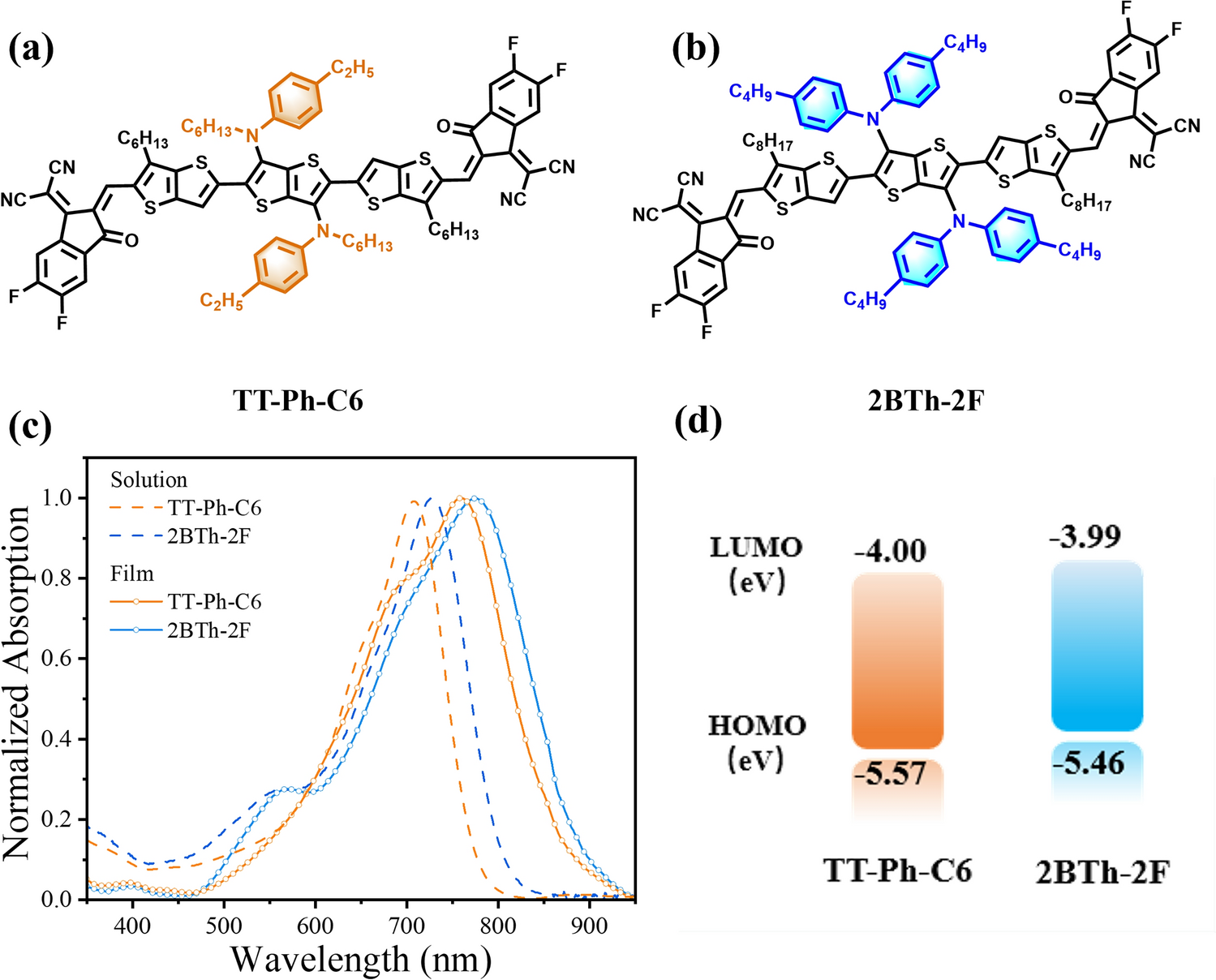

As demand for low-cost, printable photovoltaics grows, nonfused ring electron acceptors (NFREAs) are attractive because they skip lengthy ring-closure steps, but their film-thickness tolerance and fill factors still lag behind fused-ring counterparts. Now, researchers from Beijing Normal University and Qingdao University, led by Prof. Zhishan Bo, Prof. Cuihong Li, Prof. Yahui Liu and Prof. Hao Lu, present an asymmetric side-group strategy that delivers a record FF of 80.1 % and maintains >14 % efficiency even at 300 nm active-layer thickness—setting new performance benchmarks for thick-film NFREA devices.
Why TT-Ph-C6 Matters
- Highest Fill Factor: 80.1 % is the highest FF reported for NFREA-based OSCs.
- Exceptional Thick-Film Tolerance: 15.18 % PCE at 200 nm and 14.64 % at 300 nm—among the highest efficiencies for non-fused acceptors.
- Scalable Synthesis: Five-step, high-yield route avoids costly ring-closure reactions.
Innovative Design & Features
- Asymmetric Phenylalkylamino Side Chains: Enhance solubility and promote compact 3-D π-stacking (dπ–π = 3.21 Å) with multiple S···O/N locks.
- Balanced Charge Transport: Electron mobility reaches 2.48 × 10⁻⁴ cm2 V-1 s-1; μe/μh ≈ 1 in thick films preserves Jsc and FF.
- Extended Exciton Diffusion: 17.2 nm diffusion length (versus 13.4 nm for symmetric control) and 91.2 % hole-transfer efficiency suppress recombination.
Applications & Future Outlook
- Green Processing: Devices fabricated from o-xylene without halogenated additives.
- Roll-to-Roll Potential: Team is scaling wide-strip coating toward metre-length flexible modules.
- Next Steps: Asymmetric side-chain library will be expanded for tandem and low-energy-gap applications.
This molecular design strategy offers a cost-effective pathway to high-efficiency, thick-film organic solar cells and underscores the importance of side-chain engineering in next-generation photovoltaics. Stay tuned for more breakthroughs from Prof. Bo, Prof. Li, Prof. Liu and Prof. Lu’s groups!

Editor of Nano-Micro Letters, which is an Open-Access, peer-reviewed journal reported papers that have at least one dimension ranging from a few sub-nanometers to a few hundreds of micrometers. The journal is published by Springer Nature and indexed by SCI, EI, SCOPUS, Pubmed, etc. The 2025 JCR Impact Factor is 38.5. The 2025 CiteScore is 58.9.
Follow the Topic
-
Nano-Micro Letters
Nano-Micro Letters is a peer-reviewed, international, interdisciplinary and open-access journal that focus on science, experiments, engineering, technologies and applications of nano- or microscale structure and system in physics, chemistry, biology, material science, and pharmacy.