Behind the Paper: From Hostile Classrooms to Curious Ones — The Story Behind the VIBE Framework
Published in Education and Mathematics


Mathematics is often described as objective, universal, and independent of culture. My experience as both a student and an educator has taught me something very different: how mathematics is experienced depends enormously on the learning environment surrounding it.
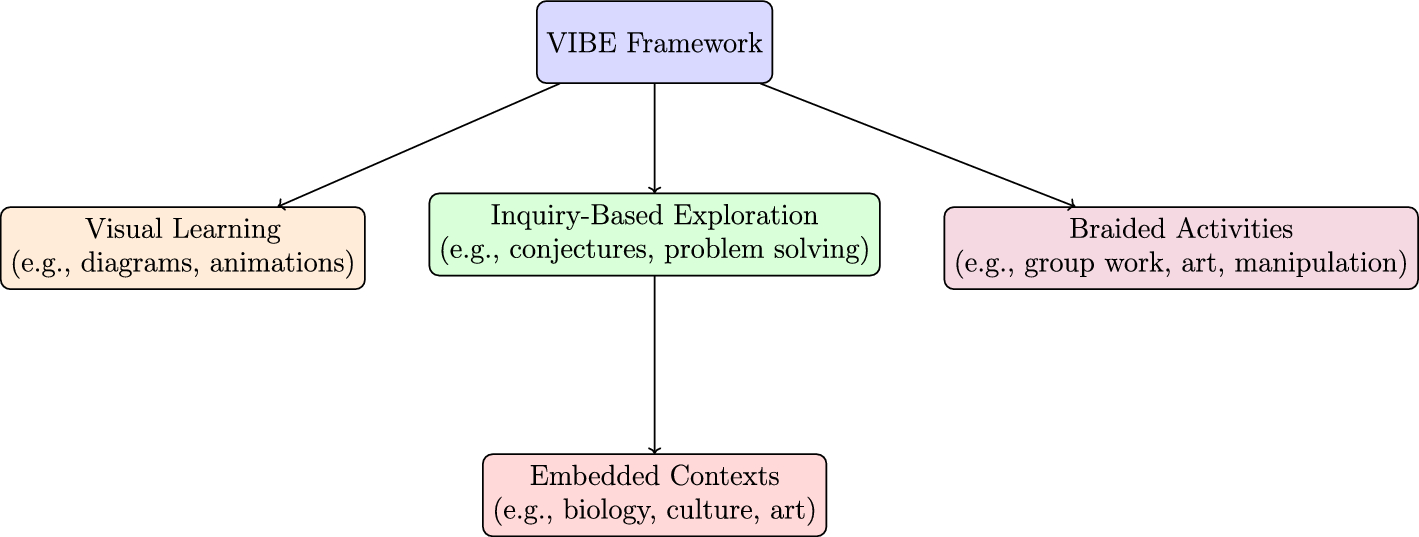
The VIBE Framework (Visual–Inquiry–Braided–Embedded), recently published in Discover Education, did not begin as an abstract pedagogical theory. It emerged slowly, shaped by personal experiences across three very different academic cultures, by my work as a topologist, and by an unexpected push from colleagues during my University Teaching Qualification (UTQ) journey at Maastricht University.
This post is the story behind that paper.
Learning mathematics in a hostile environment
As an undergraduate student in Greece, mathematics often felt like a battlefield.
The environment was intensely competitive and, at times, discouraging. Large lecture halls, minimal interaction, and an implicit expectation that only a small fraction of students would succeed created a culture where struggling was almost synonymous with failure. Questions were not always welcomed. Confusion was something to hide rather than explore.
Many students survived by memorizing techniques rather than understanding ideas.
I remember thinking that mathematics itself could not possibly be as inaccessible as it sometimes appeared in the classroom. When I later began teaching private tutorials, I noticed something surprising: students who were labeled “weak” or “not mathematical” often understood complex ideas quickly when given time, visual explanations, and encouragement to ask questions.
That realization stayed with me.
Competition and precision in China
Years later, teaching in China exposed me to a completely different academic culture.
The environment there was not hostile; it was highly driven and extraordinarily competitive. Students were hardworking, disciplined, and deeply respectful of knowledge. Expectations were high, both from institutions and from students themselves.
What struck me most was the pace.
Students could execute technical procedures with impressive speed and accuracy. Yet even in such strong academic settings, I occasionally encountered the same phenomenon I had observed earlier: students mastering methods without always feeling ownership of the ideas behind them.
The question returned again:
How can mathematics become something students explore rather than something they merely execute?
Discovering a different philosophy in the Netherlands
Moving to the Netherlands introduced me to yet another perspective.
At Maastricht University, problem-based learning places discussion, collaboration, and inquiry at the center of education. Students challenge each other’s reasoning. Facilitators guide rather than dominate conversations.
For someone trained in more hierarchical educational systems, this was initially surprising (even disorienting).
Students openly questioned assumptions.
They debated. They experimented.
And something remarkable happened: understanding often emerged collectively.
I began to see how strongly learning environments shape intellectual confidence. When students feel safe to explore uncertainty, curiosity replaces anxiety.
This contrast between my experiences in Greece, China, and the Netherlands became one of the strongest motivations behind the VIBE Framework.
A topologist thinking about education
My research background is in topology, the mathematics of shapes, structures, and relationships. Topologists rely heavily on visualization. Knot diagrams, surfaces, and transformations are not merely illustrations; they are thinking tools.
In topology, drawing is reasoning.
Students encountering knot theory for the first time often experience a moment of surprise. Suddenly mathematics is not just symbols on a page but something tangible they can manipulate and observe.
I began asking myself:
Why should visualization be reserved for advanced mathematics?
Why not start there?
The visual intuition that helps researchers understand complex structures could also help beginners approach abstraction with confidence.
The unexpected role of the UTQ
Interestingly, the VIBE Framework might never have become a published paper without the University Teaching Qualification (UTQ).
During the UTQ process at Maastricht University, educators are encouraged to reflect critically on their teaching philosophy and classroom practice. What initially felt like an administrative requirement became an opportunity for deep reflection.
I started documenting what I had been doing intuitively for years:
-
beginning with visual exploration,
-
encouraging inquiry before formal definitions,
-
connecting topics across courses,
-
embedding mathematics within meaningful contexts.
A colleague reviewed my work and said something simple but decisive:
“You should publish this”.
At first, I hesitated. As a research mathematician, publishing typically meant knot theory, braids, or algebraic structures, not pedagogy. But the more I reflected, the clearer it became that teaching innovation also deserves scholarly discussion.
The paper grew directly from that encouragement.
What VIBE means in practice
The framework combines four ideas.
- Visual learning emphasizes diagrams, patterns, and intuition before formal symbolism.
- Inquiry invites students to ask questions and test ideas rather than passively receiving conclusions.
- Braided learning connects topics instead of isolating them into separate chapters.
- Embedded learning situates mathematics within meaningful contexts and applications.
None of these ideas are entirely new on their own. What VIBE attempts to do is weave them together into a coherent structure informed by classroom experience.
In practice, this might mean asking students to manipulate diagrams before introducing definitions, encouraging group exploration before presenting proofs, or connecting topology with data science or economics to demonstrate relevance.
Moments that convinced me
Some of the strongest confirmation came from small classroom moments.
Students who rarely spoke began leading discussions.
Groups argued passionately about whether two diagrams represented the same structure.
Mistakes turned into starting points for discovery rather than embarrassment.
One student once remarked after a session:
“I didn’t realize mathematics could feel creative”.
For a mathematician, that sentence is unforgettable.
Looking forward
Publishing in Discover Education is not the end of the story. It represents an invitation to continue the conversation about how mathematics can be taught differently across cultures and disciplines.
The VIBE Framework continues to evolve through classroom experimentation, student feedback, and collaboration with colleagues interested in teaching innovation.
Educational systems differ widely across countries, and no single approach fits every context. But my journey through very different academic cultures convinced me of one thing:
Students do not fear mathematics itself.
They fear environments where curiosity feels risky.
If we can create classrooms where exploration is encouraged and understanding grows collectively, mathematics becomes something very different.
Not a barrier. But an invitation.

Follow the Topic
-
Discover Education
An international, peer-reviewed open access journal that publishes original work in all areas of education, serving the community as a broad-scope journal for academic trends and future developments in the field.

Related Collections
With Collections, you can get published faster and increase your visibility.
Beyond the Tool: Technology-Enhanced Pedagogical Innovation in Active Learning
The integration of emerging technologies into the classroom has created a paradigm shift in education, yet the academic focus has often remained on the tools themselves rather than their underlying pedagogical application.
This Collection, "Beyond the Tool: Technology-Enhanced Pedagogical Innovation in Active Learning," seeks to bridge this gap by prioritizing pedagogical excellence and student-centered frameworks as the foundation for technological adoption. The core objective is to investigate how modern technological tools—with a primary focus on Generative Artificial Intelligence (GenAI)—can be strategically woven into established active learning methodologies, such as Project-Based Learning (PBL), Story-based Learning, Flipped Classroom, and Challenge-Based Learning. We aim to move the conversation forward: instead of viewing technology as a mere add-on, weexplore it as a sophisticated "scaffolding" mechanism that enhances cognitive engagement, facilitates personalization, and scales human-centric teaching.
While traditional active methodologies are highly effective, they often face challenges regarding scalability and real-time assessment. This Collection showcases how technology-driven integration can overcome these hurdles, fostering metacognition and enabling authentic assessment practices that were previously resource-intensive.
We invite original research, systematic reviews, and evidence-based case studies that address the practical and ethical integration of contemporary technologies within active learning environments. By focusing on the transformation of teaching practices and the development of higher-order thinking skills, this Collection provides a timely and necessary contribution to the educational sciences, ensuring that technological innovation serves the ultimate goal of inclusive and high-quality education (SDG 4).
Publishing Model: Open Access
Deadline: Jan 04, 2027
Advancing Teaching & Learning: Integrating AI, Emerging Technologies, and Pedagogical Innovation
Collection "Advancing Teaching & Learning: AI, Emerging Technologies and Pedagogical Innovation" addresses a major challenge in education today. There is a lack of resources that bring advanced technologies and innovative teaching together. AI, digital tools and emerging technologies are transforming classrooms. Yet many teachers and education leaders struggle to use these tools effectively. This Collection fills that gap. It offers expert insights, practical strategies and real-world examples for modern teaching and learning.
The Collection is linked to the United Nations Sustainable Development Goal 4 on quality education. It shows how to make learning more accessible, inclusive and effective for all. AI, adaptive learning platforms and immersive technologies can personalise instruction. They can engage students and support diverse needs. At the same time, the human element of teaching remains central.
Readers will find practical guidance on curriculum design, digital literacy and evidence-based teaching methods. The approaches can be applied in classroom, blended and online learning. Beyond tools, the Collection inspires educators to rethink traditional methods. It encourages them to embrace innovation while keeping learning meaningful and student-focused.
By addressing the lack of comprehensive resources on advanced technologies, Advancing Teaching & Learning helps teachers, school leaders and instructional designers navigate the digital age. It equips them to create engaging, future-ready learning experiences. Students are prepared for a connected, digital world. Educators gain the confidence to unlock the full potential of every learner.
This Collection supports and amplifies research related to the United Nations Sustainable Development Goal 4 on quality education. It shows how to make learning more accessible, inclusive and effective for all. AI, adaptive learning platforms and immersive technologies can personalise instruction. They can engage students and support diverse needs. At the same time, the human element of teaching remains central.
Keywords: Teaching and Learning; AI in Education; Emerging Technologies; Digital Tools in Classrooms; Pedagogical Innovation; Adaptive Learning Platforms; Immersive Technologies; Quality Education (SDG 4); Classroom Innovation; Blended and Online Learning; Student Engagement; Teacher Professional Development; Future-Ready Learning; Instructional Design; Educational Technology Integration.
Publishing Model: Open Access
Deadline: Apr 15, 2027