Behind the Paper: Navigating the Hidden Hurdles of Science in Ecuador
Published in Biomedical Research


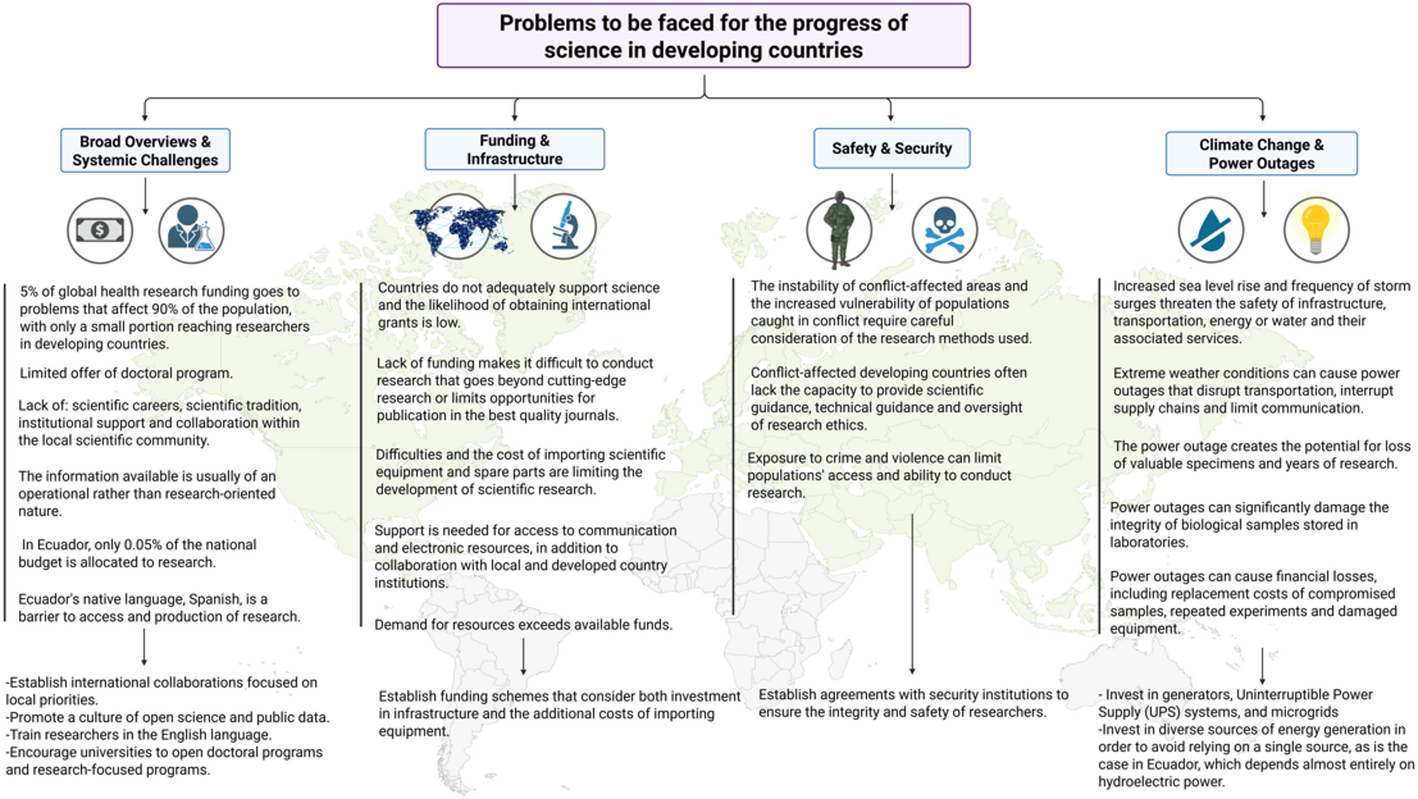

As a researcher based in Quito, Ecuador, I've spent over a decade immersed in the world of public health and One Health studies at Universidad de Las Américas. Our recent paper, "The Non-Traditional Challenges of Conducting Science in Developing Countries: The Case of Ecuador," published in Discover Global Society, wasn't born from a grand experiment or groundbreaking data. Instead, it emerged from the everyday frustrations and triumphs that define doing science in the Global South. It's an opinion piece that shines a light on the "non-traditional" barriers we face—things like sudden power blackouts derailing experiments or security threats forcing us to abandon fieldwork. These aren't the glamorous parts of research you read about in glossy journals, but they're the reality for many of us. In this post, I'll share the story behind the paper, weaving in personal anecdotes, the challenges we overcame, and what it all means for the future of global science.
The spark for this paper came during a particularly chaotic week in late 2023. I was in the lab analyzing samples for a study on vector-borne diseases when—poof—the lights went out. Again. Ecuador was grappling with one of its worst droughts, fueled by the El Niño event, which crippled our hydroelectric power grid. Refrigerators holding precious biological samples thawed, computers shut down mid-analysis, and our team's momentum ground to a halt. This wasn't a one-off; power outages had become a routine disruptor, affecting everything from sample storage to accessing online journals. As I sat in the dark, scribbling notes by phone flashlight, I realized these "invisible" challenges were rarely discussed in academic circles. Sure, we all know about funding shortages in developing countries, but what about the daily grind of unreliable electricity or fearing for your safety during fieldwork? That's when my co-authors—Rasa Zalakeviciute, Jorge Vasconez-Gonzalez, and Juan S. Izquierdo-Condoy—and I decided to document it all.
Our methodology was straightforward: a qualitative narrative drawing from our lived experiences, peer-reviewed articles, and news reports from 2000 to 2025. We chose Ecuador as our case study because it's home turf—we've navigated these waters firsthand. Ecuador isn't unique in its struggles; similar issues plague much of Latin America and the Global South. But by focusing here, we could add personal depth. For instance, funding is a perennial headache. Government grants hover around $5,000 to $40,000 per year—peanuts compared to the millions available in the Global North. And it's not just the amount; political instability means budgets swing with each election. One year, you're funded; the next, you're scraping by on university scraps. We've seen projects stalled because grants were awarded based on connections rather than merit.
Then there's infrastructure. Labs in Quito might look modern, but dig deeper, and you'll find outdated equipment and a heavy reliance on imports. Reagents and tools cost double or triple what they do elsewhere due to taxes and customs delays. I remember ordering specialized PCR kits for a COVID-19 project during the pandemic— they arrived two months late, compromising our timeline. Rural areas fare even worse; research is concentrated in big cities, leaving smaller institutions isolated. But the paper delves into less-talked-about issues, like those power outages. During the 2023-2024 crisis, blackouts lasted hours or days, leading to lost data and ruined experiments. In one instance, our team lost a batch of mosquito samples critical for a dengue study because the freezer failed overnight. It's not just inconvenient; it's a blow to productivity. We've adapted with UPS systems and generators, but these are band-aids on a systemic wound tied to climate vulnerability.
Security adds another layer of complexity. Latin America has some of the world's highest crime rates, and Ecuador's recent surge in violence—linked to narcotrafficking—has hit researchers hard. Fieldwork in coastal or rural areas, once routine, now feels risky. A colleague of mine, a biologist studying biodiversity in Azuay province, had to suspend his work after kidnapping threats. Another researcher abandoned two decades of coastal ecology studies due to escalating dangers. Personally, I've cut short expeditions in the Amazon region, opting for safer, less ideal sites. Even in urban settings, working late in labs or libraries isn't always feasible without worrying about theft or assault. These fears don't just affect output; they deter international collaborations. Foreign teams have canceled visits, widening the gap between North and South.
Despite these hurdles, Ecuador's scientific community is resilient and innovative. We wanted the paper to balance critique with hope, highlighting successes that prove progress is possible. Take the Ecugen PCR kit we developed at UDLA during the pandemic— a homegrown COVID-19 diagnostic tool costing just $8 per test versus $80 for imports. It boosted our autonomy and saved lives by making testing affordable. Or the National Institute of Agricultural Research (INIAP)'s partnerships with international bodies from South Korea and Germany, advancing crop studies amid food security challenges. The Geological and Energy Research Institute's LED lighting lab, accredited in 2021 with UNDP support, is another win, promoting energy efficiency in a blackout-prone country. And the "Pandemic Prevention and Response, One Health" program with Germany strengthens our epidemiological surveillance. These examples show that with targeted support, we can innovate. One untold story: during power crises, our team jury-rigged solar-powered mini-fridges for sample storage—a hack born of necessity that sparked ideas for sustainable lab tech.
Writing this paper wasn't without its ironies. As we drafted it, another blackout hit, forcing us to switch to laptops and hotspots. It underscored our point: science in the Global South demands extra grit. The implications? We need a global rethink. Funding agencies should account for import costs and climate risks, perhaps through grants for backup systems or security training. Collaborations must be equitable, not just "knowledge transfer" from North to South—local expertise matters. For future research, this opens doors to studies on adaptive strategies, like resilient infrastructure or mental health impacts on scientists in unstable environments. Personally, it's reminded me why I do this: to bridge divides and amplify voices from places like Ecuador.
In the end, our paper is a call for empathy and action. Science shouldn't be a privilege of the wealthy North; it thrives when inclusive. By sharing these stories, we hope to foster dialogue and change. If you're a researcher in a similar boat, know you're not alone. And to those in the Global North: let's build partnerships that lift everyone

Follow the Topic
-
Discover Global Society
This is an interdisciplinary, international journal that welcomes research on the complexities of modern global society, its development and its challenges.

Related Collections
With Collections, you can get published faster and increase your visibility.
Migration, Social Change, and Policy Responses in a Global Society
Migration is a defining feature of contemporary global societies, shaping social structures, political debates, economic outcomes, and cultural identities across regions. In recent years, migration dynamics have been further reshaped by profound geopolitical transformations, including armed conflicts, shifts in international alliances, border reconfigurations, and changing migration governance regimes. These developments interact with long-standing economic inequalities, demographic change, and environmental pressures, producing increasingly complex migration patterns and societal responses.
At the same time, migration has become central to public and political debates concerning its economic and fiscal implications. Across countries, questions persist regarding the costs associated with immigration—such as public spending on integration, welfare, and services—and the extent to which migration contributes to state finances through taxation, labour market participation, and long-term demographic sustainability. Assessing whether and under what conditions immigration represents a fiscal burden or a net benefit for public budgets remains a key empirical and policy challenge.
This Topical Collection aims to advance research on migration and social change from a global and comparative perspective, with particular attention to the interaction between geopolitical change, fiscal sustainability, and migration policy. It welcomes contributions examining migration flows, integration processes, public attitudes toward migrants, cost–benefit assessments of immigration, and policy design at local, national, and supranational levels.
The Collection is open to studies addressing different migration types, including labour migration, forced displacement, refugee movements, return migration, and environmentally influenced mobility. Special emphasis is placed on quantitative, mixed-method, and computational approaches, including econometric analysis, survey data, experimental methods, fuzzy and multi-criteria decision models, and text-as-data techniques. Comparative and cross-national studies are especially encouraged, particularly those linking migration outcomes to institutional capacity, fiscal frameworks, and governance arrangements. The Collection aims to provide empirically grounded insights to inform academic debates and evidence-based policymaking in an increasingly unstable and interconnected world.
Publishing Model: Open Access
Deadline: Nov 13, 2026
Agentic Artificial Intelligence, Gender Equity, and Inclusive Digital Futures
This proposed Collection examines how Artificial Intelligence (AI), particularly agentic AI systems capable of autonomous decision-making and adaptive orchestration, can advance gender equity and inclusive development within digital societies. While AI-driven transformation reshapes governance, labor markets, financial systems, and public service delivery, structural gender inequalities risk being encoded and amplified within algorithmic systems.
This Collection seeks interdisciplinary research that critically evaluates both the empowering potential and structural risks of agentic AI, with emphasis on women’s economic participation, algorithmic governance, digital inclusion, and institutional accountability. Contributions are encouraged that explore AI-enabled financial inclusion, gender-responsive digital policy, bias auditing in autonomous systems, women’s participation in digital entrepreneurship, and AI’s role in strengthening social cohesion and public institutions.
The Collection prioritizes empirical research, comparative studies, computational audits, and policy frameworks, particularly from developing and emerging economies, aligned with Sustainable Development Goals. By foregrounding women not only as users but as designers, innovators, and decision-makers within AI ecosystems, this Collection advances structural approaches to equitable digital transformation.
This Collection aims to:
1. Advance rigorous, evidence-based research on AI and gender equity.
2. Develop governance and regulatory frameworks for responsible agentic AI deployment.
3. Highlight empirical cases from developing economies and Global South contexts.
4. Foster cross-disciplinary dialogue among Information Systems, Sociology, Economics, Public Policy, and Gender Studies.
5. Provide actionable policy insights aligned with sustainable digital development strategies.
Submissions using quantitative (SEM, causal modeling), qualitative (case studies, institutional analysis), computational auditing, and mixed-method approaches are particularly encouraged.
Publishing Model: Open Access
Deadline: Dec 18, 2026