Behind the Paper: Teaching AI to See the Tracks Ahead — A Computer Vision Approach to Railway Safety -
Published in Computational Sciences
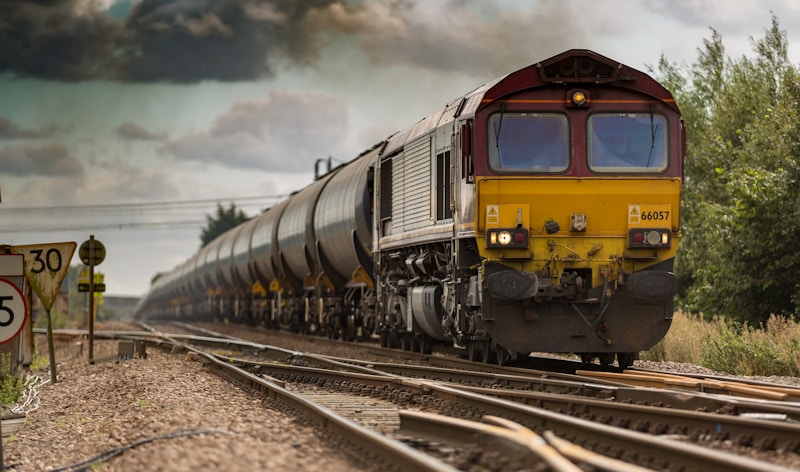






The Problem That Sparked Our Research
Every day, railway systems around the world transport billions of passengers and countless tons of freight. It's one of the safest forms of transportation we have — but when accidents happen, they can be catastrophic. Derailments, collisions with obstacles, and track obstructions continue to pose significant threats to railway operations globally.
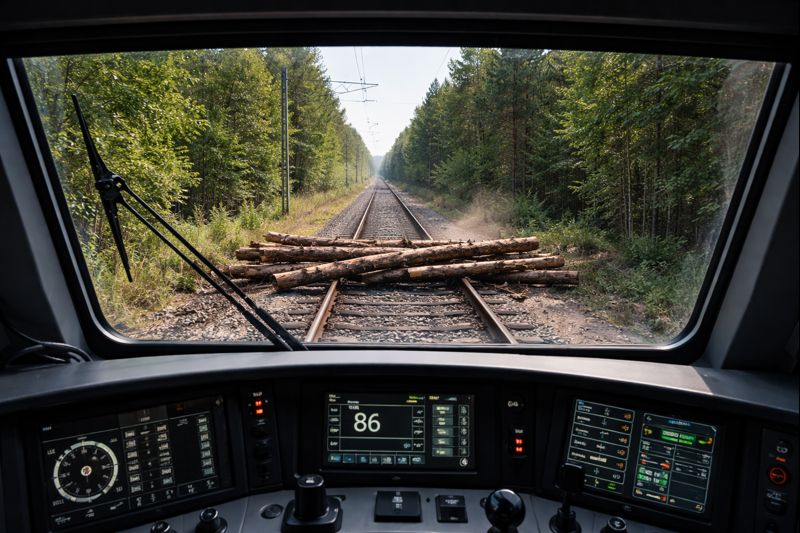
Traditional methods for detecting track obstructions rely heavily on two things: manual track inspections and the vigilance of locomotive operators. But here's the challenge — human attention has limits. Fatigue sets in during long shifts. Visibility drops in fog, rain, or at night. A split-second distraction can mean the difference between spotting an obstacle in time or not.
We asked ourselves: What if we could give train operators an AI co-pilot that never gets tired and never looks away?
Our Approach: Teaching Computers to "See" Like Train Drivers
Our research, published in Discover Computing, introduces a visual intelligence framework that uses deep learning and computer vision to segment railway tracks in real-time and assess potential hazards based on their location.
Breaking Down the Track into Safety Zones
One of our key innovations was dividing the track area visible from the locomotive into four distinct regions, each representing a different threat level:
| Zone | Description | Threat Level |
|---|---|---|
| Major | The main track area directly in front of the locomotive | Highest (on-track, near field) |
| Front Minor | The track area further ahead along the path | Medium (on-track, far field) |
| Left Minor | The area immediately to the left of the track | Lower (off-track, near field) |
| Right Minor | The area immediately to the right of the track | Lower (off-track, near field) |
![Track Segmentation Zones Diagram] Figure: The four safety zones our system identifies in every frame
This classification scheme allows our system to not just detect that something is on or near the tracks, but to immediately assess how dangerous it is based on where it's located. An object in the "Major" zone requires immediate attention, while something in the "Left Minor" zone might be monitored but isn't an immediate threat.
Building Our Own Dataset: When No One Has Done This Before
One of the biggest challenges we faced was the lack of existing datasets specifically designed for railway track segmentation. While there are plenty of datasets for autonomous vehicles on roads, railway environments present unique challenges — different track types, platform configurations, curves, and infrastructure elements.
So we built our own.
We extracted frames from publicly available videos filmed from locomotive cab views, capturing diverse scenarios:
- Straight tracks and curved tracks (both left and right curves)
- Stations with platforms on one side, both sides, or no platforms
- Various lighting conditions and infrastructure configurations
Each of the 1,638 images in our dataset was meticulously annotated using polygon shapes to define the exact boundaries of each safety zone. We then used data augmentation techniques — including mosaic composition, horizontal flipping, and multi-scale scaling — to make our models more robust to real-world variations.
The YOLO Family: Our Detection Champions
For our detection engine, we turned to the YOLO (You Only Look Once) family of algorithms — renowned for their speed and accuracy in real-time object detection. We evaluated six different YOLO variants across three generations:
- YOLOv8: YOLO-n8 (nano) and YOLO-m8 (medium)
- YOLOv9: YOLO-c9 (compact) and YOLO-e9 (enhanced)
- YOLOv11: YOLO-n11 (nano) and YOLO-m11 (medium)
Why so many? Because different deployment scenarios have different requirements. A system running on a powerful cloud server can handle larger, more accurate models. But a system deployed directly on a locomotive's embedded computer needs to be lightweight while still reliable.
The Results: High Accuracy Across All Safety Zones
After training our models for 70 epochs on an NVIDIA A100 GPU, we achieved impressive results:
Best Performers: YOLO-m8 and YOLO-c9
- Mean Average Precision (mAP@0.5): 94%
- Precision: 97%
- Recall: 96%
Class-wise Accuracy (YOLO-c9):
- Major zone: 89.3%
- Front Minor: 87.9%
- Left Minor: 84.7%
- Right Minor: 83.5%
What's particularly encouraging is that the "Major" zone — representing the highest-threat area directly in the locomotive's path — achieved the highest accuracy. This is exactly where we need the system to perform best.
Watching the AI Learn
One of the fascinating aspects of our research was observing how the models improved over time. Early in training (around epoch 10), the models struggled with the "Major" class, achieving confidence scores as low as 0.76. But by epoch 70, this same class reached confidence scores of 0.97-0.98.
The learning curves told an interesting story: most models achieved about 90% of their final performance within just 20-30 epochs, with incremental refinements thereafter. This finding has practical implications — for rapid prototyping or resource-constrained deployments, shorter training periods might be acceptable.
Connecting to India's Railway Modernization
Our work aligns with real-world railway safety initiatives, particularly India's Gati Shakti Project and the deployment of Kavach — an Automatic Train Protection (ATP) system designed to prevent collisions.
Current ATP systems like Kavach use radio frequency-based communication for collision avoidance, but they haven't yet fully leveraged computer vision for enhanced situational awareness. Our framework provides a pathway for integrating visual intelligence into these existing systems, adding another layer of safety without replacing proven technologies.
Limitations and the Road Ahead
We're proud of our results, but we're also honest about our limitations:
- Geographic Scope: Our dataset primarily covers specific regions and track types. Expanding to include diverse international railway systems would improve generalizability.
- Weather Conditions: Further validation under adverse weather (heavy rain, fog, snow) and extreme lighting is needed.
- Complete System Integration: Our current framework focuses on track segmentation. A complete safety system would need integration with obstacle detection and classification modules.
- Field Testing: Extended trials under continuous operational conditions are required before real-world deployment.
What This Means for the Future of Railway Safety
Our research demonstrates that AI-powered visual intelligence can achieve the accuracy and speed needed for real-time railway safety applications. The ability to segment tracks into threat-level zones in milliseconds opens possibilities for:
- Real-time driver alerts when obstacles enter high-threat zones
- Reduced cognitive burden on locomotive operators during long shifts
- Complementary safety layer to existing ATP systems
- Data collection for improved track monitoring and maintenance
As railways continue to modernize and speeds increase, the need for intelligent, automated safety systems will only grow. We hope our framework provides a foundation for future developments in this critical area.
The Team Behind the Research
This research was conducted at the Center of Excellence in Signal and Image Processing at the Electronics and Telecommunication Department of COEP Technological University, Pune, India.
Authors:
- Yogesh Madhukar Gorane (Corresponding Author)
- Radhika D. Joshi
Published in Discover Computing (2025) 28:328
DOI: 10.1007/s10791-025-09872-z
Journal Badge: Discover Computing
Channel: Behind the Paper
Topics: #ComputerVision #MachineLearning #RailwaySafety #DeepLearning #YOLO #InstanceSegmentation #TransportationSafety #ArtificialIntelligence #IndianRailways #AutonomousSystems
The datasets generated during this study are available from the corresponding author upon reasonable request.
This article is licensed under a Creative Commons Attribution-NonCommercial-NoDerivatives 4.0 International License.

Follow the Topic
-
Discover Computing
Previously Information Retrieval Journal. Discover Computing is an open access journal publishing research from all fields relevant to computer science.

Related Collections
With Collections, you can get published faster and increase your visibility.
Advances in Knowledge-Driven Artificial Intelligence: Methods and Applications
As AI systems are increasingly deployed in information access, decision support, and personalized learning, their ability to incorporate, reason over, and update structured and unstructured knowledge has become critical. Knowledge-driven methods provide a promising pathway to improve accuracy, explainability, personalization, robustness, and trustworthiness, especially in scenarios where data are heterogeneous, dynamic, sparse, or domain-specific. This Collection aims to bring together high-quality research on knowledge-driven artificial intelligence for recommendation systems, question answering, knowledge graphs, and knowledge tracing.
The Collection welcomes original research and review articles on theories, models, algorithms, systems, and applications related to knowledge-enhanced recommendation systems, knowledge graph construction and reasoning, knowledge graph question answering, retrieval-augmented generation, large language models with external knowledge, explainable and trustworthy AI, user modelling, learner modelling, and knowledge tracing. Topics of interest also include graph neural networks, neuro-symbolic reasoning, causal and counterfactual methods, multimodal knowledge representation, dynamic and continual knowledge learning, learning analytics, educational intelligence, and real-world knowledge-intensive applications. The goal is to promote interdisciplinary advances in knowledge-centered intelligent systems and foster robust, interpretable, and adaptive AI technologies.
This Collection supports and amplifies research related to SDG 9.
Keywords: Knowledge-driven AI; Knowledge graph; Recommender systems; Question answering; Knowledge tracing; Retrieval-augmented generation; Large language models; Graph neural networks; Learning analytics
Publishing Model: Open Access
Deadline: Feb 28, 2027
Trustworthy and Explainable Intelligent Systems for Real-World Computing
This Collection focuses on trustworthy and explainable intelligent systems designed for real-world computing applications. As artificial intelligence and data-driven systems are increasingly deployed in critical domains such as healthcare, smart cities, industrial automation, and digital infrastructure, concerns related to transparency, robustness, fairness, and accountability have become central challenges.
The aim of this Collection is to bring together recent advances in explainable artificial intelligence (XAI), trustworthy machine learning, and responsible computing, with a strong emphasis on practical deployment and system-level perspectives rather than purely theoretical contributions. The Collection seeks to highlight methods, models, and frameworks that enhance human understanding, trust, and control over intelligent systems operating in real-world environments.
Specific areas of interest include, but are not limited to: interpretable and explainable models, robustness and reliability of intelligent systems, human-centered and human-in-the-loop computing, evaluation methodologies for trustworthy AI, ethical and responsible computing practices, and application-driven case studies demonstrating real-world impact. By providing a focused yet interdisciplinary forum, this Collection aims to foster high-quality contributions that bridge the gap between advanced computational methods and trustworthy deployment in practice.
This Collection supports and amplifies research related to SDG 9.
Keywords: Explainable Artificial Intelligence (XAI); Trustworthy Computing; Responsible AI; Interpretable Machine Learning; Human-Centered Computing; Robust Intelligent Systems; Ethical Computing; Real-World AI Applications
Publishing Model: Open Access
Deadline: Nov 20, 2026