Beneath the Surface: How Climate Change Intensifies Erosion and Suspended Sediment Loads
Published in Earth & Environment and Civil Engineering

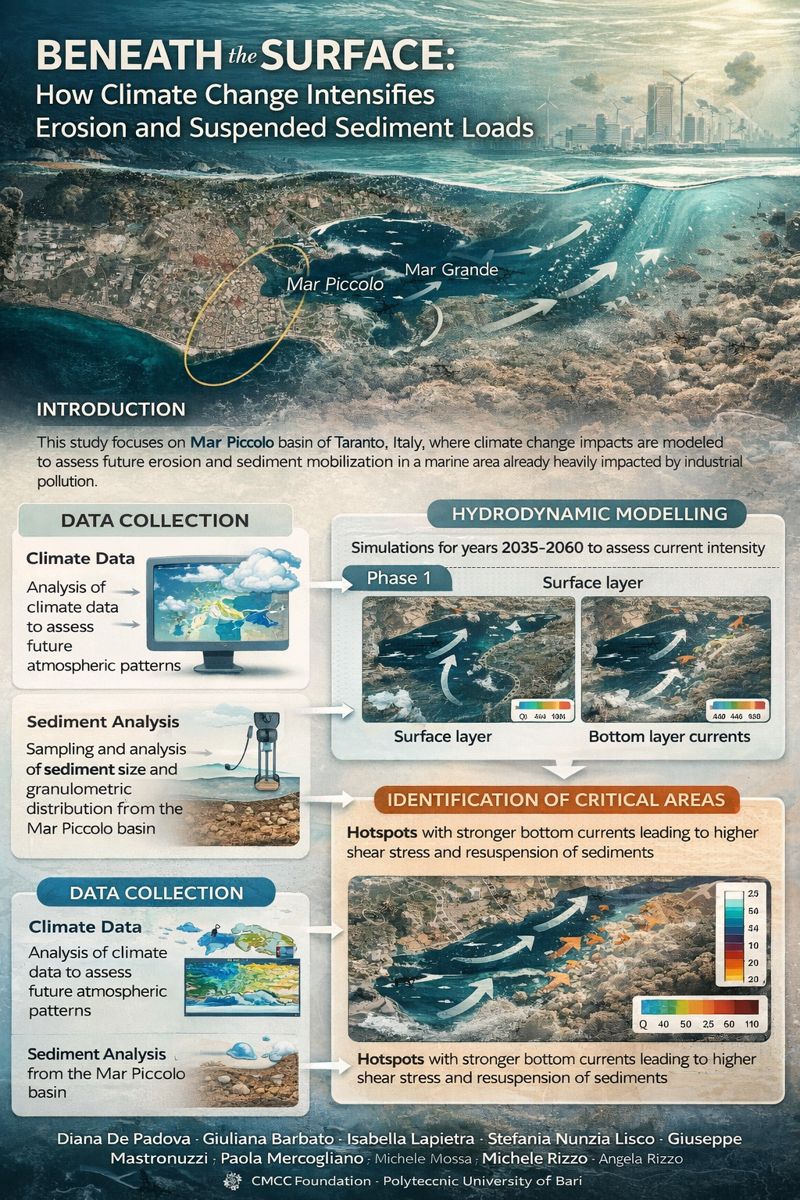


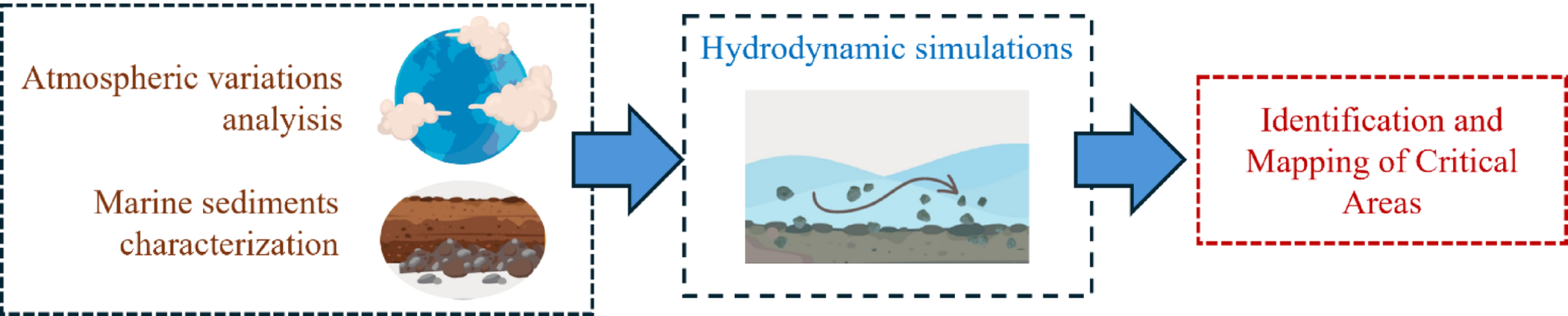

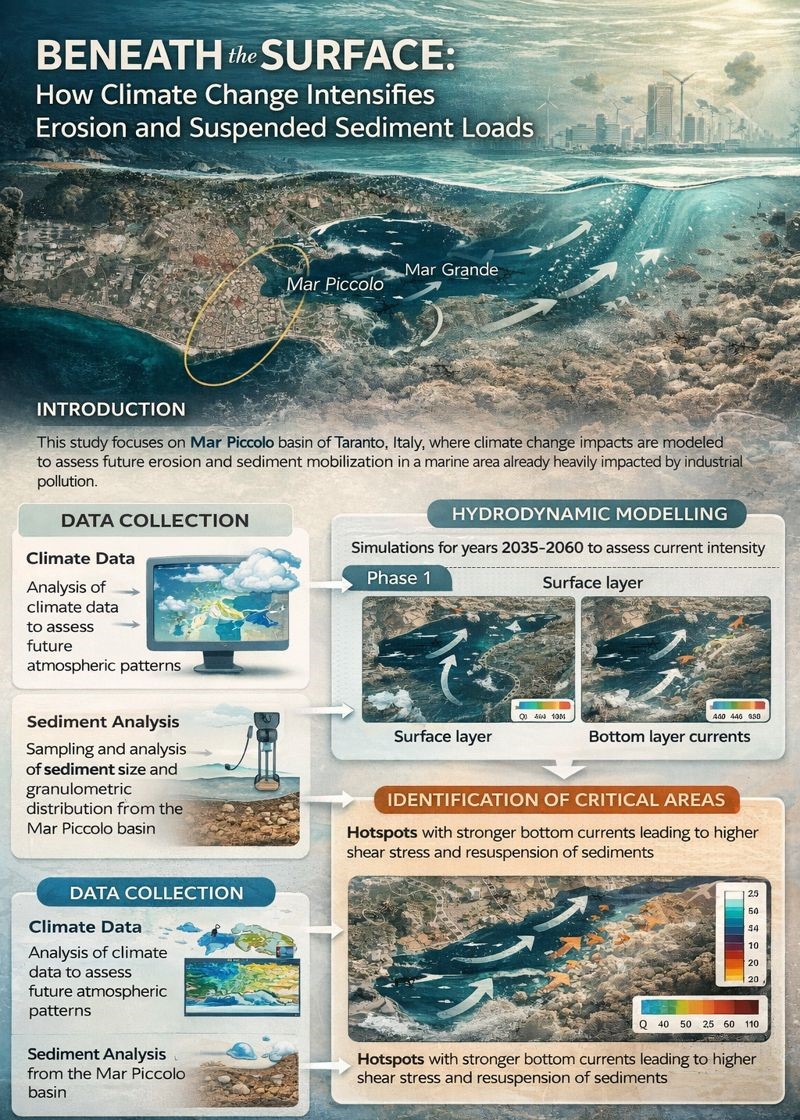 The study “Beneath the Surface: How Climate Change Intensifies Erosion and Suspended Sediment Loads” (see the paper at this link: https://link.springer.com/article/10.1007/s41748-025-00871-0) represents a significant contribution to coastal environmental science, particularly in the context of climate change impacts on polluted marine systems. Focusing on the Mar Piccolo basin of Taranto (Southern Italy), the research provides a robust methodological framework that combines very high-resolution climate datasets with three-dimensional hydrodynamic and sediment transport modeling. The importance of this work lies not only in its scientific rigor, but also in its practical implications for environmental management, risk assessment, and remediation planning in vulnerable coastal areas.
1. Context and environmental relevance
The Mediterranean region hosts numerous industrial and urban coastal zones that have been exposed to decades of anthropogenic pressure. Taranto is one of the most emblematic examples: it contains one of Europe’s largest steel plants, oil refineries, military infrastructures, and harbors, all concentrated around a semi-enclosed marine basin. As highlighted in the study, this long-term industrialization has caused severe contamination of marine sediments, especially in the First Bay of the Mar Piccolo, where heavy metals and organic pollutants often exceed national safety thresholds.
Such polluted sediments represent a latent environmental risk. Under stable hydrodynamic conditions, contaminants may remain buried; however, changes in current intensity or bottom shear stress can remobilize them, reintroducing pollutants into the water column and food web. This makes the Mar Piccolo basin an ideal natural laboratory for investigating how climate change can indirectly amplify environmental hazards in already compromised ecosystems.
2. Innovation in methodology
One of the most important aspects of this study is its methodological innovation. The authors exploit very high-resolution climate datasets (VHR-REA_IT and VHR-PRO_IT), characterized by a spatial resolution of approximately 2.2 km, which allows for an unprecedented representation of local atmospheric dynamics. Unlike coarser global models, these datasets can capture fine-scale wind patterns that are crucial in shallow, semi-enclosed basins such as Mar Piccolo.
These climate projections are coupled with the MIKE 3 FM hydrodynamic model, a state-of-the-art three-dimensional numerical tool that simulates water circulation and sediment transport. By integrating climate data, seabed granulometry, and hydrodynamics, the study establishes a comprehensive framework capable of linking atmospheric changes directly to seabed erosion and sediment resuspension processes. This integrated approach is still relatively rare in climate impact studies on contaminated coastal sites, making the research highly innovative.
3. Key findings and their significance
The results clearly indicate that, starting from 2035, significant changes in hydrodynamic conditions are expected in the Mar Piccolo basin. Although mean wind speeds show a slight decreasing trend, the intensity and frequency of extreme wind events increase, particularly during spring seasons. These extremes play a dominant role in driving stronger marine currents, both at the surface and near the seabed.
Hydrodynamic simulations reveal that future scenarios are characterized by a marked increase in current intensity, especially in the bottom layers. This leads to enhanced shear stress at the sediment–water interface, frequently exceeding the critical threshold for sediment erosion. As a consequence, sediment resuspension becomes more widespread, particularly in the Second Bay, where such processes were previously limited or absent.
The importance of these findings is substantial. Sediment resuspension not only alters seabed morphology but also facilitates the redistribution of contaminants stored in the sediments. Pollutants that were previously confined to deeper layers can be released into the water column, increasing ecological risks and potentially affecting fisheries, aquaculture (e.g., mussel farms), and human health.
4. Implications for environmental management and remediation
Another key strength of this study lies in its strong applied relevance. Taranto is classified as a Site of National Interest (SIN) in Italy, meaning that remediation strategies are a national priority. Traditional remediation approaches often assume relatively stable hydrodynamic conditions; however, this study demonstrates that future climate change may fundamentally alter these assumptions.
By identifying “hotspot” areas prone to increased bottom stress and sediment mobilization, the research provides essential guidance for targeted remediation planning. For example, areas that are projected to experience stronger erosion may require different containment or dredging strategies compared to zones dominated by sediment accumulation. Incorporating climate projections into remediation plans can therefore improve their long-term effectiveness and prevent costly failures.
Moreover, the methodological framework proposed in this study is transferable. Other polluted coastal sites in the Mediterranean and beyond share similar characteristics, such as shallow waters, limited circulation, and strong anthropogenic pressure. As such, the approach can be adapted to support climate-informed environmental management strategies at a broader regional scale.
5. Contribution to climate change impact assessment
From a broader scientific perspective, this study highlights the importance of moving beyond direct climate change indicators (such as temperature rise or sea-level rise) to include indirect, process-based impacts. The research clearly shows that changes in wind regimes—even when mean values decrease—can still intensify erosion and sediment transport through increased extremes.
This insight is crucial for climate impact assessments, as it underscores the need to analyze not only average trends but also variability and extreme events. In shallow coastal systems, these extremes can have disproportionate effects, triggering processes that fundamentally reshape environmental dynamics.
6. Overall importance of the study
In conclusion, the importance of this study lies in its ability to bridge climate science, coastal engineering, and environmental remediation. It demonstrates how high-resolution climate data can be effectively translated into actionable knowledge about future hydrodynamic and sedimentary processes. The findings warn that climate change may exacerbate existing pollution problems by remobilizing contaminated sediments, thereby increasing ecological and human health risks.
By providing a scientifically robust and operationally relevant framework, the study represents a crucial step toward climate-resilient management of polluted coastal environments. It reinforces the idea that sustainable remediation and coastal protection strategies must be forward-looking, integrating climate projections to anticipate and mitigate future environmental challenges rather than reacting to them after they occur
Follow the Topic
-
Earth Systems and Environment
This is a multidisciplinary journal publishing peer-reviewed research on Earth System sciences and environment-related topics.






Please sign in or register for FREE
If you are a registered user on Research Communities by Springer Nature, please sign in