Beyond who is there: uncovering active functions in the coral holobiont
Published in Ecology & Evolution and Microbiology



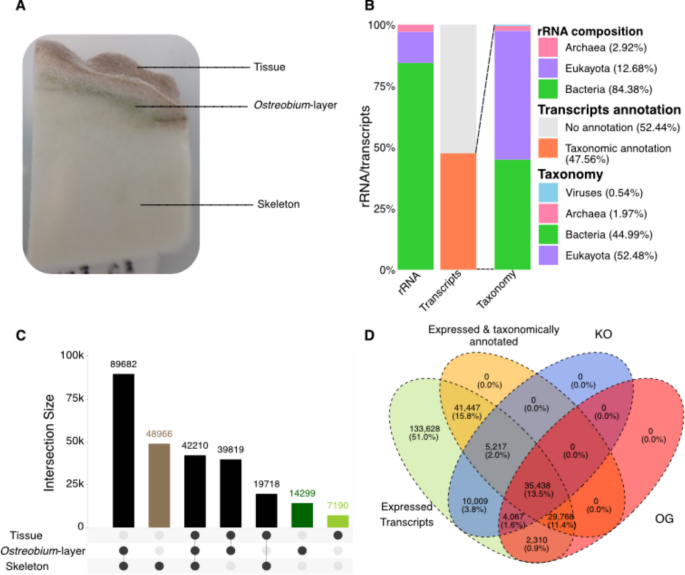

Corals are often described as the rainforests of the sea. They build complex reef structures, support extraordinary biodiversity and sustain coastal ecosystems around the world. But a coral is not a single organism working alone. It is a partnership between the animal host and a diverse community of microscopic partners, including photosynthetic algae, bacteria, archaea, fungi and other microorganisms. Together, these partners form what is known as the coral holobiont. For many years, coral microbiome research has helped reveal which microbes live with corals. This has been incredibly valuable, but it also leaves an important question unanswered: what are these organisms actually doing?
This question was the starting point for our study, now published in Microbiome. We wanted to move beyond describing the members of the coral-associated community and instead ask a functional question: within the coral Porites lutea, which members of the holobiont are active, where are they active, and what biological processes are they contributing to? RNA-seq gave us a way to approach this question. DNA-based methods can show which genes are present in a community, but genes that are present are not always being used. RNA captures genes being expressed at the time of sampling, allowing us to examine the active biology of the coral holobiont.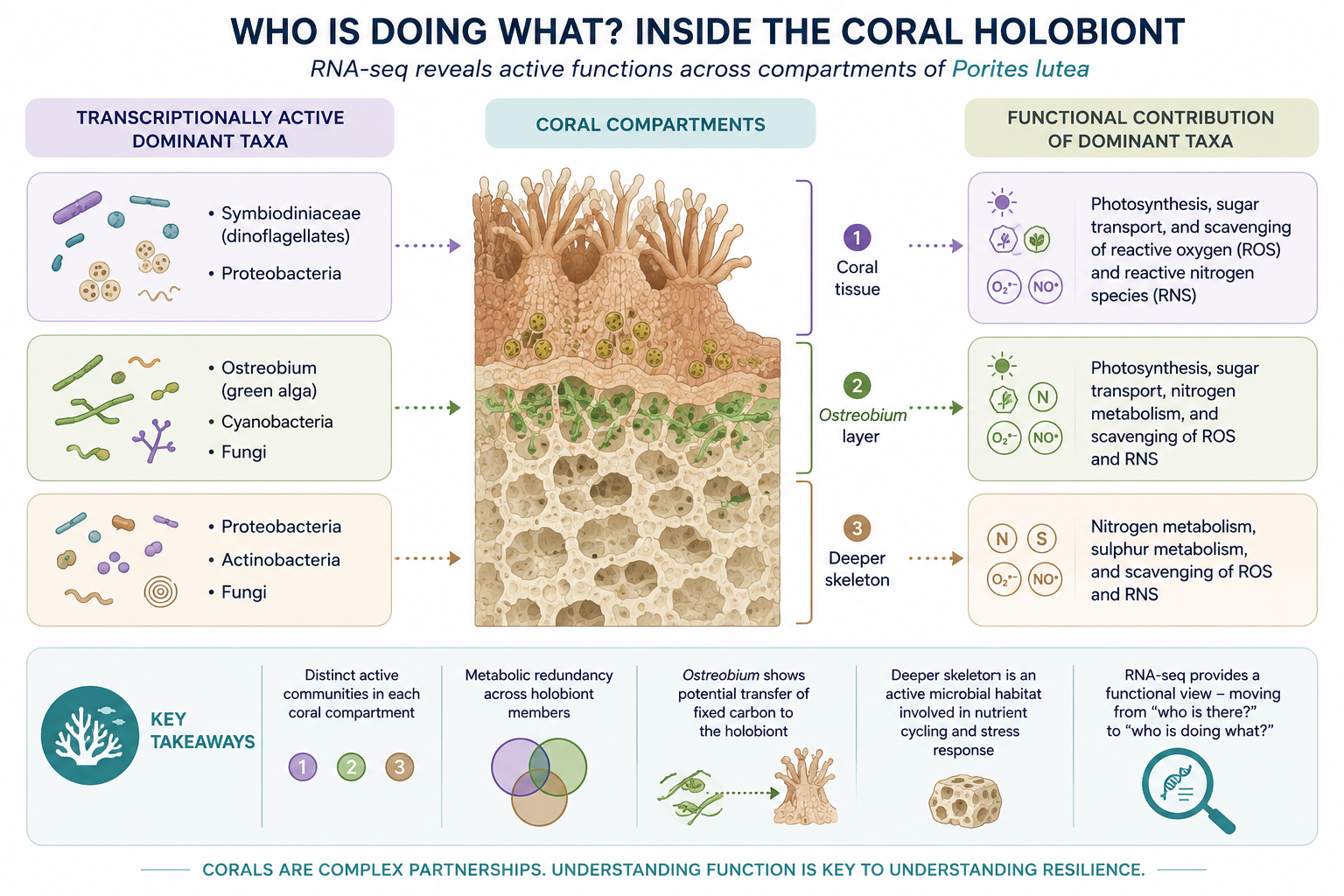
A key feature of this study was that the coral was not treated as a single uniform sample. A coral contains different internal compartments, each with its own physical and biological environment. We focused on three compartments: the coral tissue, the green endolithic algal layer dominated by Ostreobium, and the deeper coral skeleton. These layers are close to one another, but they are not the same habitat. Light, nutrients, oxygen and microbial community structure can all vary across these spaces. This compartment-level view allowed us to ask not only which organisms were active, but also where their activity was taking place. The coral tissue, the Ostreobium layer and the deeper skeleton each contained distinct metabolically active communities, showing that the coral skeleton is not simply a passive structure underneath the living tissue, but an active microbial habitat with its own biological processes.
Working with coral RNA-seq data is challenging because the data are inherently mixed. A sample can contain RNA from the coral animal, photosynthetic symbionts, endolithic algae, bacteria, archaea and other members of the holobiont. This means the analysis cannot stop at quantifying gene expression. It also requires careful assignment of transcripts to their likely biological source and interpretation in the context of the compartment they came from. This complexity also makes the approach especially valuable. Instead of producing only a list of microbes, RNA-seq can help map active functions across the holobiont. In this study, we focused on key processes involved in carbon, nitrogen and sulfur cycling, photosynthesis, sugar transport and the scavenging of reactive oxygen and nitrogen species. These functions are important because they relate directly to how the coral holobiont maintains its internal nutrient economy and responds to changing chemical conditions.
One major theme that emerged was metabolic redundancy. Different members of the holobiont appeared to contribute to similar broad nutrient-cycling functions. This redundancy may be important for stability. In a complex symbiotic system, having multiple organisms capable of contributing to key processes could help maintain function even when environmental conditions shift or when the activity of individual community members changes. Another important finding was the role of the Ostreobium layer. Ostreobium is a green endolithic alga that lives within the coral skeleton, beneath the tissue. It has long been suggested that endolithic algae may contribute to coral nutrition, particularly under stressful conditions. Our study provides transcriptomic evidence supporting the ability of Ostreobium to transfer fixed carbon to other members of the holobiont, including the coral host. This adds molecular-level evidence to a long-standing ecological idea: that life inside the coral skeleton may be actively supporting the coral above it.
The deeper skeleton also stood out. It is easy to imagine the coral skeleton as a mostly inert calcium carbonate framework, but the data showed metabolically active microbial communities in this compartment. These communities were involved in nutrient cycling and stress-related processes, including pathways associated with scavenging reactive oxygen and nitrogen species. Together, these findings support a more spatially organised view of the coral holobiont. The question is not simply “which microbes are present?” but “how are biological roles distributed across the coral?” This shift in perspective is important. In microbiome research, taxonomy is useful, but it does not always explain function. Functional approaches, especially when combined with careful compartment-level sampling, can reveal how different organisms contribute to the biology of the host-associated ecosystem.
This matters because corals are under increasing pressure from warming oceans, pollution and other environmental stressors. Understanding coral resilience will require more than knowing which species are present in healthy or stressed corals. We need to understand the processes that sustain the coral holobiont, how these processes are organised, and which members are actively involved. Our study provides a baseline view of active microbial functions in healthy Porites lutea. It shows that different coral compartments
contain distinct active communities, that nutrient-cycling functions are distributed across multiple holobiont members, and that the coral skeleton contains biologically active microbial habitats.
By looking beneath the coral surface, this study reveals hidden microbial activity within the coral structure itself. These findings add to a growing view of corals as dynamic, multi-partner biological systems, where the health and function of the whole depends on interactions across host tissues, symbiotic algae and microbial communities living both on and within the skeleton. More broadly, it highlights the value of RNA-seq for moving coral microbiome research from “who is there?” toward “who is doing what?”

Follow the Topic
-
Microbiome
This journal hopes to integrate researchers with common scientific objectives across a broad cross-section of sub-disciplines within microbial ecology. It covers studies of microbiomes colonizing humans, animals, plants or the environment, both built and natural or manipulated, as in agriculture.

Related Collections
With Collections, you can get published faster and increase your visibility.
Oncobiome
This collection of papers delves into the burgeoning field of oncobiome research, exploring the intricate relationship between cancer and the microbiome. The oncobiome encompasses the diverse microbial communities residing in and on the human body, which influence cancer development, progression, and treatment responses. By examining these interactions, our aim is to unravel the complex mechanisms through which the microbiome impacts oncogenesis and therapeutic outcomes.
This compilation highlights cutting-edge research, offering insights into potential diagnostic markers and novel therapeutic strategies, thereby advancing our understanding of cancer biology and paving the way for innovative, microbiome-targeted cancer treatments.
This is a cross-journal collection between:
Experimental Hematology and Oncology
Articles will undergo the standard peer-review process of the journal to which they are submitted and are subject to either the BMC editorial policies or those of BJC Reports. Articles will be added to the Collection as they are published. The Editors have no competing interests with the submissions which they handle through the peer review process. The peer review of any submissions for which the Editors have competing interests is handled by another Editorial Board Member who has no competing interests.
Publishing Model: Open Access
Deadline: Ongoing
The Apple Microbiome
Microbiome and Environmental Microbiome are calling for submissions to our Collection on the Apple Microbiome.
With world apple production estimated at 84 million tons, the microbiome of the apple has significant implications for agriculture, food security, and human health. Understanding the complex interactions between apple plants and their associated microbial communities can lead to improved crop management strategies, enhanced fruit quality and longevity, and sustainable agricultural practices. Recent advances have highlighted the role of specific bacteria and fungi in promoting plant health and resilience against specific pathogens. Moreover, detailed profiling of these microbial communities, revealing their diversity and functional potential facilitate exciting future developments, such as the identification of beneficial microbial consortia for biocontrol and the formulation of tailored probiotic treatments for both plants and humans. By advancing our collective understanding in this area, we can work towards a more sustainable and resilient agricultural system.
Topics of interest include but are not limited to:
-Microbial diversity and function associated with apples
-Effects of soil health and rhizosphere interactions on apple production
-Impact of climate change on the apple microbiome
-Role of the apple microbiome in fruit quality
-Microbiome-driven strategies for disease resistance
This collection is open for submissions from all authors on the condition that the manuscript falls within both the scope of the collection and the journal it is submitted to.
All submissions in this collection undergo the relevant journal’s standard peer review process. Similarly, all manuscripts authored by a Guest Editor(s) will be handled by the Editor-in-Chief of the relevant journal. As an open access publication, participating journals levy an article processing fee (Microbiome, Environmental Microbiome). We recognize that many key stakeholders may not have access to such resources and are committed to supporting participation in this issue wherever resources are a barrier. For more information about what support may be available, please visit OA funding and support, or email OAfundingpolicy@springernature.com or the Editor-in-Chief of the journal where the article is being submitted.
Publishing Model: Open Access
Deadline: Sep 30, 2026



Please sign in or register for FREE
If you are a registered user on Research Communities by Springer Nature, please sign in