Bilateral Functional Hippocampectomy Following Recurrent Bacterial Meningitis: When Infection Erases Memory Formation
Published in Neuroscience and Biomedical Research
Case summary
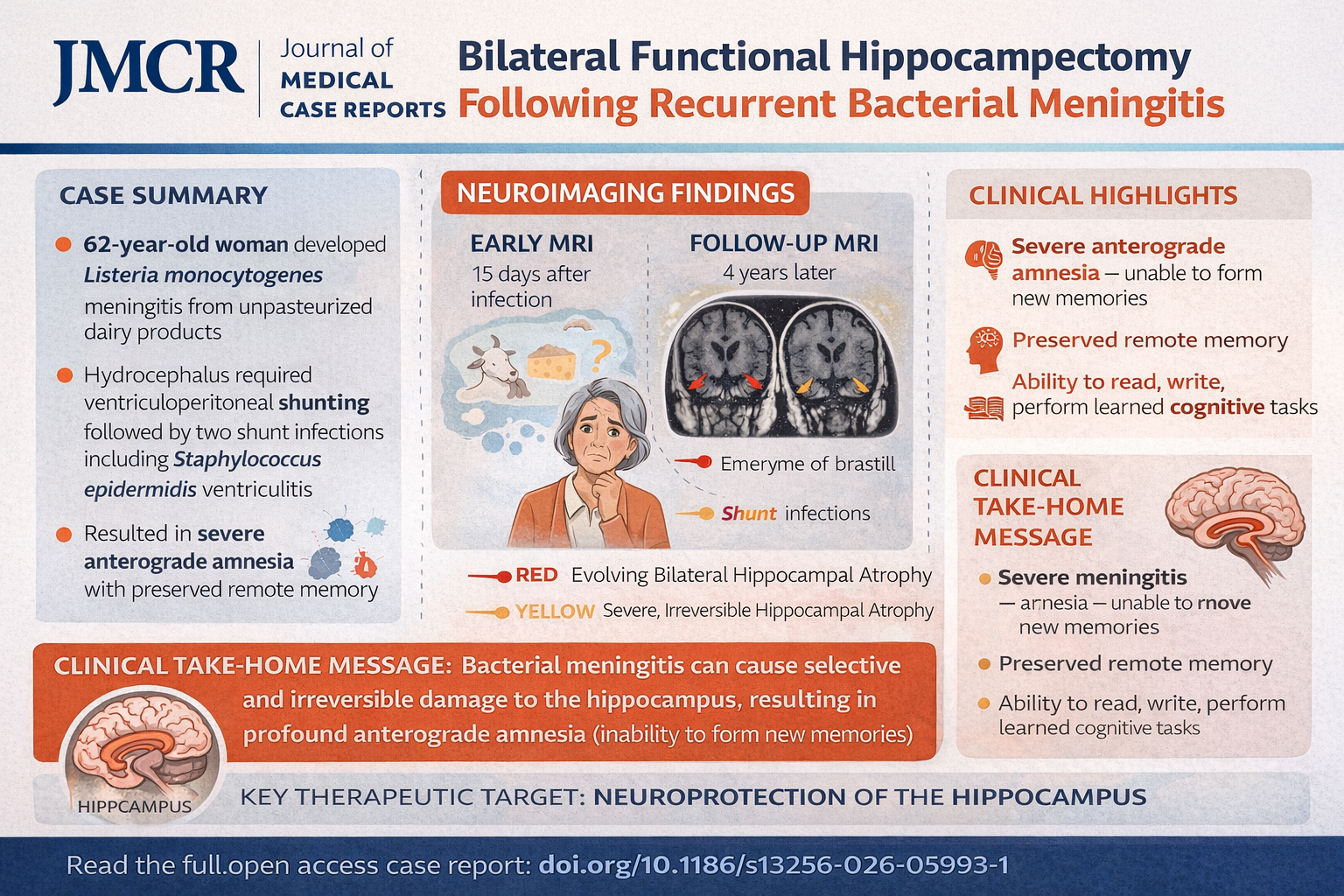
In this case from the Journal of Medical Case Reports, Djukic and colleagues describe a 62-year-old woman who developed severe, irreversible anterograde amnesia following recurrent bacterial central nervous system infections.
The patient initially presented with Listeria monocytogenes meningitis after ingestion of unpasteurized dairy products. Her clinical course was complicated by hydrocephalus requiring ventriculoperitoneal shunting, followed by multiple shunt infections including Staphylococcus epidermidis ventriculitis.
Serial neuroimaging revealed progressive bilateral hippocampal atrophy. Early MRI demonstrated evolving hippocampal volume loss, while follow-up imaging years later showed marked atrophy with dilation of the temporal horns—consistent with structural destruction of the hippocampal formation.
Clinically, the patient exhibited a striking dissociation:
Severe anterograde amnesia (inability to form new memories)
Preserved remote memory, language, and executive function
Retained ability to read, write, and perform learned cognitive tasks
Neuropsychological assessment confirmed a near-complete inability to encode new information, while previously acquired knowledge remained intact.
This constellation effectively represents a “functional bilateral hippocampectomy”—a phenomenon classically described in surgical cases, but here resulting from infectious and inflammatory injury.
Why this case matters
This report highlights several important clinical and mechanistic insights:
The hippocampus is uniquely susceptible to inflammatory and ischemic injury in meningitis.
Recurrent infection and ventriculitis may amplify cumulative neuronal damage.
Conventional adjunctive therapies (e.g., corticosteroids) may not adequately protect hippocampal structures.
Long-term cognitive outcomes in meningitis extend beyond survival and gross neurologic recovery.
Notably, despite restoration of CSF dynamics, the patient’s memory deficit remained permanent—underscoring that structural hippocampal injury is largely irreversible once established.
Clinical take-home message
Bacterial meningitis can result in selective, irreversible hippocampal injury leading to profound anterograde amnesia—even when other cognitive domains are preserved. Neuroprotection of the hippocampus should be considered a key therapeutic target in meningitis management.
Question:
Which cognitive function is most directly impaired by bilateral hippocampal damage as seen in this case?
A. Language comprehension
B. Executive function
C. Formation of new memories
D. Motor coordination
Correct answer:
C. Formation of new memories
Explanation:
The hippocampus is essential for encoding and consolidating new information into long-term memory. Bilateral damage results in profound anterograde amnesia, while previously stored memories and other cortical functions may remain intact—precisely as demonstrated in this case.
Journal of Medical Case Reports is the world’s first international, PubMed-listed, medical journal devoted to publishing case reports from all medical disciplines and will consider any original case report that expands the field of general medical knowledge, and original research relating to case reports. The journal is open access, and strongly endorses the CARE guidelines for case reports, requiring authors to submit populated CARE checklists with submissions to improve transparency in reporting.
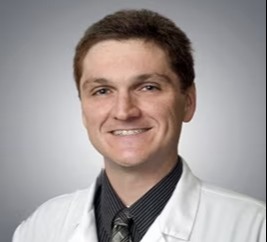
Richard Alan Rison is the interim Editor-in-Chief of Journal of Medical Case reports. He is also an associate neurology editor (editorial board) for BMC Neurology, and the former lead editor for case reports of BMC Research Notes (currently on the editorial board). His scholarly work focuses on medical case reporting, reporting standards, and editorial methodology. Dr. Rison participated in the development and dissemination of the CARE guidelines for clinical case reporting and has authored numerous publications addressing both neurological disorders and the role of case reports in advancing medical knowledge. Dr. Rison practices general neurology and served as the founding medical director of the PIH Health Hospital-Whittier Stroke Program and the PIH Health Hospital-Whittier Non-Invasive Vascular Laboratory, is a clinical assistant professor of neurology at the University of Southern California Keck School of Medicine and Los Angeles County Medical Center, and is a Fellow of the American Academy of Neurology, the American Neurological Association, and the American Association of Neuromuscular and Electrodiagnostic Medicine. Dr Rison is board-certified by the American Board of Psychiatry and Neurology in neurology and vascular neurology, and neurocritical care and neuroimaging by the United Council of Neurologic Subspecialties. He is also board-certified by the American Board of Electrodiagnostic Medicine in electrodiagnostic medicine. Dr. Rison is a former president of the Los Angeles Neurological Society.
Follow the Topic
-
Journal of Medical Case Reports
This journal will consider any original case report that expands the field of general medical knowledge, and original research relating to case reports.


Please sign in or register for FREE
If you are a registered user on Research Communities by Springer Nature, please sign in