Can we really have a “global” research agenda for peatlands?
Published in Social Sciences and Earth & Environment





Peatlands cover only around 3% of the Earth’s land surface, but store more carbon than all the world’s forests combined. When intact, they lock away carbon for thousands of years, regulate water supply and quality, support unique biodiversity, and underpin local livelihoods. When drained or converted, they rapidly switch from slow carbon sinks to powerful greenhouse gas sources. Interest in peatlands has surged in recent years as countries look for nature-based solutions to help meet climate and biodiversity targets, but policy attention has outpaced some of the underlying science. We still have major gaps in understanding how peatlands respond to a changing climate, how restoration performs over decades, how to monitor vast and remote peatland areas, and how to balance climate and conservation goals with the rights and needs of people who live in and around peatlands.
Against this backdrop, we began to ask: if we could collectively steer peatland research for the next decade, what would we prioritise? The result, now published in Communications Earth & Environment, is a list of 50 community-defined research questions spanning carbon dynamics, climate resilience, restoration, technology, and policy. Some address long-standing scientific uncertainties; others focus on implementing what we already know in complex, real-world settings. Getting there, however, taught us a lot about what “global” really means in practice.
Asking the world
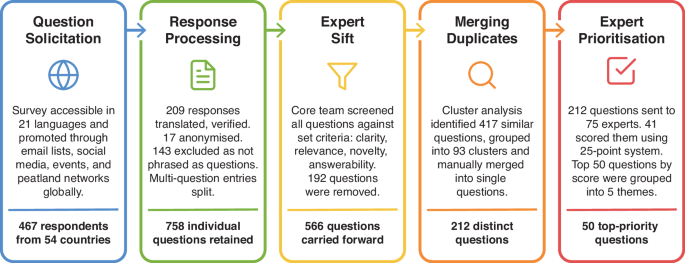
From the outset, we wanted this to be a genuinely community-led exercise rather than a small group of scientists deciding in isolation. So we designed an open online survey that simply asked people to submit their priority questions in peatland research. It was open to anyone: researchers, government officials, NGO staff, community members, and students.
An English-only survey would have excluded large numbers of potential respondents, so we translated it into 20 additional languages, from Spanish, French and Portuguese to Chinese, Russian and Indonesian. We used AI translation as a starting point, but every version was checked and corrected by a native speaker working in peatlands. “Peatland” does not translate simply into every language, and in some regions the concept itself is framed quite differently. For example, in our initial Thai AI translation, “peatland” translated into “Chinese sausage”!
But translation alone doesn’t guarantee participation. A survey available in Indonesian still needs to reach Indonesian-speaking peatland practitioners, and that requires networks, trust and active outreach.
Key contacts on the ground
With the core project team based in the UK, Ireland, Indonesia, and the USA, we knew our own networks would only reach so far. So we enlisted key contacts in peatland regions around the world: from the DRC, Nigeria and South Africa to Colombia, Peru, Thailand, China and beyond. We asked them to act as regional ambassadors for the survey. They distributed it through whatever channels worked locally: professional mailing lists, WhatsApp groups, university departments, in-person meetings and conferences, and direct conversations with colleagues who might not have seen an international call for input.
The difference a single well-connected contact could make was striking. In some countries, one person sharing the survey through the right local network generated dozens of responses. In other regions, key contacts worked hard, sending reminders, translating follow-up messages, reaching out individually, and still saw very little uptake. The reasons for low uptake varied: limited time, low internet access, survey fatigue, concern over sharing research ideas, scepticism about the value of contributing to yet another international exercise, or simply fewer peatland specialists and institutions to reach.
Watching the map fill in and the gaps that remained
As responses to the survey came in, we plotted respondent locations on a map and watched it grow in real time. The UK and northern Europe quickly became hotspots, as did parts of China, North America, Democratic Republic of Congo and Indonesia.
But we could also see gaps persisting, even after targeted outreach. Parts of Amazonia, home to large, relatively recently mapped peatlands, had very few respondents. The same was true for much of Africa outside the Congo Basin, and Oceania. Europe still accounted for 45% of respondents, and the top five contributing countries made up half the total.
We try to be explicit about these biases in the paper. The final dataset is not a perfect global poll. It is a well-documented snapshot of an engaged, but still partial, peatland community. Sixty-seven per cent of respondents were researchers; Indigenous perspectives and local community voices, critical for peatland management in many parts of the world, were underrepresented. Acknowledging this openly felt important because understanding whose perspectives shaped the list (and didn’t) matters as much as the list itself.
From 467 submissions to 50 priorities
In total, 467 people from 54 countries took part, submitting over 1,100 entries, ranging from carefully phrased research questions to brief keywords, regional concerns and longer reflections. Distilling these into a manageable set of priorities meant merging and generalising. Twenty separate submissions about peatland mapping became one question about the global extent and distribution of peatlands. Place-specific questions from Poland, the Congo Basin and Southeast Queensland were either woven into broader questions or preserved in the full dataset we have made publicly available, so that nothing is lost.
The final 50 questions were prioritised by a panel of experts selected independently by the Global Peatlands Initiative for diversity across gender, geography, sector and expertise. Each expert voted anonymously on a randomised list, so no single perspective could dominate. We recognise, though, that expertise as conventionally defined has its own boundaries, and that local and Indigenous knowledge holders, however important to peatland management in practice, typically sit outside this kind of exercise.
What “global” really means
What did we learn from all this? That the hard part wasn’t designing a global survey, it was reaching people. Translation helped, but what really mattered was having contacts in different regions who could get the survey to the right people in the right way. Even then, some gaps persisted and some of those likely represent other structural barriers to this kind of exercise, rather than logistical ones.
We see the 50 questions not as the final word but as a framework that can be adapted. We hope regional and national groups will take the list, reshape it for their own contexts, add the locally critical questions that a global exercise inevitably masks, and use it as a starting point for conversations to build new collaborations.
Perhaps what matters most is that nearly 500 people took the time to tell us what they think peatland science should focus on next. That collective engagement feels like the real foundation of this work.
This article was written in collaboration with Michelle McKeown (University College Cork, Ireland), Monika Ruwaimana (Universitas Atma Jaya Yogyakarta, Indonesia), Angela Gallego-Sala (University of Exeter, UK) and Julie Loisel (University of Nevada, Reno, USA). We are grateful to Johanna Menges (University of Bremen, Germany) and Thomas Roland (University of Exeter, UK) for their invaluable contributions, and all co-authors from around the world who contributed to PeatQuest as translators, regional contacts, and expert prioritisation panel members, as well as the many people who submitted questions anonymously to the survey and helped distribute it.

Follow the Topic
-
Communications Earth & Environment
An open access journal from Nature Portfolio that publishes high-quality research, reviews and commentary in the Earth, environmental and planetary sciences.
Related Collections
With Collections, you can get published faster and increase your visibility.
Hazards in Mountain Regions
Publishing Model: Open Access
Deadline: Nov 02, 2026
Carbon Dioxide Removal
Publishing Model: Hybrid
Deadline: Jan 16, 2027




Please sign in or register for FREE
If you are a registered user on Research Communities by Springer Nature, please sign in