Cd₃As₂ Kinetic Inductance for Miniaturized Terahertz Circuits
Published in Physics




The terahertz (THz) region of the electromagnetic spectrum, long regarded as technologically elusive, is rapidly becoming central to next-generation communication, sensing, and integrated photonic-electronic systems. Its vast bandwidth and potential for ultralow-latency transmission make it an attractive candidate for future 6G networks and dense Internet-of-Things infrastructures. Yet the transition from experimental platforms to scalable chip-level THz technologies continues to face an unglamorous but fundamental obstacle: passive components have not kept pace with advances in sources, detectors, and active devices.
Inductors are a particularly stubborn bottleneck. In conventional electronics, inductance is governed by geometry, magnetic energy stored by currents flowing through patterned metallic conductors. As circuits shrink, geometry alone cannot sustain useful inductance, forcing a trade-off between footprint and performance. High conductivity metals such as aluminium or copper, therefore, impose severe footprint penalties when used in terahertz integrated circuits, limiting the density and scalability of on-chip THz systems. Addressing this constraint requires more than incremental design optimisation; it demands a shift in perspective toward materials that fundamentally alter how inductance is generated.
Our recent work (Discover Electronics 3, 14 (2026). https://doi.org/10.1007/s44291-026-00160-8) exploring spiral inductors fabricated from the Dirac semimetal Cd₃As₂ highlights the promise of such a shift. Instead of relying solely on magnetic-field storage dictated by geometry, this approach exploits carrier dynamics intrinsic to the material itself. Electromagnetic simulations comparing identically patterned aluminium and Cd₃As₂ inductors reveal a striking outcome: the Cd₃As₂ devices exhibit markedly lower resonance frequencies and significantly higher inductance despite identical dimensions. The enhancement arises from kinetic inductance, additional inductance due to inertia of the charge carriers in the oscillating electric fields.
In most conventional metals, kinetic inductance is negligible. High carrier density and rapid scattering allow electrons to follow alternating fields almost instantaneously, suppressing inertial energy storage. Materials hosting low-density, high-mobility carriers with longer relaxation times behave differently. Their carriers respond with finite delay, introducing an additional inductive component that becomes increasingly important at high frequencies. Cd₃As₂, with its linear band dispersion and Dirac-like carriers, falls squarely within this regime. Simulated compact spiral geometries show kinetic contributions dominating the total inductance, yielding values several times greater than those achievable with traditional metals.
This behaviour points to a conceptual pivot: inductance need not remain geometry limited. By embedding functionality in electronic structure rather than physical size, compact THz components can achieve performance previously unattainable through scaling alone. The implications extend well beyond a single material system. Weyl semimetals, topological conductors, and superconducting platforms may offer comparable opportunities, inviting systematic exploration of quantum-material electrodynamics as a design toolkit for passive device engineering.
Equally important is the potential for active tunability. Since kinetic inductance depends on carrier density and scattering dynamics, it can be modulated through optical excitation, temperature variation, or electrostatic gating. This enables frequency-agile resonant circuits and reconfigurable metamaterial elements without modifying the device geometry, which is highly desirable for multifunctional terahertz platforms operating in dynamic environments.
As terahertz technologies progress toward practical deployment, passive components will play a crucial role in determining integration and efficiency. Recent advances in Cd₃As₂-based inductors highlight the broader opportunity of engineering electromagnetic response through quantum-material properties. This approach offers new design flexibility beyond conventional metals, suggesting that future compact terahertz circuits may benefit more from advanced material choices than from geometric optimisation alone.
Sahu, A., Andola, B. & Srivastava, Y.K. Harnessing large kinetic inductance in Cadmium Arsenide (Cd₃As₂) for miniaturised terahertz spiral inductors. Discover Electronics 3, 14 (2026).
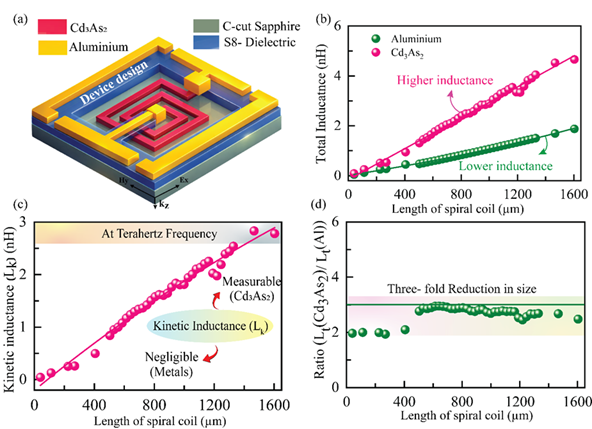
Miniaturised spiral inductor: a) Device design, (b) Total inductance of Aluminium and Cd₃As₂ inductor. (c) Kinetic inductance of Cd₃As₂ inductor, (d) Ratio of the total inductance of Cd₃As₂ inductor to that of the aluminium inductor.

Follow the Topic
-
Discover Electronics
This is a fully open access, peer-reviewed journal that supports multidisciplinary research and policy developments across the fields of electronics and electrical engineering.

Related Collections
With Collections, you can get published faster and increase your visibility.
Advanced Electronic Systems for Intelligent Sensing, Control, and Energy-Efficient Technologies
The ongoing development of electronic systems—fueled by advances in embedded architectures, intelligent sensing, nonlinear signal processing, and optoelectronic devices—has led to technologies that significantly impact education, energy, and industrial innovation. Modern research in electronics increasingly combines computational intelligence, photonic and optoelectronic components, nonlinear control, and complex dynamic behaviors. These trends are seen in current applications such as smart energy platforms, advanced sensor networks, precision instrumentation, autonomous systems, and high-performance communication hardware.
This collection aims to gather high-quality submissions focused on the design, modeling, implementation, and analysis of advanced electronic and optoelectronic systems. Of particular importance are works that combine theoretical frameworks with experimental validation, address nonlinear or complex dynamics in electronic and photonic circuits, and propose innovative solutions for real-world constraints in industry, infrastructure, and sustainable development.
The thematic scope of this collection is aligned with the research activity of the Guest Editors, whose academic trajectories include:
-Intelligent and embedded electronic systems
-Nonlinear dynamics and control in electrical and optoelectronic devices
-Design and analysis of complex electronics networks
-Modeling and implementation of photonic systems and optical communication components
-Signal amplification circuits
-Electronic architectures for sensing and measurement
-Hybrid dynamical systems
-Energy-efficient and resilient electronic platforms
-Novelty, chaotic or hyper-chaotic circuits and some applications
By combining these perspectives, the collection aims to promote interdisciplinary dialogue across electronics, photonics, applied physics, mechatronics, control engineering, and computational modeling. Contributions that explore emerging paradigms—such as photonic-assisted electronics, energy-efficient embedded computation, or nonlinear electronic systems showing multistability or chaotic behavior—are particularly welcomed.
Scope and Topics of Interest
Submissions may include, but are not limited to, the following topics:
Electronic Systems and Embedded Architectures
-Advanced embedded systems and microcontroller platforms
-Real-time implementation of control algorithms
-Intelligent and adaptive sensing architectures
-FPGA-based systems, SoC integration, and hardware acceleration
Nonlinear and Complex Dynamics in Electronic and Photonic Devices
-Nonlinear electronic circuits (e.g., Rössler, Chua, Duffing systems)
-Control, synchronization, bifurcation, stability and multi-stability analysis
-Applications of chaos and complex dynamics in sensing, communications, or encryption/decryption methods
-Photonic and optoelectronic systems exhibiting complex dynamical regimes
Optoelectronics, Photonics, and Communication Systems
-Laser-based systems for sensing, measurement, or amplification
-Fiber-optic communication components and signal conditioning
-Photonic devices integrated with electronic control
-Structured light systems, optical modulation, and high-gain amplifier modeling
-Fiber optic sensor
Energy-Efficient and Sustainable Electronic Technologies
-Power electronics for renewable-energy systems
-Energy-efficient signal processing and embedded computing
-Smart grids, advanced monitoring, and instrumentation
-Electronics for solar energy harvesting and storage management
-Portable energy intelligent stations
Modeling, Simulation, and Computational Methods
-Mathematical modeling of electronic, optoelectronic, and hybrid systems
-System identification and data-driven modeling
-Machine learning for electronic system optimization
-Real-time simulation environments (e.g., MATLAB/Simulink)
This Collection supports and amplifies research related to SDG 4, SDG 7 and SDG 9.
Keywords: Nonlinear dynamics in electronic systems; Chaotic and multistable circuits; Real-time control; Complex systems; Intelligent sensing; Energy-efficient electronics; Optoelectronics and photonic devices; Fiber-optic communication; Fiber optic sensor; Computational modeling &Renewable energy instrumentation
Publishing Model: Open Access
Deadline: Mar 16, 2027
Physics-based Modeling and Simulation of Semiconductor Devices for Circuit and System Design
Semiconductor device models are mathematical representations of the behavior of electronic components, which are essential building blocks of modern electronic circuits. These models capture the complex physical phenomena underlying the operation of semiconductor devices, allowing circuit and system designers to accurately predict the performance and behavior of electronic systems.
To make the most of semiconductor devices, compact device models and design software are crucial. Predictive and physical device models that work with circuit design software can speed up development cycles and address issues of device efficiency, manufacturing yield, and product stability. The performance and accuracy of the design software depend on having accurate device models, especially compact models for circuit design.
The development of accurate and efficient semiconductor device models is crucial for the design and optimization of a wide range of electronic systems, from simple analog circuits to complex digital integrated circuits. These models enable designers to explore different circuit topologies, optimize component values, and analyze the impact of various design parameters on the overall system performance.
Incorporating semiconductor device models into circuit and system design tools enables engineers to evaluate electronic circuits and systems before physical implementation, saving time and resources. This allows for the exploration of design alternatives, the identification of potential issues, and the optimization of circuit and system performance, ultimately leading to the development of more reliable and efficient electronic products.
To fully harness the unique and promising potential of emerging technologies, it is crucial that their experimental discoveries and advancements are supported by a deep understanding of the underlying physics and their implications at the materials, device, circuit, and system levels. Modelling novel materials and devices is expected to play a pivotal role in accelerating this process. These models should provide valuable insights into material properties, device operation, and scalability, while also enabling efficient and accurate estimates of performance and energy efficiency for circuits based on emerging technologies. As we strive to achieve revolutionary breakthroughs in computing and storage, models at different levels of design abstraction will be essential.
In support of this grand challenge, this Collection aims to address key issues in the field of device modelling for circuit and system design.
Suggested topics include, but are not limited to:
1. Emerging Topics
- Linking Atomistic/TCAD simulation to compact modeling
- Machine learning and compact modeling
- Millimeter wave frequency modeling for IoT and 5G/6G applications
- Automated Parameter extraction
- Modeling for biosensors
2. Modeling of Silicon based Transistor
- Advanced Bulk and SOI MOSFETs
- Multi-Gate, Nanosheet and GAA MOSFETs
- Junctionless MuGFETs
- Power and high voltage MOSFETs
3. Compound semiconductor FET modeling
- GaN HEMTs, MISHEMTs, and MOSFETs
- Wide bandgap devices for power electronics
4. Emerging semiconductor devices
- Steep-Slope Devices: Tunnel FETs, Negative Capacitance Transistors etc.
- Molecular transistors
- Single Electron Transistors
- Quantum Dot Transistors
- Memories - MRAM, PCRAM etc.
- Spintronic devices
- Layered/2D materials
- MEMS/NEMS
- Neuromorphic devices
5. Modeling of physical effects
- Noise
- High frequency operation
- Variability including mismatch and process statistics
- Strain
- High energy particle interactions in ICs (radiation effects)
- Ballistic and quasi-ballistic transport
- Layout dependent effects
6. Reliability and Variability Modeling
- Hot carrier degradation
- Electromigration/ESD events
- Radiation effects
- NBTI/PBTI
- Variability including mismatch and process statistics
7. Photonic devices and Modeling
- Photodiodes
- Solar cells
- LED, OLED etc.
This Collection supports and amplifies research related to SDG 9.
Keywords: Nanoscale MOSFETs, Modeling & Simulation of Nanoscale Devices, MOSFET Characterization, Emerging Non-CMOS Devices, Quantum-Mechanical Devices, 2D Materials, Emerging Nanoscale Devices, Quantum Devices, TFET, ISFET, Graphene, MoS2, Carbon Nanotube Transistor, NEMS
Publishing Model: Open Access
Deadline: Oct 31, 2026