Combating corruption and promoting economic resilience: legal and institutional reform in Saudi Arabia
Published in Social Sciences and Law, Politics & International Studies


Understanding how Saudi Arabia maintains economic resilience in the presence of corruption is a critical inquiry for both corruption studies and development economics, particularly in resource-rich and rent-dependent states. Corruption is widely recognized as a structural constraint on growth, institutional quality, and public trust, yet empirical outcomes across countries remain uneven. This study contributes to this debate by examining how Saudi Arabia has managed to sustain economic stability and growth despite acknowledged corruption risks, emphasizing the role of legal reforms, institutional design, and strategic public investment.
The article adopts a mixed-methods approach, combining quantitative indicators and qualitative institutional analysis over the period 2016–2022. This timeframe is particularly significant, as it coincides with intensified anti-corruption reforms and the broader economic transformation agenda under Vision 2030. Quantitative data include internationally recognized corruption and governance indicators, alongside macroeconomic and fiscal performance measures, while qualitative analysis focuses on legal reforms, oversight mechanisms, and institutional restructuring. This methodological integration allows the study to move beyond perception-based assessments and toward a more nuanced understanding of corruption’s functional impact on economic resilience.
A central finding of the study is that corruption in Saudi Arabia, while present, has not translated into systemic economic fragility. Instead, the Saudi case demonstrates that the negative effects of corruption can be mitigated through a combination of legal empowerment, centralized oversight, and targeted economic policy interventions. Key resilience drivers identified include oil wealth, which continues to provide fiscal buffers during periods of volatility, and economic diversification efforts aimed at reducing long-term dependence on oil. Importantly, the study does not treat oil wealth as a purely protective factor; rather, it acknowledges its dual role as both a potential source of rent-seeking and a stabilizing resource when managed through disciplined fiscal and institutional frameworks.
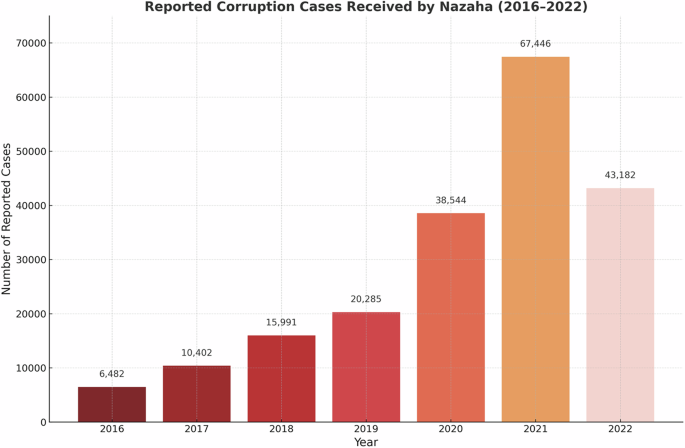
Legal and institutional reforms emerge as a decisive factor in shaping this outcome. The empowerment of oversight bodies, the strengthening of anti-corruption enforcement mechanisms, and the expansion of regulatory accountability have contributed to improved detection, investigation, and deterrence of corrupt practices. The study highlights that increased reporting of corruption cases during the study period should not be interpreted as worsening corruption levels, but rather as evidence of enhanced institutional capacity, transparency, and enforcement effectiveness. This distinction is essential, as misinterpretation of enforcement data often leads to inaccurate conclusions about reform failure rather than reform maturation.
From an economic resilience perspective, the findings suggest that proactive anti-corruption initiatives can coexist with, and even reinforce, growth-oriented policies. Targeted public investments—particularly in infrastructure, digital governance, and strategic sectors—have helped maintain investor confidence and economic momentum, even as anti-corruption measures intensified. This challenges the assumption that rigorous enforcement necessarily constrains economic activity, instead supporting the view that predictable legal frameworks and credible oversight enhance long-term economic performance.
The study also contributes to the broader literature by situating Saudi Arabia within comparative debates on corruption and development. While much of the existing scholarship focuses on Western or low-income contexts, this research underscores the importance of examining middle- and high-income resource-based economies with distinct governance models. The Saudi experience illustrates that anti-corruption effectiveness should be evaluated not only through perception indices but also through institutional performance, legal coherence, and economic outcomes. In doing so, the article calls for greater methodological pluralism in corruption research, particularly in contexts where traditional indicators may not fully capture enforcement dynamics or reform trajectories.
Overall, the article argues that Saudi Arabia’s economic resilience amid corruption is not accidental, nor solely a product of resource wealth. Rather, it reflects a deliberate strategy combining legal reform, institutional strengthening, and economic diversification. These findings have broader implications for other resource-rich and reform-oriented states seeking to balance anti-corruption enforcement with economic stability. By demonstrating how institutional capacity and legal empowerment can mitigate corruption’s economic harm, the study contributes to a more differentiated and policy-relevant understanding of corruption, governance, and resilience in contemporary development contexts.
Read the full article here. https://www.nature.com/articles/s41599-025-05873-x#Abs1

Dr. Omar Alatawi, an Assistant Professor with a keen interest in the intersection of Criminal Law, Administrative Law, and Anti-Corruption Strategies, brings a deep understanding of legal issues related to white-collar crime, regulatory compliance, and good governance practices. He actively investigates criminal law issues related to financial and administrative corruption and anti-corruption measures.
Follow the Topic
-
Humanities and Social Sciences Communications
A fully open-access, online journal publishing peer-reviewed research from across—and between—all areas of the humanities, behavioral and social sciences.

Related Collections
With Collections, you can get published faster and increase your visibility.
Environmental advocacy: psychological and behavioural dynamics
Publishing Model: Open Access
Deadline: Nov 25, 2026
Tourists, go home? Sustainable tourism in popular destinations
Publishing Model: Open Access
Deadline: Dec 18, 2026