Crystallographic Engineering Enables Fast Low‑Temperature Ion Transport of TiNb2O7 for Cold‑Region Lithium‑Ion Batteries
Published in Bioengineering & Biotechnology, Chemistry, and Materials
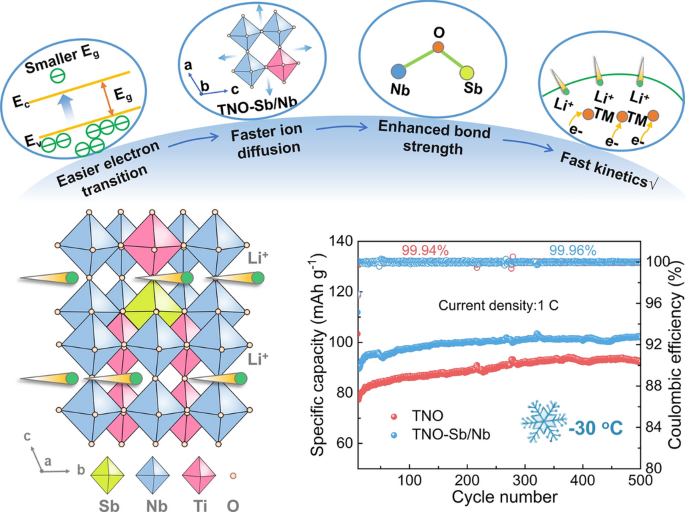

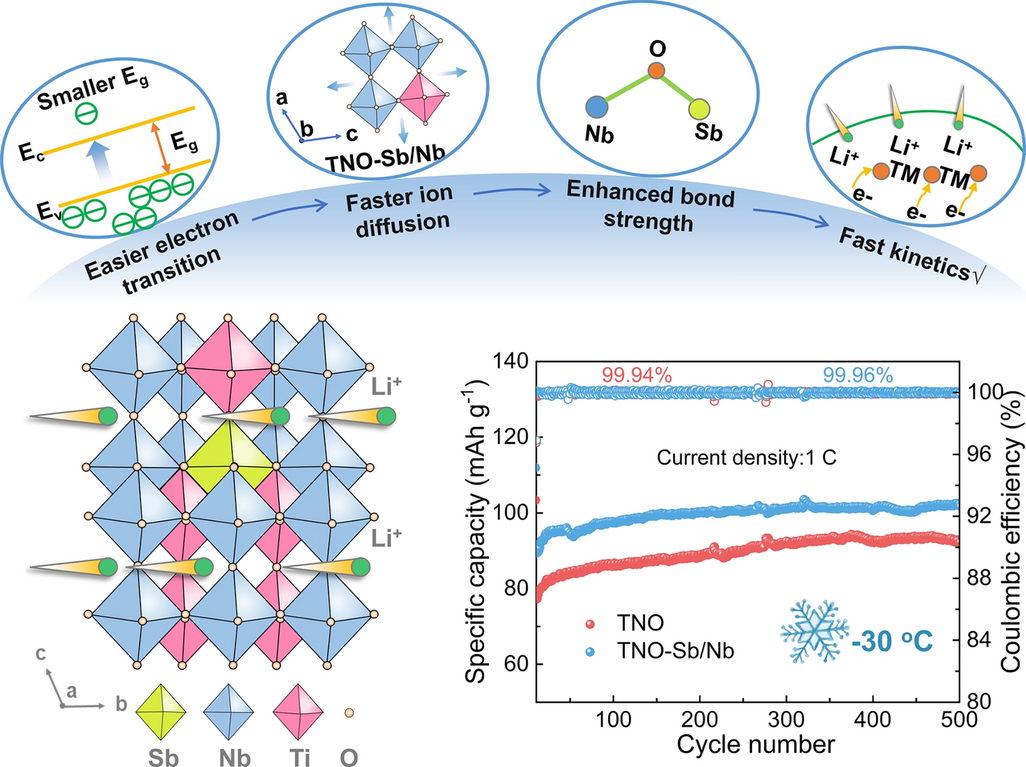

As fast-charging lithium-ion batteries race toward sub-zero markets, the anode bottleneck—graphite plating risk and Li4Ti5O12 capacity ceiling—intensifies. Now, researchers from Harbin Institute of Technology, led by Prof. Yan Zhang and Prof. Shuaifeng Lou, unveil an Sb/Nb co-doped TiNb2O7 (TNO) anode that unlocks 140 mAh g-1 at 20 C and 500 stable cycles at −30 °C. Published in Nano-Micro Letters, the work delivers a practical pouch cell delivering 1.14 Ah at 17 C with 93.8 % retention after 700 cycles.
Why Crystallographic Engineering Matters
- Band-Gap Narrowing: Sb5+substitution lowers the gap from 1.83 → 1.64 eV, doubling intrinsic electronic conductivity.
- Li⁺ Highway Expansion: Nb5+ enlarges lattice parameters a & c, cutting diffusion barrier from 0.96 → 0.74 eV along the b-axis.
- Low-T Robustness: Stronger Sb–O bonds (6.51 vs 6.13 eV ICOHP) suppress lattice distortion, holding volume swing to 9 % versus 9.5 % in pristine TNO.
Innovative Design & Features
- Single-Step Solid-State Route: Commercial Sb2O3+ Nb2O5 co-dope at 1100 °C yields 500 nm–2 µm rod crystals without secondary phases.
- Multi-Scale Verification: In-situ XRD tracks solid-solution → two-phase → solid-solution pathway; synchrotron 3D nano-CT shows crack-free grains after 500 cycles at −30 °C.
- Pseudocapacitive Boost: 92 % capacitive contribution at 1 mV s-1 enables 102 mAh g-1 at −30 °C with 99.96 % CE.
Applications & Future Outlook
- Pouch-Cell Validation: TNO-Sb/Nb || NCM (N/P 1.05) delivers 94 Wh kg-1, 243 Wh L-1and 0.0089 % fade per cycle at 3 C.
- Extreme Climate Suitability: Stable from −40 °C (101 mAh g-1, 0.2 C) to high-rate 20 C, outperforming 14 reported TNO variants.
- Scalable Pathway: Earth-abundant dopants and ambient-air synthesis position the material for gigafactory adoption in cold-region EVs and aviation.

Editor of Nano-Micro Letters, which is an Open-Access, peer-reviewed journal reported papers that have at least one dimension ranging from a few sub-nanometers to a few hundreds of micrometers. The journal is published by Springer Nature and indexed by SCI, EI, SCOPUS, Pubmed, etc. The 2025 JCR Impact Factor is 38.5. The 2025 CiteScore is 58.9.
Follow the Topic
-
Nano-Micro Letters
Nano-Micro Letters is a peer-reviewed, international, interdisciplinary and open-access journal that focus on science, experiments, engineering, technologies and applications of nano- or microscale structure and system in physics, chemistry, biology, material science, and pharmacy.