Daycare at conferences
Published in Bioengineering & Biotechnology, Cell & Molecular Biology, and Behavioural Sciences & Psychology





Ok, pool slides are rare but indoor playrooms are common, when you can find conference daycare. In the past, sadly, and in too many cases, scientific conferences did not set up daycare for the children of attendees. In recent years, that has changed as conference organizers adjusted their practices. The cost of daycare is often subsidized by the conference organizer.
Here is a story I did for Nature Methods on the subject of conference daycare—I interviewed scientists who are also mothers. The conference attendees told me about their experience with daycare at conferences: the American Society for Human Genetics annual meeting and some also spoke about their experience with daycare at the annual Society of Neuroscience meeting.
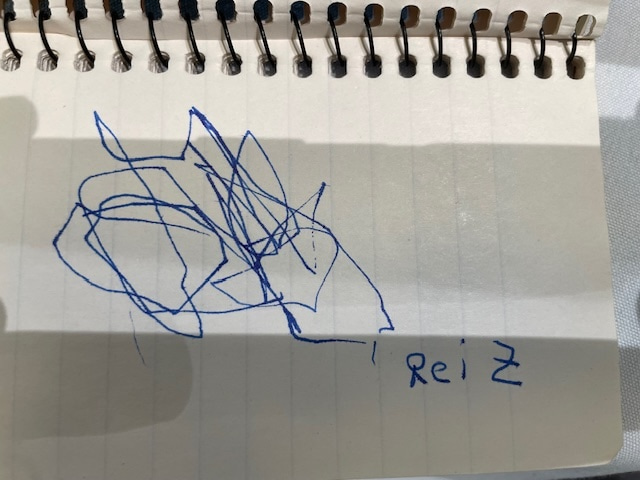
I interviewed children, too. Rei is one of the interviewees, he is two years old. And although he stopped singing when I held up a mic to capture his singing, he did find it ok--with his mom's consent, of course--to draw in my notebook. She is Dr. Saori Sakaue, a genomics researcher at the University of Washington and is also in the story. She availed herself of the daycare offering at the ASHG annual meeting.

I signed his drawing 'Rei Z' because that is how I read his daycare name tag. But it was a number 2, not a Z, silly me. So here is original artwork by Rei.
It’s genuinely good news that childcare is being offered at more conferences, such as ASHG and SfN, says University of California Davis neuroscientist Dr. Rebecca Calisi Rodríguez. “But these services need to be visible, affordable, and inclusive,” she says. “Childcare should be highlighted as proudly as the keynote lineup, because both determine who gets to be in the room.”
In the experience of some of my interviewees, the daycare offering was not advertised well and hard to find, which made their travel planning difficult. “Offering childcare but failing to advertise it is like building a ramp to the back of the building and not putting up a sign. Accessibility without visibility isn’t equity,” she says.
In 2018, Rebecca Calisi Rodríguez co-authored an opinion piece in the Proceedings of the National Academy of Sciences on the lack of conference childcare.

Her co-authors were from a working group of the nonprofit organization Mothers in Science , The organization Mothers in Science also has resources about fathers and fatherhood
In the paper, they note:
“Supporting childcare, either at home or at the event, would overcome a major hurdle to conference attendance. …Onsite facilities, such as those provided by the Society for Neuroscience and the Society for Integrative and Comparative Biology, allow for frequent check-ins from parents and support breastfeeding.”
…the Society for Molecular Biology and Evolution, the American Society of Cell Biology, the Genetics Society of America, the American Society of Plant Biologists, the European Society for Evolutionary Biology, and other organizations offer grants to fund travel and housing for a caregiver to attend their annual meeting.”
On the subject of parent-child schedule-juggling they point out:
“Welcoming children at social events, such as society lunches and banquets, can help parents feed their children more easily without removing themselves from conference social activities and potential networking opportunities. To assuage parent–child schedule-juggling challenges, smaller conferences might even consider offering early-registrant parents flexibility in selecting the day or time they give their presentation.”
I caught up with Dr. Calisi Rodríguez who is in the Nature Methods story, too. Here, I am sharing some of her additional thoughts. “In 2018, we were just beginning to see conference organizers take childcare seriously as a matter of equity, not convenience,“ she says. Changes have taken place and there has been progress. “More conferences now offer onsite care or family grants, but access and affordability remain the choke points,” she says. Now what is needed, she says, is for these supports to be normalized, not have them be exceptional.
It’s her sense that the conversation has shifted from whether to provide childcare to how equitably it’s provided. “That’s an important cultural shift, but it’s still not universal, and parents, especially trainees, continue to pay the price for patchy implementation.”
According to Mothers in Science, 34% of mothers globally leave full-time STEMM employment in science, technology, engineering, math and medicine (STEMM) after having children. The ‘baby penalty’ hasn’t disappeared, but it has evolved, says Calisi Rodríguez.
“Even when mothers remain in science, they often face slowed advancement, fewer leadership opportunities, and lingering bias about their commitment,” she says. In her view, until caregiving is valued as integral to human life and not as a not a career liability, the gap will persist.
Awareness has grown. “What hasn’t changed enough is the structure,” she says. “Awareness without accountability doesn’t close the gap.”
An important aspect about childcare is cost and this is true for childcare at conferences. Interviewees in the story talked about this. For many parents, especially trainees or international scholars, the cost of childcare at conferences remains prohibitive and for graduate students, “it’s more often than not impossible.” But pricing out parents means a loss of talent in the scientific community. Overall, she says, “We’ve made progress, but piecemeal solutions won’t fix systemic exclusion.“
-
Just adding that after I first published this, I heard from parents.
Guy Plunkett III, senior scientist emeritus from the University of Wisconsin-Madison mentioned that female scientists mainly face this juggle about childcare but fathers face plenty of conundrums on the subject of childcare.
As a post-doctoral fellow at University of California, Berkeley, Plunkett had to skip several department retreats. "My wife was a nurse who worked night shifts, and with no care options for our 3-year old son I had to be home every night," says Plunkett. "In memory of those times, I have for years donated to the UW-Madison Department of Bacteriology's Moms on the Go Fund." The fund provides support for parents of all genders who need help with childcare to attend conferences and other events.
Additional resources:
The Society for Molecular Biology & Evolution (SBME) has caregiver awards. The meeting provides daycare and offers up to $2,000 to SMBE members with children or dependent adults --this includes adult children with a disability or elderly relatives, or those in need of personal assistance" to spend as they wish to facilitate the member’s attendance at the annual SMBE meeting and SMBE satellite meetings. " (Thank you to UCSC's Russ Corbett-Detig for mentioning this).

(GoodLifeStudio/Getty Images)