Designing Amino Functionalized Titanium-Organic Framework on Separators Toward Sieving and Redistribution of Polysulfides in Lithium-Sulfur Batteries
Published in Materials


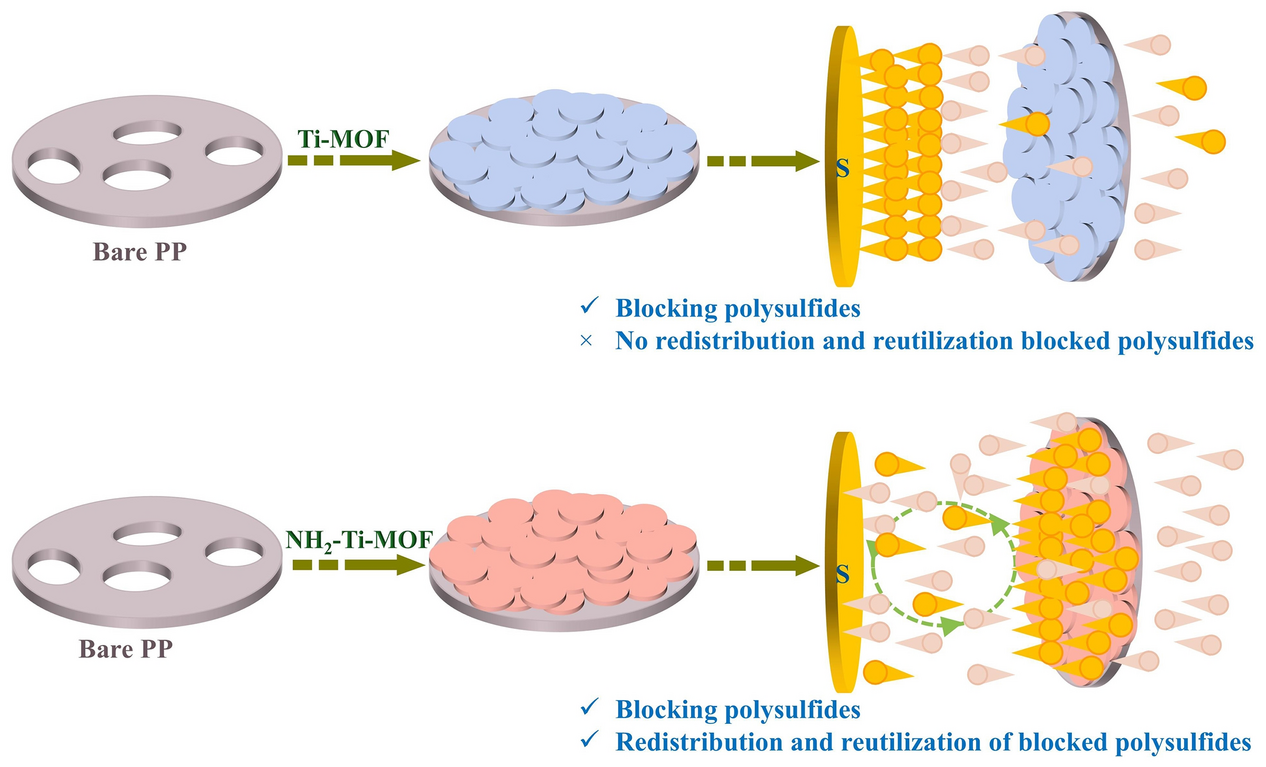

Lithium–sulfur batteries (LSBs) are poised to reshape energy storage with their ultra-high theoretical capacity (1675 mAh g-1) and energy density (2800 Wh kg-1). Yet, the notorious “polysulfide shuttle” continues to erode cycle life and slash sulfur utilization. Now, researchers from the State Key Laboratory of Advanced Processing and Recycling of Non-Ferrous Metals at Lanzhou University, led by Professor Fen Ran, unveil a precision separator coating that turns the old problem into a new advantage. Their work, reported in Nano-Micro Letters, delivers a sub-nanometer ionic gate that not only blocks polysulfides but also re-uses them.
Why This MOF Coating Matters
- Sub-nanometer precision gate: The –NH2 functional group shrinks Ti–MOF pore size from 0.95–1.10 nm to a uniform 0.83 nm—exactly the “sweet spot” that sieves out long-chain polysulfides while letting solvated Li+ slip through unhindered.
- Electrostatic recycling station: Positively charged –NH2 moieties act as a dynamic depot, adsorbing escaped polysulfides via electrostatic attraction, then releasing them back to the cathode during charge—boosting active-material utilization and extending cycle life.
- Lewis acid–base fast lanes: Nitrogen lone-pairs form transient Li+–N coordination bonds, lowering desolvation energy and guiding directional Li+ transport, cutting polarization to 0.15 V at 0.1 C.
Engineering the Functional Separator
- One-step solvothermal synthesis of NH2–Ti–MOF nanocakes (~200 nm) followed by low-temperature activation (250 °C, N2) to open micropores without collapse.
- Doctor-blade coating onto commercial Celgard® 2500 yields a dense 9-μm layer (0.37–0.50 mg cm-2) that withstands 180 °C thermal abuse and retains structural integrity even after 1003 cycles.
- Coin-cell validation with Ketjenblack/S cathodes (0.84–1.0 mg cm-2 S) shows an ultralow capacity fade of 0.045 % per cycle over 1 000 cycles at 1 C—outperforming bare PP (0.073 %) and Ti–MOF-only (0.056 %) controls.
Characterizing the Nano-Gate
- Visual shuttle test: In an H-cell, a 0.83 nm NH2–Ti–MOF membrane keeps Li2S6 solution colorless for 24 h, while PP and Ti–MOF separators show visible yellowing—direct evidence of suppressed crossover.
- In-situ Raman mapping: After discharge to 1.7 V, separator-facing Li anode surfaces reveal zeropolysulfide signatures for NH2–Ti–MOF, versus strong S62- peaks for PP.
- DFT & MD calculations: Adsorption energies for Li2S4, Li2S6, and Li2S8 on –NH2 sites jump by 0.3–0.5 eV compared to pristine Ti–MOF, while MD shows a 150.8 kJ mol-1 diffusion barrier for S62- through 0.83 nm pores.
Future Outlook
- Scalable roll-to-roll coating: The cake-like morphology and benign aqueous/methanol processing route promise compatibility with industry-scale separator production lines.
- High-loading cathodes: Preliminary tests at 3.0 mg cm-² sulfur still deliver 403.7 mAh g-1after 153 cycles, indicating robustness under practical areal capacities.
- Next-gen chemistries: The same gating concept can be extended to Na–S, K–S, or even solid-state systems by tuning pore size and surface functionality.
With a single, elegantly engineered layer, the Lanzhou team transforms the separator from passive barrier to active polysulfide gatekeeper—ushering lithium–sulfur batteries toward real-world, long-lifetime deployment.

Editor of Nano-Micro Letters, which is an Open-Access, peer-reviewed journal reported papers that have at least one dimension ranging from a few sub-nanometers to a few hundreds of micrometers. The journal is published by Springer Nature and indexed by SCI, EI, SCOPUS, Pubmed, etc. The 2025 JCR Impact Factor is 38.5. The 2025 CiteScore is 58.9.
Follow the Topic
-
Nano-Micro Letters
Nano-Micro Letters is a peer-reviewed, international, interdisciplinary and open-access journal that focus on science, experiments, engineering, technologies and applications of nano- or microscale structure and system in physics, chemistry, biology, material science, and pharmacy.


Please sign in or register for FREE
If you are a registered user on Research Communities by Springer Nature, please sign in