Dynamic Network‑ and Microcellular Architecture‑Driven Biomass Elastomer toward Sustainable and Versatile Soft Electronics
Published in Electrical & Electronic Engineering and Materials
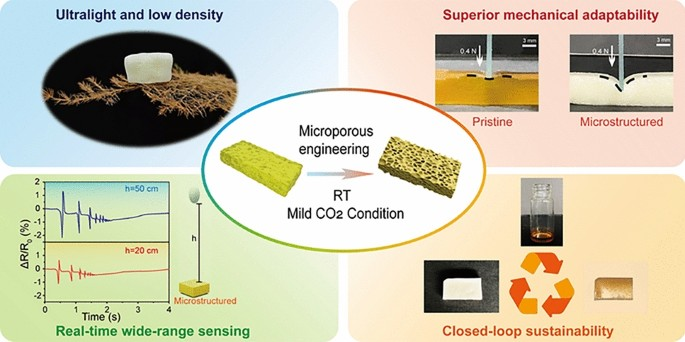


Soft sensors that feel gentle taps yet survive 500 % stretch still rely on petro-based rubbers and energy-intense foaming. A ZJUT–USTC–Xi’an Jiaotong team led by Prof. Shanqiu Liu and Prof. Jingguo Li now twists lipoic-acid chemistry into an ultralight (~0.25 g cm-3) biomass conductive elastomer that self-foams at room temperature under 2 MPa CO2, heals in 5 h and recycles five times without property loss. The resulting “micro-spring” lattice delivers a gauge factor of 4.8 under 1 % strain, rebounds 93 % after 200 % pull and tracks handwriting, heartbeat and ball drops in real time.
Why This Matters
- Mild, Scalable Foaming: CO2 plasticises dynamic disulfide/H-bond networks at 25 °C—80 % less energy and pressure than super-critical routes—yet yields 70 % porosity and 5× volume expansion.
- Micro-Spring Sensitivity: Closed cells act as strain amplifiers; GF jumps 3× in tension and 2.75× in compression versus the dense film, while cyclic drift stays <1 % over 100 cycles.
- Self-Healing & Closed-Loop Recycling: Cut samples rejoin at room temp, restoring 90 % mechanical and 98 % electrical performance; ethanol depolymerisation separates nano-fillers, ionic liquid and polymer for direct reuse.
- Green Feedstock: All building blocks (lipoic acid, SiO2, imidazolium sulfate) are bio-sourced or recyclable, cutting cradle-to-gate CO2 footprint by 45 %.
Innovative Design & Features
- Dynamic Crosslink Toolbox: Disulfide metathesis provides covalent reversibility; ionic liquid forms CO2-affinity sites that lower nucleation energy and furnish long-range ionic pathways (~0.65× dense-state conductivity).
- Tunable Architecture: Pore size (20–200 µm) and density are dialled by CO2 pressure (1–5 MPa) and nano-filler loading, giving density as low as 0.18 g cm-3—light enough to rest on a dandelion.
- Multi-Modal Sensing: Detects <1 % micro-strain, 50 µN contact force, 0.3 s rapid deformation and 5 °C temperature steps; handwriting and droplet impacts generate distinct, reproducible resistance patterns.
Applications & Future Outlook
- Wearable Health Patches: 300-µm film laminated on fabric monitors pulse, respiration and joint flexion with <0.05 s lag, surviving 10000 bend cycles.
- Soft-Robot Skin: Foam strips wrapped around grippers provide tactile feedback for delicate fruit handling, maintaining sensitivity after 500 % inflation.
- Circular Manufacturing: Team is scaling a roll-to-roll CO2chamber (1 m min-1) and exploring wireless BLE modules that dissolve in ethanol for tech-metal recovery.
By marrying a biomass backbone with CO2-blown micro-springs, the work offers a production-ready route to sensing foams that are light, tough, healable and endlessly reusable—pointing toward truly sustainable soft electronics that can be worn, folded, recycled and reborn.

Editor of Nano-Micro Letters, which is an Open-Access, peer-reviewed journal reported papers that have at least one dimension ranging from a few sub-nanometers to a few hundreds of micrometers. The journal is published by Springer Nature and indexed by SCI, EI, SCOPUS, Pubmed, etc. The 2024 JCR Impact Factor is 36.3. The 2024 CiteScore is 53.1.
Follow the Topic
-
Nano-Micro Letters

Nano-Micro Letters is a peer-reviewed, international, interdisciplinary and open-access journal that focus on science, experiments, engineering, technologies and applications of nano- or microscale structure and system in physics, chemistry, biology, material science, and pharmacy.
Please sign in or register for FREE
If you are a registered user on Research Communities by Springer Nature, please sign in