Effective air pollution prediction using wavenet deep learning with Xgboost (1DCNN-BiLSTM-XgRC) for urban US embassies
Published in Earth & Environment and Mathematics



The reality highlights the pressing need for accurate forecasting models to address this challenge effectively. In this study, we proposed a hybrid Pro-1: Proposed 1DCNN-BiLSTMmodel, where a wavenet architecture combined with two 1DCNN branches feeds into a BiLSTM layer for PM2.5 prediction. Furthermore, introduce an enhanced version, the Proposed 1DCNN-BiLSTM-XGBoost residual correction model, which incorporates XGBoost-based residual correction to optimize prediction accuracy. The proposed models are compared to traditional deep learning models like BiLSTM, CNN, GRU, LSTM, and RNN. The Pro-1 model demonstrates a noteworthy improvement in RMSE compared to the CNN model, recording a value of 79.909 ± 19.760 across the dataset. It achieves a minimum RMSE of 3.463 in the Colombo dataset, while the Pro-2 model has an RMSE of 0.2658 in the same dataset. The Pro-1 model’s maximum RMSE reaches 23.778 in the Ulaanbaatar dataset, whereas Pro-2 peaks at 2.554. Pro-2 consistently outperforms all models, achieving the lowest RMSE, MAE, and MSE across all cities, as demonstrated by Friedman’s post hoc test, which ranked 1st with statistically significant improvements. The model ranking was 1DCNN − BiLSTM − XGBoost > 1DCNN − BiLSTM > BiLSTM > GRU > LSTM > RNN > CNN to the RMSE. Further, the Diebold-Mariano test, AIC-BIC test, and Taylor diagrams will be used to validate the proposed models. These results establish the proposed models as the most effective predictive model for PM2.5 forecasting, offering improved accuracy and reliability for air pollution monitoring.
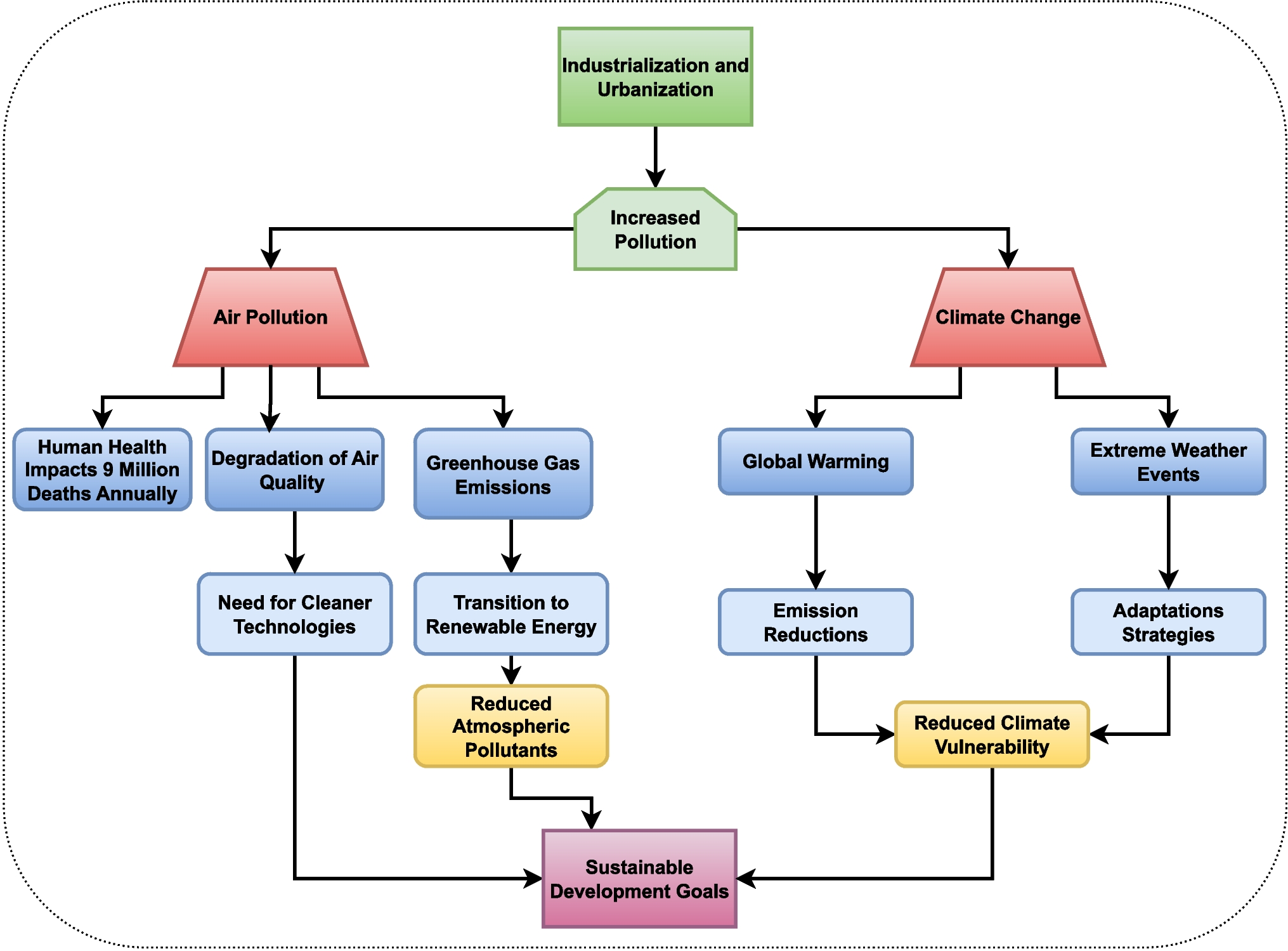
Air pollution is hazardous to human health. The quality of the air decreases day by day. It is one of the most common causes of environmental issues, leading to droughts, heat waves, floods, and forest fires. Climate change looks like a natural phenomenon, but humans cause the truth behind it Suthar and Singh (2025). Climate change has long-term and short-term effects on humans. High levels of pollutant gases are one of the causes of modifying the natural characteristics of the atmosphere. Air pollution is a critical issue that demands immediate attention, as it significantly contributes to climate change and adversely affects human health (Saxena 2025). Both pollutant and meteorological parameters alter the climate, making it essential to monitor and manage these factors effectively (Singh and Suthar 2025). Exceeding pollutant concentrations like particulate matter, carbon dioxide, nitrogen oxide, sulfur dioxide, and carbon monoxide affect humans and the atmosphere (Arooj et al. 2025).
The authors compiled 17 comprehensive datasets from all US embassies and consulates, representing a population of 1.5 million, with historical data available since 2017. Among these datasets, only 10 contain fewer than 10,000 missing values, and several do not include data for the year 2023. The high proportion of missing values can significantly hinder effective model building. To address this issue, the author imputed all missing values by using the mean of the corresponding PM2.5 features. The approach calculates the average while excluding zeros, effectively minimizing the impact of outliers and ensuring our analysis remains accurate and reliable. The data originates from US embassies and official air monitoring stations, utilizing PM2.5 datasets from multiple cities, including Abu Dhabi, Beijing, Colombo, Delhi, Dhaka, Jakarta, Kampala, Kuwait City, Manama, and Ulaanbaatar.
Traditional statistical and machine learning models often fail to capture air pollution data’s highly nonlinear and complex temporal patterns. This research addresses the challenge of accurately predicting air pollution concentrations at urban U.S. embassies, crucial monitoring points in international cities. The comparison of LSTM and ANN models for daily ozone forecasting in Liaocheng City illustrates the practical advantages of recurrent structures in capturing temporal dependencies in atmospheric pollutant levels.
This experiment, a time series window of 10 time steps and 10 steps was utilized for a batch size of 10. The model architecture in both models is two branches: 1DCNN, then BiLSTM. The Xgboost was used in Pro-2 to improve the model’s accuracy. Uses of the regularization in the Xgboost regression model, in which alpha and lambda are one. The authors trained all traditional and proposed models for epoch 200 with a callback reduceLROnPlateau, and EarlyStopping when the model fully qualified for all the datasets.
https://doi.org/10.1007/s00704-025-05715-5

Follow the Topic
-
Theoretical and Applied Climatology

Theoretical and Applied Climatology, founded in 1949, showcases latest and significant developments from global studies in climate, atmosphere, and meteorology. A successor to Meteorologische Zeitschrift, it carries forward the traditions of one of the world’s oldest meteorological journals.
Related Collections
With Collections, you can get published faster and increase your visibility.
Climate Extremes and Urban Resilience: Integrating Physical Process, Adaptation Strategies, and Socio-Economic Impacts
Publishing Model: Hybrid
Deadline: Oct 30, 2027
Please sign in or register for FREE
If you are a registered user on Research Communities by Springer Nature, please sign in