Entangling Motional Atoms and an Optical Loop at Ambient Condition
Published in Physics

Human perception of the real-life world is mainly derived from the phenomena of macroscopic matter movements, described by the laws of classical physics. Quantum mechanics, however, endows the nature of superposition and entanglement is able to express the universe in a clearer and more concise manner. Therefore, expanding quantum theory to more general ambient systems and exploring the quantum phenomena in macroscopic objects push the researches of the transition boundary between classical and quantum realm [1,2]. On the other hand, the capability of establishing and sharing remote high-fidelity entanglement over long distances is necessary for scalable quantum technologies which promise to outperform their classical counterparts, such as in the areas of communication, computing, sensing and metrology.
Over the past two decades, enormous advances have been made in entangling macroscopic systems, and quantum entanglement has been observed in some matter systems, such as atomic ensembles, individual atoms, trapped ions, quantum dots, color centers and massive mechanical oscillators. While, due to strong internal interactions and external coupling with the environment, it is still challenging to observe quantum entanglement with a low noise level in macroscopic systems at ambient condition. Photons, as the most widely-used state carriers in quantum world today, still suffer from inevitable loss, either propagating in free space or optical fibers. Together with the probabilistic nature of quantum mechanics, the creation and dissemination of the entangled states are hard to be scalable for longer distances or for more nodes in a quantum network.
Creating the heralded entanglement between two quantum memories
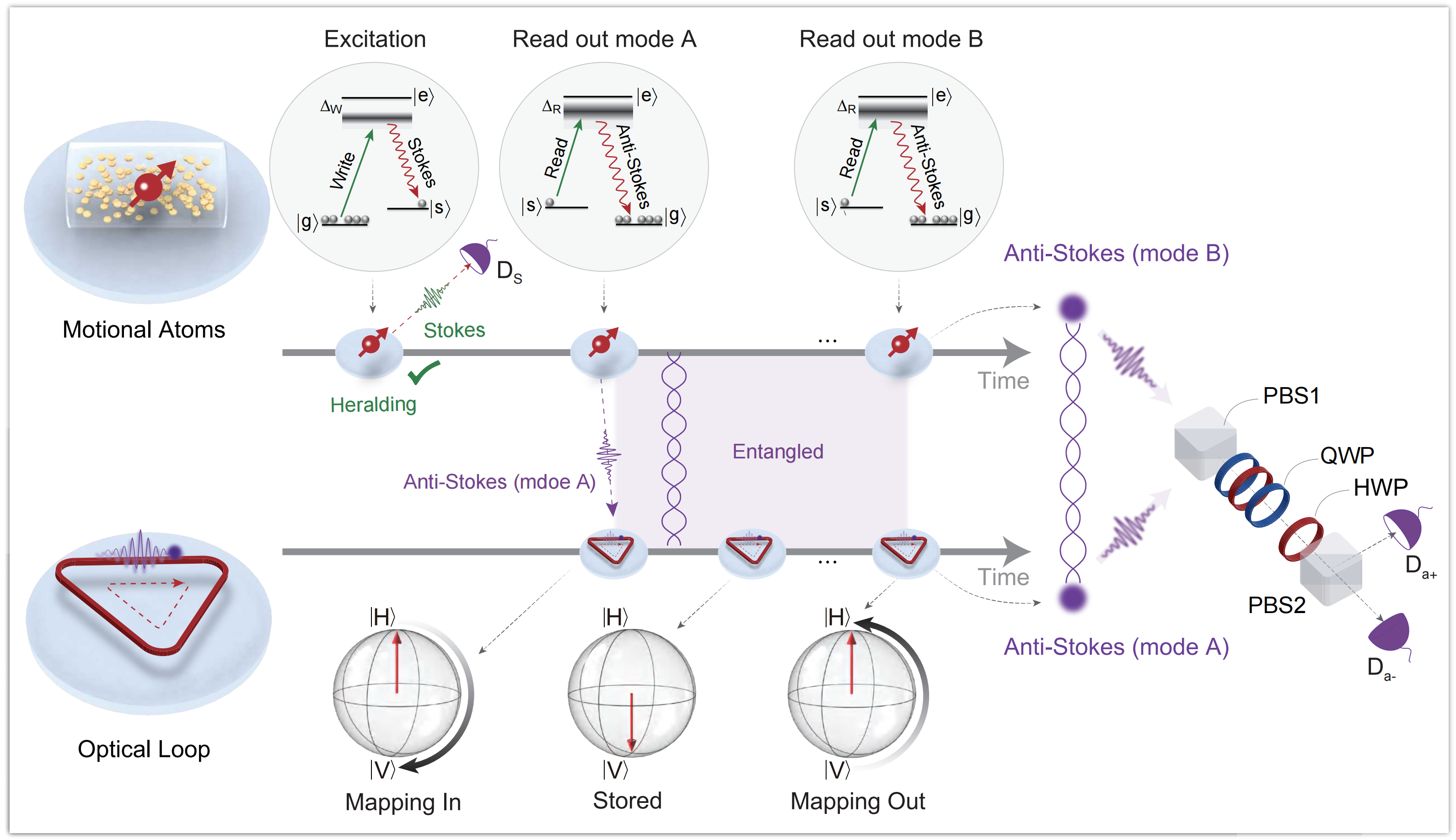
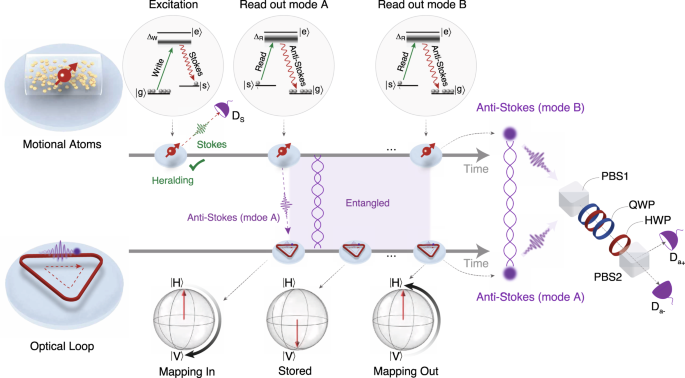
In this work, we demonstrate the creation of the heralded entanglement between two different room-temperature quantum memories: a single-photon entangled state delocalized between motional atoms as a collective excitation and an all-optical loop as a flying qubit. The experimental scheme used for generating photons is based on the far off-resonance Duan-Lukin-Cirac-Zoller protocol in a memory-built-in fashion, and its implementations have been demonstrated as intrinsically broadband and low-noise at room temperature [3]. Initially, motional atoms are prepared into the ground state, waiting for the write pulse to produce an excitation among atoms, and meanwhile, the process is accompanied by a flying Stokes photon via spontaneous Raman scattering to herald a successful creation of an excitation. After a programmable storage time, the collective excitation state can be probabilistically mapped out as an anti-Stokes photon, and into various temporal modes by a series of read pulse. The probability distribution can be tuned by applying different amplitudes of each read pulse. An all-optical loop serves as another quantum memory node, for mapping flying anti-Stokes modes in and out with programmable storage times individually. Once a Stokes photon occurs, the horizontally-polarized anti-Stokes mode entering the loop will be converted to vertically polarized, so that the photon will be trapped in the optical loop until its polarization is converted back. Thus, the heralded entanglement between two quantum memories is established.
The verification of the entanglement
To reveal the quantum entanglement, the states stored in these two quantum memories are mapped back to optical modes, then via a single-photon interference. We observe the single-photon interference curve, and the calculated visibility value up to (88 ± 5)% indicates that the coherence between two stored modes is preserved well during the storage time. We demonstrate a non-zero concurrence [4] of the retrieved light modes, and also observe a violation of Cauchy-Schwarz inequality up to 209 SDs, which implies that the non-classical feature of the photons is demonstrated with high confidence. A cross-correlation value up to 15.39±0.26 is obtained, which well exceeds the boundary of 6 above which quantum correlation is able to violate Bell’s inequality.
Discussion and perspectives
For the optical loop memory, the limitation of storage efficiency and lifetime is set by the transmission efficiency of the Pockels cell. The Pockels cell with a higher transmission efficiency and a higher bandwidth is about to be upgraded. For the DLCZ memory based on warm atoms, the dominant factor of decoherence mechanism is random motion induced loss of atoms. By keeping atoms staying in the interaction region, applying a small-diameter cell is an available way to alleviate the above detrimental effect for longer memory lifetime [5]. In addition, anti-relaxation coating should be adopted to preserve the atomic polarization during the collision between atoms and the inner wall of glass cell. Besides, it is promising to prolong the storage time of quantum memory by transferring the spin wave of alkaline metal atoms to noble-gas nuclear spins in the regime of spin exchanging, as is proposed in [6].
Our results show that quantum entanglement can be sustained in macroscopic matters at ambient condition, which enriches the fundamental researches of the transition boundary between quantum and classical worlds. The large time bandwidth product and the ability of operating at ambient condition of both quantum memories make the network promptly applicable. It highlights the potential cooperation between atomic ensembles and all-optical loop as quantum nodes at ambient condition, bringing a significant step towards practical quantum networks.
References
[1] Zarkeshian, P. et al. Entanglement between more than two hundred macroscopic atomic ensembles in a solid. Nat. Commun. 8, 906 (2017).
[2] Kotler, S. et al. Direct observation of deterministic macroscopic entanglement. Science 372, 622-625 (2021).
[3] Dou, J. P. et al. A broadband DLCZ quantum memory in room-temperature atoms. Commun. Physics. 1, 55 (2018).
[4] Chou, C. W. et al. Measurement-induced entanglement for excitation stored in remote atomic ensembles. Nature 438, 828-832 (2005).
[5] Dideriksen, K. B., Schmieg, R., Zugenmaier, M. & Polzik, E. S. Room-temperature singlephoton source with near-millisecond built-in memory. Nat. Commun. 12, 3699 (2021).
[6] Katz, O., Shaham, R. & Firstenberg, O. Quantum interface for noble-gas spins based on spin-exchange collisions. PRX Quantum 3, 010305 (2022).

Follow the Topic
-
npj Quantum Information
The scope of this journal spans across all relevant disciplines, fields, approaches and levels and so considers outstanding work ranging from fundamental research to applications and technologies.

Related Collections
With Collections, you can get published faster and increase your visibility.
Foundations and Advances in HPC/AI-Quantum Co-Design
Publishing Model: Open Access
Deadline: Dec 20, 2026
Quantum-Enabled Bioimaging
Publishing Model: Open Access
Deadline: Nov 04, 2026