Evaluation of Anticholinesterase Activity of Orthoclase and Kaolin from Selected Yemeni Stones: Potential Anti-Alzheimer Agents
Published in Chemistry and Biomedical Research



Background and Objectives
There are many Yemeni stones that have demonstrate different biological activities that could be used as source of promising drugs. These stones can have interesting activities .the stones Are effectiveness as antimicrobial ,antioxidant and also anti-Alzheimer's diseases .Therefore, this study will concern on the study of some selected stones as antimicrobial and anti-oxidant activities and evaluate the in vivo activity of stones as anti-Alzheimer activity. To elevate the targeted biological activities ,stones were collected based on the present of silica , aluminum and other minerals for activities .
Materials and Methods
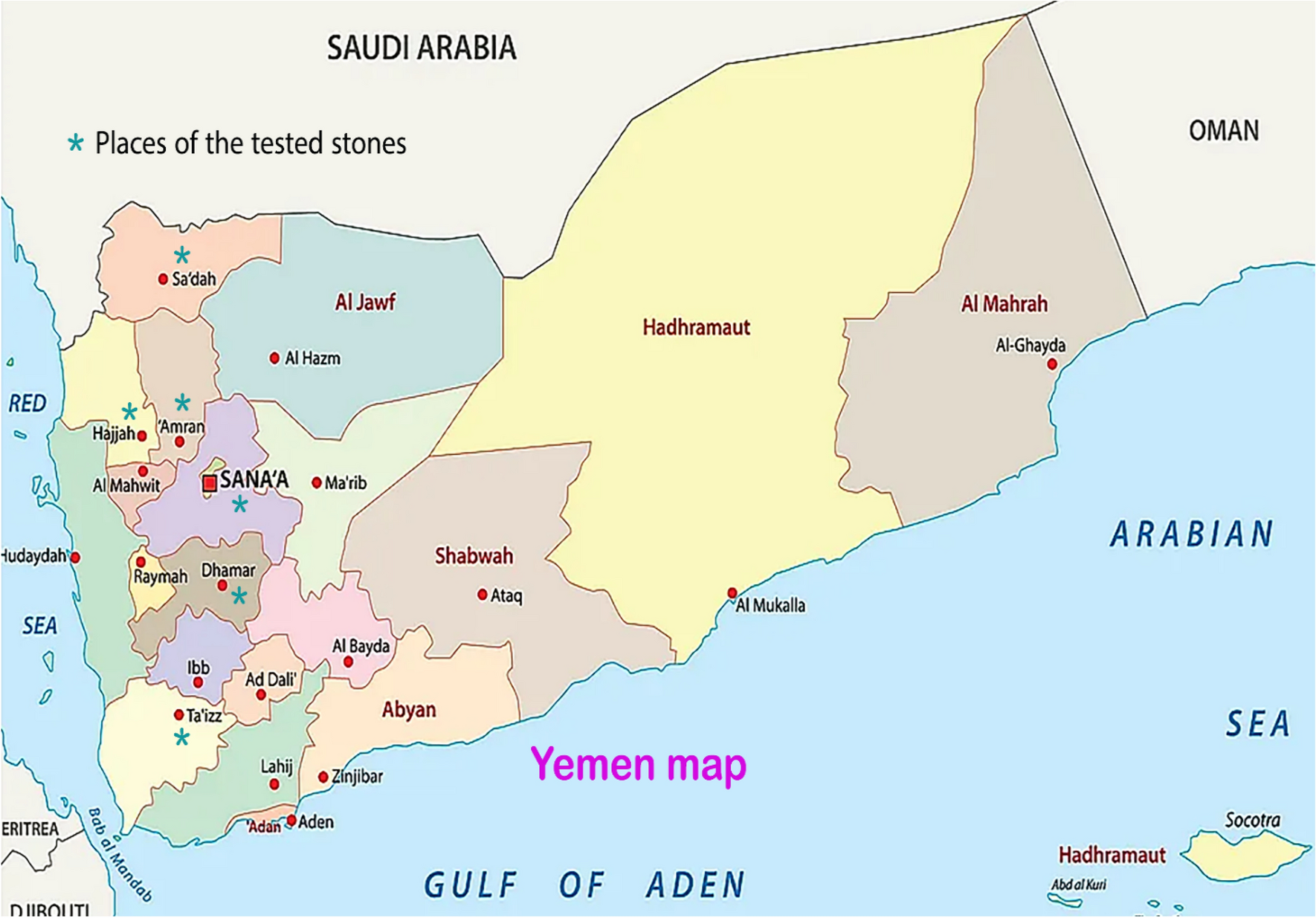
The collected stones responsible. Were studied between the period of collected stones were between December 2023 to October 2023. The stones were collected from different places in Yemen .Then the anti-microbial activity Escherichia coli , Klebsiella Staphylococcus aurous , Enterobacter , Candida were evaluated by measuring the inhibition zone and MIC(minimum inhibition zone ).The antioxidant activity were measured by determining the free radical scarving activity by DPPH. While the in- vivo activity of Orthoclase and Kaolin as anti-Alzheimer activity was elevated by measuring the behavior activity of the water maze test. Followed by conducting histopathology to the tested rats
Results
The Yemeni stones show significant biological activity, and antimicrobial activity against many types of G+ and G- bacteria and candida, the stones show stronger activity against G-+ve bacteria rather than G-ve bacteria with MIC. The collected kaolin sample showed the strongest antimicrobial activity with MIC 0.424 mg and MBC 0.683mg.Evaluation of the samples as antioxidant were strong, the orthoclase showed the strongest activity. In Alzheimer's disease the orthoclase sample showed the strongest activity when compared with the standard drug Donepezil with IC50 0.081ꭒg/ml the Orthoclase and Kaolin compared with donepezil were showed promosing activity and improvement the behavioral activity at the Morris test. In while Orthoclase and Kaolin give escape latency time 15,77 second compared with standard drug donepezil 14,9 second and non-treated mice 57,44 and normal rat 14,89 seconds
Conclusion
The results of the current study confirm the antimicrobial, antioxidant, and anti-Alzheimer disease of some Yemeni stones. The stone kaolin which was collected from Amran, Saada shows antimicrobial activity. the stone orthoclase shows good anti-oxidant activity and anti-Alzheimer disease. All biological activity achieved by stones might be associated with the presence of silicon and calcium in high concentrations

Follow the Topic
-
Discover Applied Sciences
This is a multi-disciplinary, peer-reviewed journal for the disciplines of Applied Life Sciences, Chemistry, Earth and Environmental Sciences, Engineering, Materials Science and Physics, fostering sound scientific discovery to solve practical problems.

Related Collections
With Collections, you can get published faster and increase your visibility.
Engineering: Machine Learning, AI, and Deep Learning Applications in Microwave Engineering: Devices and Communication
This Topical Collection is dedicated to highlighting the application of Machine Learning (ML), Artificial Intelligence (AI) and Deep Learning (DL) in the field of Microwave Engineering: Devices and Communication. It will concentrate on AI/ML/DL approaches in Microwave Engineering, which includes new breakthroughs, design and performance techniques of various Microwave Devices like Antennas, Filters, Couplers etc. Starting with single/multiband antennas, this topical collection will showcase the application of AI/ML/DL in the design and/or performance features of wideband to super wideband antennas including Multiple-Input-Multiple-Output (MIMO) antenna structures suited for wireless communication.
It will also focus on the use of AI/ML/DL in various aspects of Terrestrial and/or Satellite-based Microwave Communication: Processes, Algorithms and Protocols.
Publishing Model: Open Access
Deadline: Dec 31, 2026
Engineering: Technological Advancement in Wireless Sensor Networks and Its Scope in Industry 4.0 IoT
This Topical Collection is dedicated to highlighting the cutting-edge methods and latest research in the field of smart sensing, primarily in terms of exploring the latest machine learning analytics to extract information from the consequent sensory data, and investigating potential risk and countermeasures to ensure the security and privacy of sensing devices in WSN based Internet of Things/ Industrial Internet of things (IoT/IIoT). It allows researchers in WSN and IoT community to demonstrate their new ideas which may potentially reshape the future of IoT/IIoT. While sensing data have been traditionally processed within a powerful remote cloud server, the recent emergence of edge computing with these communication technologies makes it feasible to perform AI processing at the edges. Edge processing is aimed at overcoming the slower and more expensive method of sending the data to the cloud. The benefits of the parallel development of cloud-edge technologies in wireless sensor networks and communications are manifold. The progress in the development of these technologies has opened several new opportunities in multi-domain applications, such as smart cities, transportation, intelligent manufacturing, and e-Health.
Publishing Model: Open Access
Deadline: Sep 30, 2026