Exert control over unwanted memories with a simple instruction to forget
Published in Behavioural Sciences & Psychology



Have you ever wished that a certain bad memory would just go away? Or perhaps just hoped that it would at least stop replaying over and over in your head?
Now, imagine a world where we could help people forget specific emotional memories that cause them severe distress and suffering. While some might think that this can only occur in science-fiction movies, targeted memory manipulation is perhaps closer to reality than ever.
A simple instruction to forget
Memory manipulation is a topic that has been frequently portrayed in the mass media, but it has also inspired scientists for more than half a century. As early as the 1960s, scientists discovered that if you just instruct people to forget a simple word for example, they’ll have trouble recalling that word on a later test – even when they are offered more money to do so. Presenting people with a simple instruction to forget sounds easy enough, yet it also sounds as if it’s too good to be true. Can it possibly work?
Accumulating evidence confirms that people can be instructed to forget neutral words, syllables, sentences, images, habits, and even cognitive judgements. However, things become more difficult when people are asked to forget something with an emotional value. The effects of instruction previously observed now become smaller or even disappear completely. Memories with an emotional component tend to be stronger and more difficult to disrupt.
Persistent emotional memories in everyday life and their lab counterparts
To put this in perspective, imagine that you had a nasty experience – a car accident for instance. Now every time you see a car, it reminds you of the car accident and you have a strong emotional reaction as you vividly remember certain details surrounding the event. This memory is not only highly unpleasant, but it also interferes with your daily life, as you find yourself unable to drive and have trouble getting to where you need to go. How could this experience possibly be forgotten?
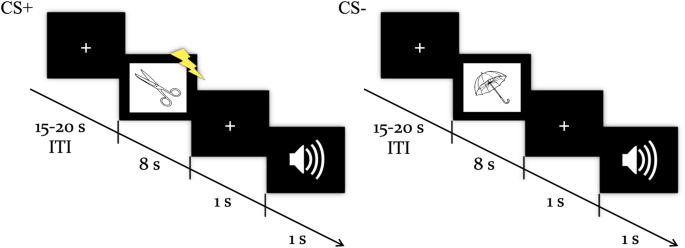
To mirror such an experience in the lab, we use what is known as fear conditioning. During fear conditioning in humans, we typically present participants with neutral stimuli, such as pictures, and repeatedly pair one (or more) of them with an aversive outcome, such as low-intensity electric stimulation that is harmless but unpleasant. After multiple pairings, the previously neutral pictures now elicit a fear response due to the negative association that has formed between the pictures and the electrical stimulation. Taking this back to our example, your car prior to the accident was a neutral stimulus, but after being linked with the accident, elicits a fear response.
Forgetting emotional associations
Could a simple instruction to forget possibly disrupt such a memory? That’s what we set out to test in our study. In a first experiment, we brought participants into the lab, presented them with multiple unique images, and paired half of them with mild electric stimulation. While doing so, we asked them to either remember or forget certain images and their association or lack of association with electrical stimulation. We repeated this procedure several times while also measuring their physiological reactions to these images. In a nutshell, this was our fear conditioning procedure. We then tested them for memory retention, using two different tasks: First, they were asked to just recall all of the images that they could (even the ones that they had been asked to forget) and indicate which ones were paired with the unpleasant stimulation. Next, they completed a recognition task, where all the experimental images were presented intermixed with novel images, and participants were asked to select the ones they recognized from the fear conditioning task, as well as specify their association with electrical stimulation.
Remarkably, participants not only showed memory deficits during retention testing for images and associations they were asked to forget, but they also developed weaker physiological reactions to these images as well. Most surprisingly perhaps, the deficits we observed were stronger for images that were previously paired with electrical stimulation than for the ones that were not paired with stimulation. In other words, we were able to disrupt memories with an emotional component – the kind of memories that had proven resistant to such disruption in prior research! Of course, in science, replication is key, so we went back and conducted roughly the same experiment again, only to obtain similar findings.
So, where does that leave us? It appears that a mere instruction to forget can be used to interfere with the encoding of emotional memories in the lab. We can now proceed to the more daunting task of adapting this procedure to manipulate naturalistic emotional memories that patients with anxiety-related disorders have been living with for years. Stay tuned!