Fool’s Gold in the Ocean – How Marine Heatwaves Can Mask a Global Fish Decline
Published in Ecology & Evolution and Sustainability





When we look at how climate change is affecting the ocean, the narrative can sometimes feel contradictory. On one hand, we hear alarming reports of widespread biomass decline and mass mortality events. On the other hand, fisheries in certain regions suddenly report high catches during unusually warm years. How can the ocean be slowly emptying, yet simultaneously bursting with fish in specific areas? Read the full paper here.
This paradox was the starting point for our team—myself, Juan David González-Trujillo, and Miguel B. Araújo at the Museo Nacional de Ciencias Naturales (MNCN-CSIC). We wanted to disentangle the mess of ocean warming. We suspected that the confusion stemmed from how we measure "warming". Are we talking about the slow, relentless, decadal rise in temperatures, or are we talking about the acute shocks of marine heatwaves (MHWs)?
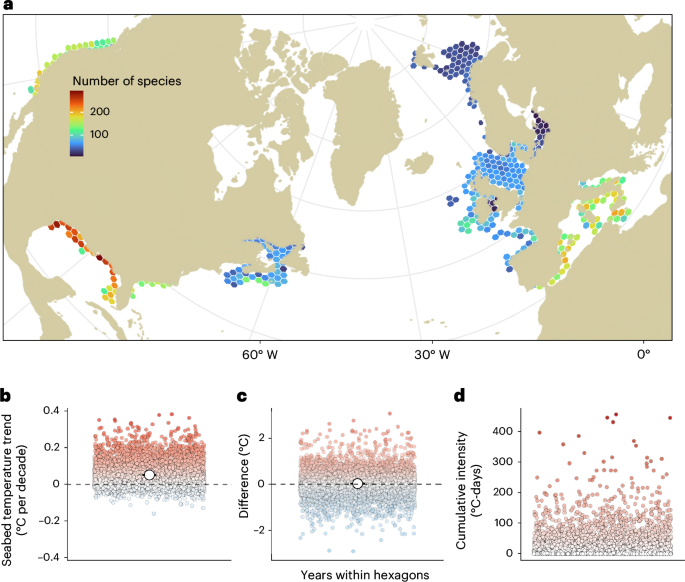
To answer this, we knew we couldn't just look at a handful of species or a single region. We needed a global, macroecological perspective. We utilized massive data sources, combining high-resolution bottom temperature reanalysis data with three decades of scientific bottom trawl surveys. In the end, we analyzed 702,037 estimates of biomass change across 33,990 fish populations, covering 1,566 species across the major Northern Hemisphere basins.
The "Aha!" Moment: Two Different Threats
When we finally ran the models isolating the effects of long-term warming from short-term temperature spikes, the results were intriguing. We had uncovered a "double threat" that operates on completely different temporal rules.
First, the long-term reality is grim. We found that long-term warming was associated with an annual biomass decline of up to 19.8%. This chronic warming acts as a persistent and dominant stressor, silently eroding fish biomass regardless of where the fish live within their geographic range. This aligns with previous large-scale studies focusing on global simulation models.
But then came the twist. When we looked at short-term thermal stressors—marine heatwaves and unusually warm years—a mixed landscape of winners and losers emerged.
.png)
The Climate Trap
The key to predicting these short-term responses lies in a population's thermal position. For fish populations living at the warm edge of their species' distribution, heatwaves are devastating. These populations experienced sharp biomass losses of up to 43.4%.
However, populations living at the cold edge of their range experienced the exact opposite. During extreme marine heatwaves, these populations showed biomass increases of up to 176%. For these fish, a sudden spike in temperature temporarily transformed a hostile, cold environment into a highly hospitable one. We saw this clearly in species like the European sprat (Sprattus sprattus), which exhibited declining biomass at its warm edge while simultaneously increasing at its cold edge during warmer years. This effect actually aligned with more than 750 of the examined species.
.png)
Why This Matters for the Real World?
This is where the science meets policy, and where our findings reveal a dangerous "climate trap". If a fisheries manager is monitoring a cold-edge population and sees a 176% boom in biomass during a warm year, it looks like a tremendous success story. The natural instinct might be to increase catch quotas. But our data shows that these gains are "transient". They are temporary spikes that mask the broader, relentless pressure of long-term warming.
Moving Forward
Working on this paper made it clear to us that we need a dual strategy. In the short term, managers need "climate-ready plans" capable of implementing temporary closures to protect vulnerable warm-edge populations the moment extreme thermal events strike. In the long term, sustainable management cannot just chase short-term biomass gains; it must structurally plan for the biomass loss expected as oceans continue to warm.
As fish populations shift their geographic ranges to stay within their thermal comfort zones, they inevitably cross international boundaries. A fish species declining in one country may become a "winner" stock in another. Effective conservation now requires transboundary collaboration and shared stock management strategies.
We hope our work helps shift the focus from chasing fleeting biomass to prioritizing the long-term resilience of these vital marine ecosystems.
Read the full paper "Long-term warming reduces fish biomass, but heatwaves shift it" in Nature Ecology & Evolution here: https://www.nature.com/
Previous content: https://go.nature.com/47Xrw7s

My research explores how marine species respond to the rapid environmental changes driven by climate change and biological invasions. I use large-scale data syntheses, field observations, and quantitative analyses to understand the complex interactions between species, their habitats, and global stressors. A key focus is investigating species redistribution, including range shifts and depth changes, and assessing whether these movements allow populations to cope with changing conditions or signify increased vulnerability. For instance, my work has revealed that rapid poleward range shifts in marine fish may not always lead to stable populations, and that while some species can deepen to escape warming, this isn't a universal solution and often doesn't offset negative impacts. I also delve into the ecological effects of invasive species, demonstrating how their interactions with native and other non-indigenous species can reshape marine communities. By identifying traits that predispose species to invasiveness and understanding the nuanced responses of marine life, my research aimed at providing insights for marine conservation and the sustainable management of our oceans in a rapidly changing world.
Follow the Topic
-
Nature Ecology & Evolution
This journal is interested in the full spectrum of ecological and evolutionary biology, encompassing approaches at the molecular, organismal, population, community and ecosystem levels, as well as relevant parts of the social sciences.
Related Collections
With Collections, you can get published faster and increase your visibility.
Biodiversity and ecosystem functioning of global peatlands
Publishing Model: Hybrid
Deadline: Jan 31, 2027
Understanding species redistributions under global climate change
Publishing Model: Hybrid
Deadline: Dec 31, 2026