From climate change and economy to particle accelerators
Published in Physics


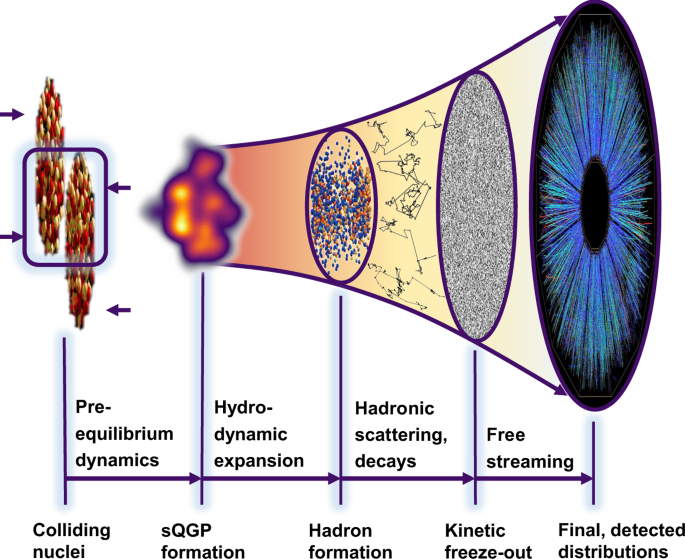

Called the Lévy walk (or in some cases the Lévy flight) after mathematician Paul Lévy, it is a type of random wandering that occurs in nature in a wide variety of ways, from predators searching for food to economic, microbiological, chemical processes to climate change. In their latest research, Dániel Kincses, Márton Nagy and Máté Csanád, researchers from the Department of Atomic Physics and the Astro- and Particle Physics Programme of Excellence (TKP) at ELTE, have shown that the motion of particles in high-energy nuclear collisions can also be described as Lévy walks, confirming the interdisciplinary nature of the phenomenon.
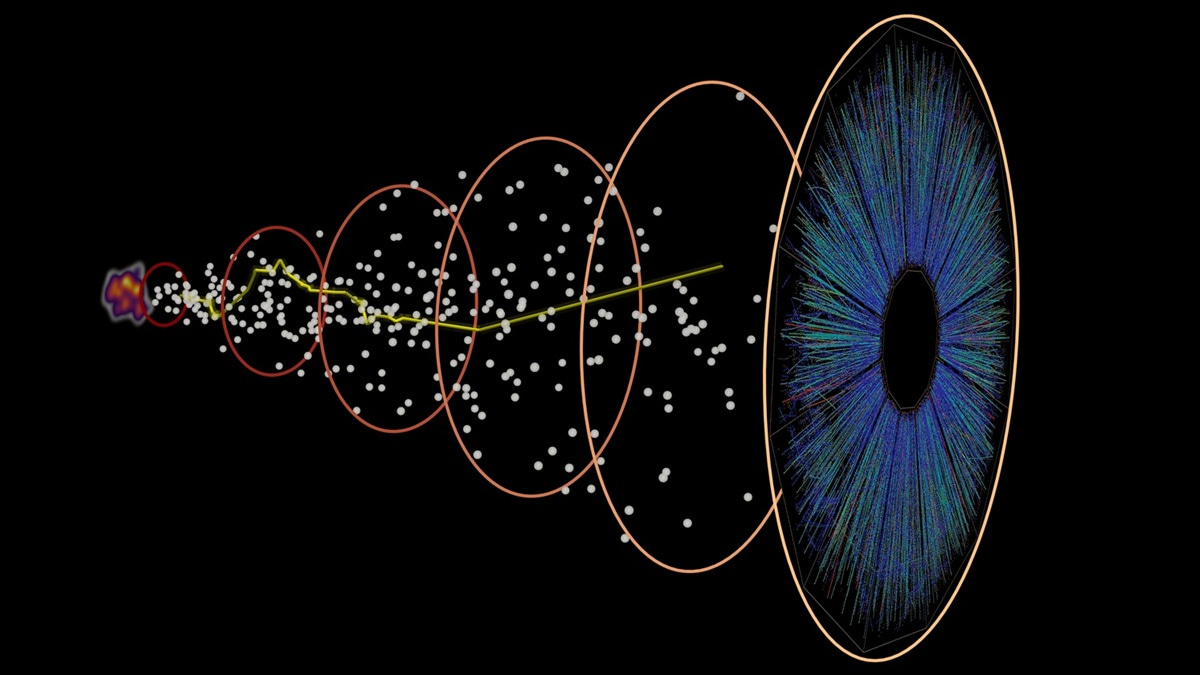
Lévy walk of pions in heavy ion collisions. An interactive version of the graph is available here.
"Our simulation-based studies have shown that if we follow the path of the particles, the length of the steps and the distribution of the final locations correspond to the mathematics of the Lévy walk," summarises Dániel Kincses, a postdoctoral researcher at ELTE.
A recent publication in Nature Portfolio Communications Physics confirms what ELTE researchers have observed in several large experiments in recent years. The results of the study, which uses numerical simulations based on theoretical models, also show good agreement with the ELTE group's measurements at the CERN SPS accelerator NA61 experiment, the BNL RHIC accelerator PHENIX and STAR experiments, and the CERN LHC accelerator CMS experiment. They show that the distribution of the positions of the particles resulting from collisions cannot be described by a normal (Gaussian) distribution, but follows a slowly decaying Lévy-stable distribution. "This also implies that the dynamics of the processes are similar to those observed in many other fields of science, from biology to earth sciences and economics," adds Máté Csanád, professor at ELTE.
The subfield of heavy ion physics that addresses similar questions is called femtoscopy, because it deals with the femtosecond-scale exploration of the spatio-temporal structure of nuclear collisions. Researchers at ELTE are at the forefront of the femtoscopy discipline, participating in related research both experimentally and theoretically, and regularly presenting their related results at major international conferences. Their recently published paper may also give a new direction to experimental research by shedding light on the origin of the observed Lévy distributions.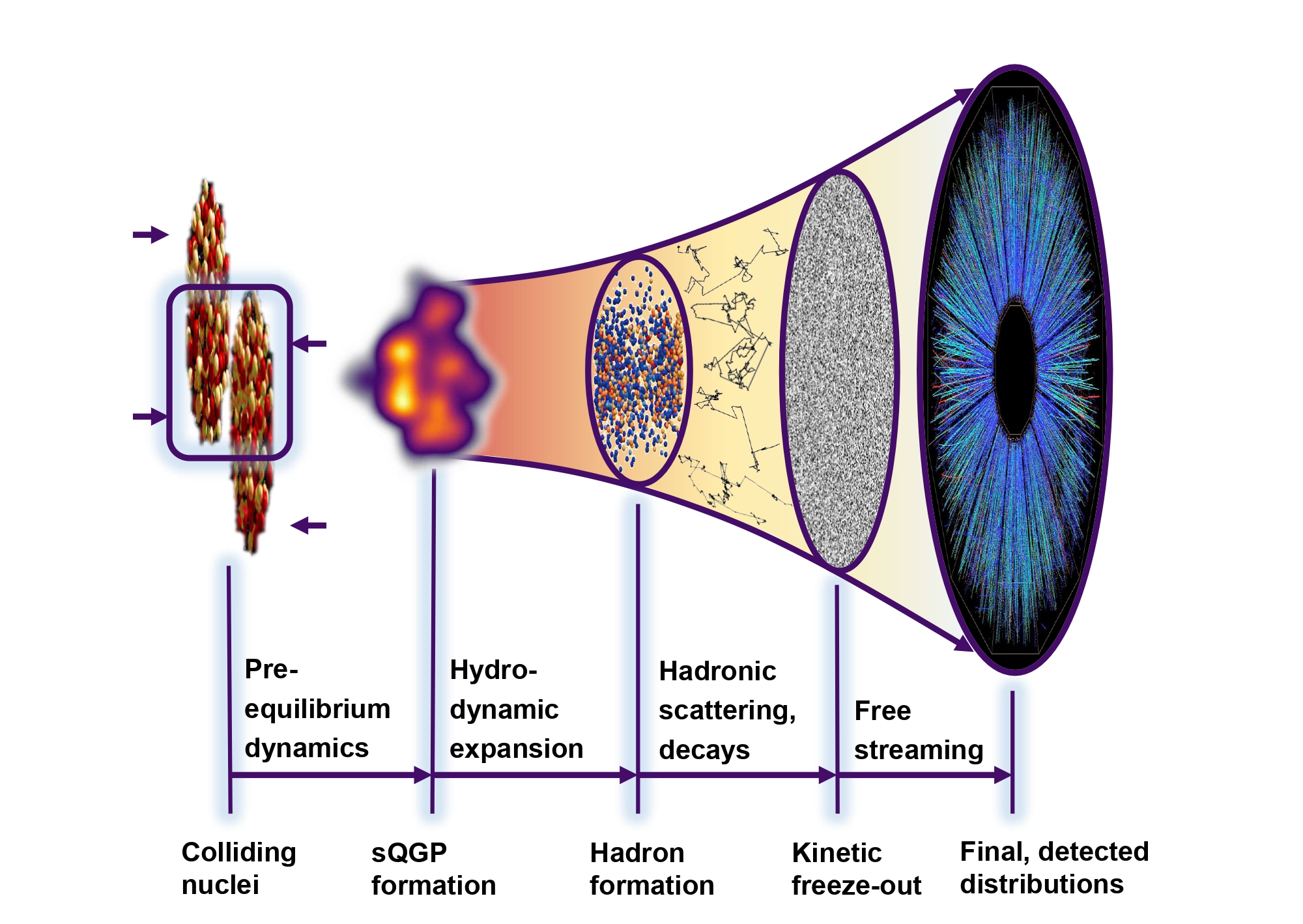
Time evolution of heavy-ion collisions with Lévy walk.
Further information:
- Publication: https://www.nature.com/articles/s42005-025-01973-x
- The research group: https://star.elte.hu/ and https://physics.elte.hu/en/content/rhic-hungary-research-group.t.11745
- Astro- and particle physics Topical Excellence Program, led by Zsolt Frei and Sándor Katz: https://physics.elte.hu/en/content/institutional-excellence-program-for-the-higher-education-astro-and-particle-physics.c3c.616

Máté Csanád started his university studies at the University of Innsbruck (Austria), and obtained a Physics MSc degree at the Eötvös University (Hungary) in 2004. He pursued his graduate studies at the Stony Brook University (NY, USA) and at the Eötvös University, where he gained a PhD in 2007. After several semesters spent at CERN and at the Brookhaven National Laboratory, he now works at Eötvös University, where he also habilitated in 2013. He obtained his DSc degree from the Hungarian Academy of Sciences in 2021, and has been a professor since then. His interests focus on high energy heavy ion physics, hydrodynamic modelling of the quark gluon plasma, quantum statistical correlations and the femtometer spacetime structure of quark matter. He leads the Hungarian participation in experiments at the Relativistic Heavy Ion Collider, and is also a member in CERN experiments. His main research interests include the understanding of spatiotemporal structures on the femtometer scale via femtoscopy, as well as analytical solutions of relativistic hydrodynamics to understand the time evolution of matter created in collider experiments.
Follow the Topic
-
Communications Physics
An open access journal from Nature Portfolio publishing high-quality research, reviews and commentary in all areas of the physical sciences.

Related Collections
With Collections, you can get published faster and increase your visibility.
Nonlinear dynamics of living systems
Publishing Model: Open Access
Deadline: Nov 09, 2026
Active, Entangled or Confined: Polymer Physics Across Synthetic and Living Matter
Publishing Model: Open Access
Deadline: Dec 31, 2026