From Values to Votes: How Justice Shapes Climate Policy Preferences
Published in Social Sciences and Law, Politics & International Studies



Getting people on board with climate policy is one of the biggest challenges of climate mitigation.1 Even when there is broad agreement that something needs to be done about climate change, specific policy proposals often face public opposition.1,2 One key reason for this is fairness.3 People care deeply about whether a policy treats everyone equitably, and when they feel it doesn't, they push back. This was on full display in France in 2018, when the Yellow Vests movement erupted in response to a proposed rise in the carbon tax. The policy was seen as placing a disproportionate burden on lower-income households, and that perceived unfairness was enough to derail it.4
Research consistently shows that how fair people perceive a policy to be is one of the strongest predictors of whether they will support it — often just as important as how effective they think it will be.5 But fairness is not a single, simple concept. Different people have fundamentally different ideas about what a fair distribution of costs and benefits looks like. Understanding this heterogeneity is crucial if we want to design climate policies that can actually win public support.
What is justice orientation
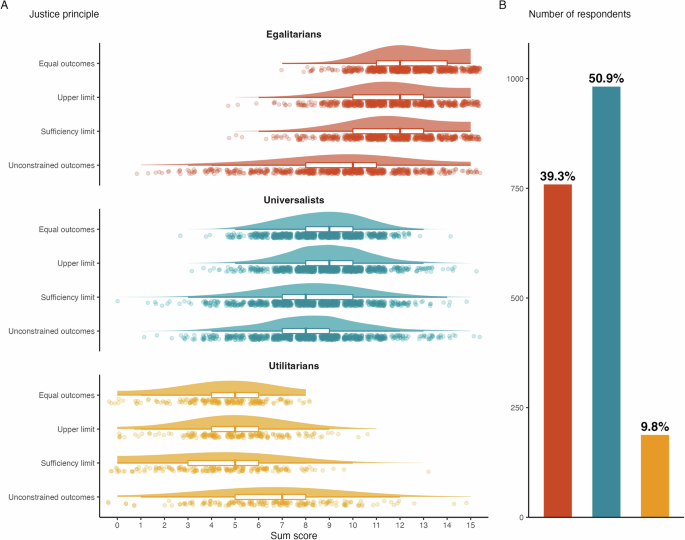
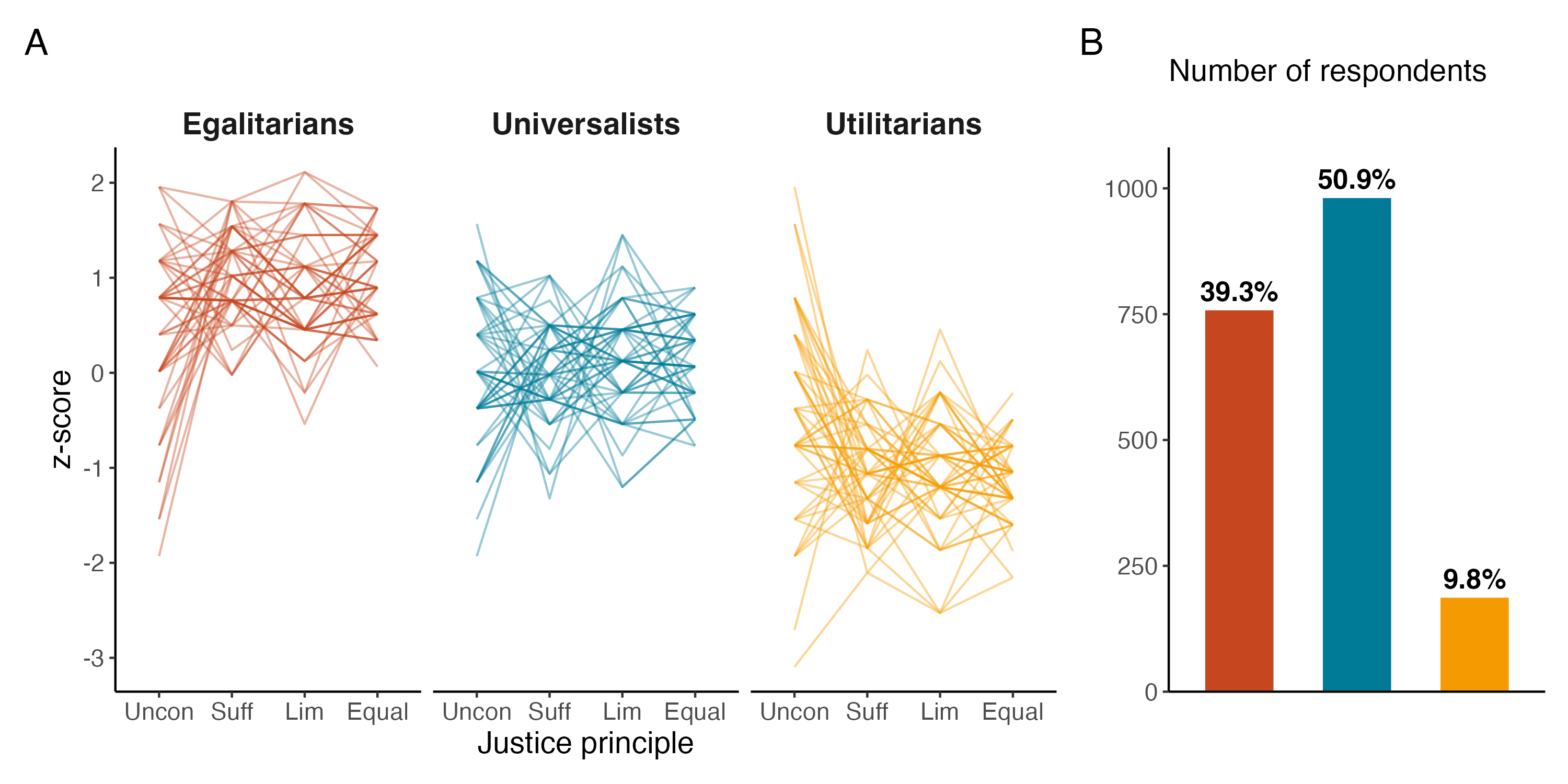
People have different ideas about how to set up a policy that is just. We tried to better understand this here by measuring people’s agreement with four distributive justice principles. These four principles included equal outcomes, representing actions that reduce existing inequities, for instance, through a progressive income tax.6 Limitarianism is the idea of curbing or capping excess, for instance, by taxing luxury goods.7 Sufficientarianism is the idea that everyone should have access to a sufficient minimum — for instance, ensuring that lower-income households can still access the benefits of the energy transition, such as subsidies for heat pumps.8 The last principle represents unconstrained outcomes, following the utilitarian principle, where the goal is to increase overall well-being.9 This is the only distribution-insensitive principle we measured.
We identified three distinct groups of people, each with its own climate justice orientation (Figure 1). Universalists, representing roughly half of the Swiss population, moderately support all four principles. Egalitarians, who make up about 40% of the population, show strong support for distribution-sensitive principles and weaker support for the unconstrained-outcomes principle. Finally, the utilitarians, the smallest group, have a polar-opposite profile to the egalitarians, showing moderate support for the unconstrained outcomes principle and weak support for the distribution-sensitive principles.
Justice orientations are associated with different climate policy preferences
So what does all of this mean for those designing climate policy? Our results point to a few clear takeaways.
First, there is considerably more public appetite for ambitious policy than policymakers sometimes assume. People do not simply prefer weaker policies because they are less disruptive. Across our sample, medium- and high-stringency packages consistently outperformed low-stringency ones (Figure 2). This suggests there may be latent majority support for meaningful climate action, but only if the policy is designed in the right way.
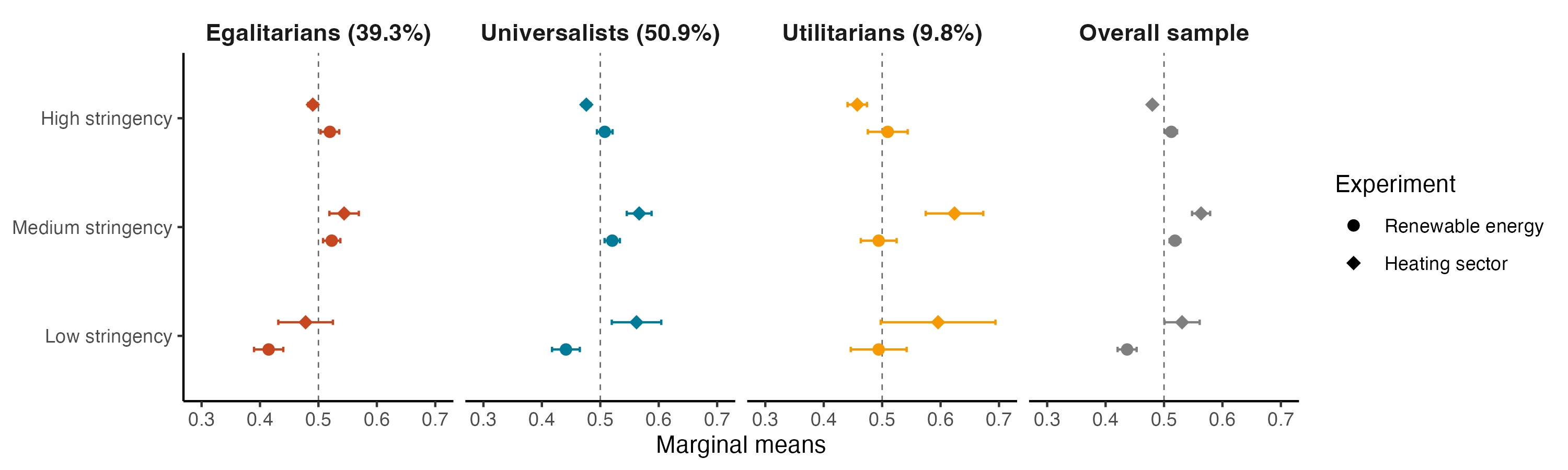
Second, how a policy distributes its costs and benefits matters enormously. Nine out of ten people in our sample held a distribution-sensitive justice orientation, meaning they care about who bears the burden of climate action. Policies that appear distribution-blind — those that focus on market mechanisms without addressing inequalities — are consistently rejected across all justice orientations.
Third, and perhaps most actionable for policymakers: exemptions for lower-income households are a powerful tool. Including such exemptions in otherwise contentious policies, like fossil fuel bans or carbon taxes, can meaningfully increase public acceptability without undermining the stringency of the measure itself.
The big picture lesson here is that packaging matters. Regulatory and redistributive policy packages — those that combine firm standards with measures to protect more vulnerable groups — are the most broadly acceptable. They don't please everyone equally, but crucially, they are acceptable to all three justice orientations we identified. That is a rare kind of political common ground, and it is worth building on.
References
- Andre, P., Boneva, T., Chopra, F. & Falk, A. Globally representative evidence on the actual and perceived support for climate action. Nat. Clim. Change 14, 253–259 (2024).
- Heyen, D. A. & Wicki, M. Increasing public support for climate policy proposals: a research agenda on governable acceptability factors. Clim. Policy 1–10 (2024).
- Bergquist, M., Nilsson, A., Harring, N. & Jagers, S. C. Meta-analyses of fifteen determinants of public opinion about climate change taxes and laws. Nat. Clim. Change 12, 235–240 (2022).
- Douenne, T. & Fabre, A. French attitudes on climate change, carbon taxation and other climate policies. Ecol. Econ. 169, 106496 (2020).
- Huber, R. A., Wicki, M. L. & Bernauer, T. Public support for environmental policy depends on beliefs concerning effectiveness, intrusiveness, and fairness. Environ. Politics 29, 649–673 (2020).
- Von Platz, J. Principles of Distributive Justice. In Boonin, D. (ed.) The Palgrave Handbook of Philosophy and Public Policy, 397–408 (Springer International Publishing, 2018).
- Robeyns, I. Why Limitarianism?. J. Political Philos. 30, 249–270 (2022).
- Herlitz, A. The indispensability of sufficientarianism. Crit. Rev. Int. Soc. Political Philos. 22, 929–942 (2019).
- Babatunde, O., Adebisi, J., Emezirinwune, M., Babatunde, D. & Abdulsalam, K. A. How serious are ethical considerations in energy system decarbonization?. Curr. Opin. Environ. Sustain. 71, 101477 (2024).
Follow the Topic
-
Communications Earth & Environment
An open access journal from Nature Portfolio that publishes high-quality research, reviews and commentary in the Earth, environmental and planetary sciences.

Introducing: Social Science Matters
Social Science Matters is a campaign from the team at Palgrave Macmillan that aims to increase the visibility and impact of the social sciences
Continue reading announcementRelated Collections
With Collections, you can get published faster and increase your visibility.
Ecological resistance and resilience under global change
Publishing Model: Open Access
Deadline: Apr 07, 2027
High-resolution modeling for Earth system
Publishing Model: Open Access
Deadline: Feb 07, 2027