From Wave Energy to Electricity: Functional Design and Performance Analysis of Triboelectric Nanogenerators
Published in Electrical & Electronic Engineering, Materials, and Sustainability
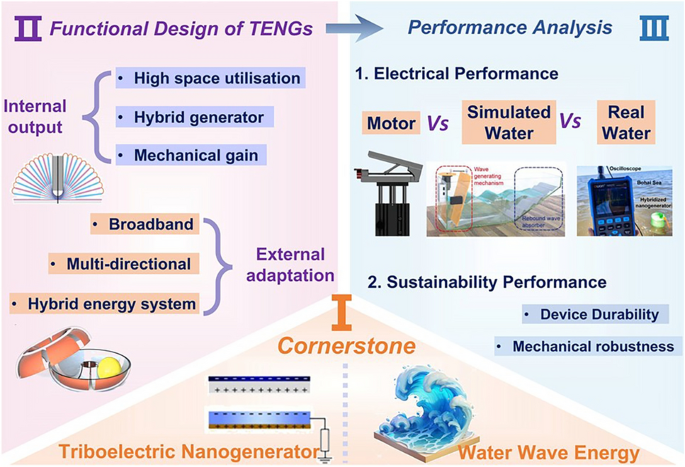


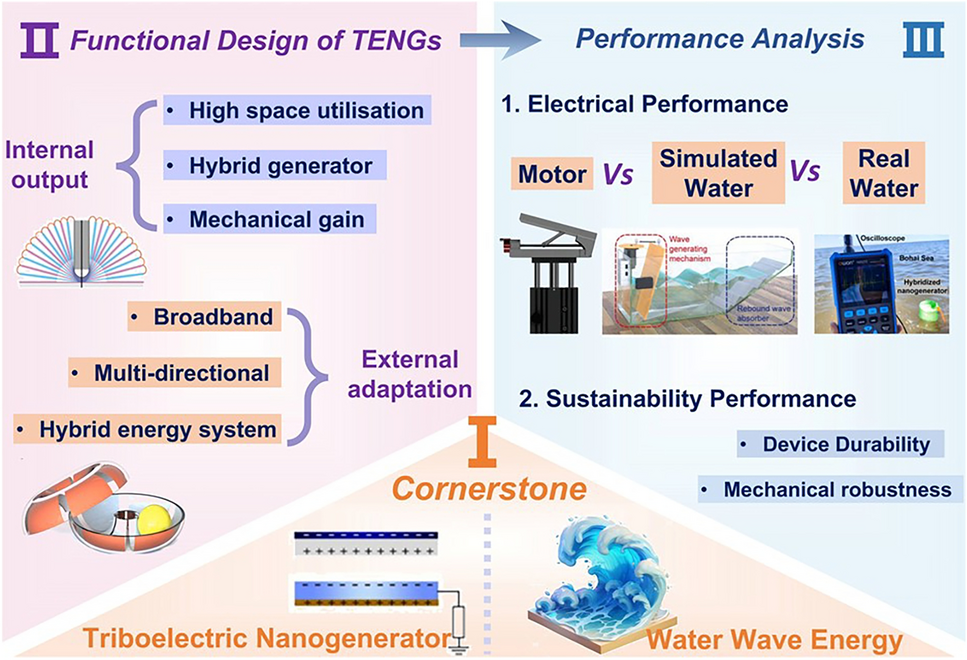

A joint team from the Beijing Institute of Nanoenergy & Nanosystems and Guangxi University, led by Professors Zhong Lin Wang, Aifang Yu and Junyi Zhai, has published a 41-page field-to-fabric review in Nano-Micro Letters that distills a decade of blue-energy research into six design pillars for next-generation triboelectric nanogenerators (TENGs). Their roadmap, titled “From Wave Energy to Electricity: Functional Design and Performance Analysis of Triboelectric Nanogenerators”, points the way to self-powered ocean grids, distributed marine IoT, and even hydrogen harvested from the sea itself.
Why Functional Design Matters
- High Space Utilization: Multilayer stacks, origami folds and magnetic-levitation frames push volumetric power density beyond 600 W m-3—three orders of magnitude above first-generation prototypes.
- Hybrid Generators: Frequency-complementary couplings of TENG, EMG and PENG create full-spectrum harvesters that deliver 117 % power-conversion efficiency in real waves.
- Mechanical Gain: Pendulum, gear and magnetic-multiplier mechanisms translate chaotic 0.1–2 Hz swells into stable high-frequency oscillations, multiplying average power 14-fold.
- Broadband Response: Resonance-tuned structures now span 0.01–5 Hz, locking onto shifting wave spectra across seasons and sea states.
- Multi-Directional Capture: Spherical, dodecahedral and tensegrity architectures harvest six-degree-of-freedom motion, eliminating orientational blind spots.
- Hybrid Energy Harvesting: Single devices co-harvest wave, wind and solar inputs, powering self-charging buoys that cut battery replacement to zero.
Engineering the Ocean Proof-of-Concept
- One-Pot Origami Route: Kapton–PTFE–Cu stacks folded into “butterfly-wing” arrays deliver 28× higher charge transfer than flat analogues.
- Magnetic-Levitation Core: NdFeB rings suspend 90 mm rotors without contact, yielding 45 mA short-circuit current after 60,000 s continuous operation—no lubrication, no wear.
- Real-Sea Validation: In Bohai Sea trials, a tribo-electro-piezo hybrid buoy lit 150 LEDs and drove wireless GPS beacons kilometers offshore; Victoria Harbour demonstrations sustained 3-day uninterrupted data streaming.
Characterizing the Blue-Energy Leap
- Hydrodynamic Modeling: Finite-element coupling of AQWA wave solvers with TENG circuit simulators pinpoints optimal buoy resonance, lifting peak power to 114.8 W m-3.
- Durability Framework: Non-contact, rolling and fur-brush designs retain >98 % output after 1.26 million cycles; solid–liquid interfaces eliminate frictional fatigue entirely.
- Environmental Armor: Arctic-grade TENGs operate at −40 °C with 5 µA surplus current; UV-shielded housings survive 72 h of 10 W irradiation without degradation.
Future Outlook
- Array Deployment: 3-D hexagonal lattices promise kW-scale “energy reefs” that double as breakwaters.
- Smart Materials Roadmap: MXene-lubricated and anti-corrosive tribo-surfaces target 10-year maintenance-free lifespans.
- Circular Economy: Device bodies molded from recycled ocean plastic could cut embodied carbon by 40 %, pushing levelized cost below US$0.03 kWh-1.
By translating chaotic ocean motion into deterministic electron flow, the Wang–Yu–Zhai team turns every swell, gust and glint of sunlight into dispatchable power—ushering in an era where the sea itself becomes a silent, self-replenishing power plant.

Editor of Nano-Micro Letters, which is an Open-Access, peer-reviewed journal reported papers that have at least one dimension ranging from a few sub-nanometers to a few hundreds of micrometers. The journal is published by Springer Nature and indexed by SCI, EI, SCOPUS, Pubmed, etc. The 2025 JCR Impact Factor is 38.5. The 2025 CiteScore is 58.9.
Follow the Topic
-
Nano-Micro Letters
Nano-Micro Letters is a peer-reviewed, international, interdisciplinary and open-access journal that focus on science, experiments, engineering, technologies and applications of nano- or microscale structure and system in physics, chemistry, biology, material science, and pharmacy.

What are SDG Topics?
An introduction to Sustainable Development Goals (SDGs) Topics and their role in highlighting sustainable development research.
Continue reading announcement