Gas‑Phase Construction of Compact Capping Layers for High‑Performance Halide Perovskite X‑Ray Detectors
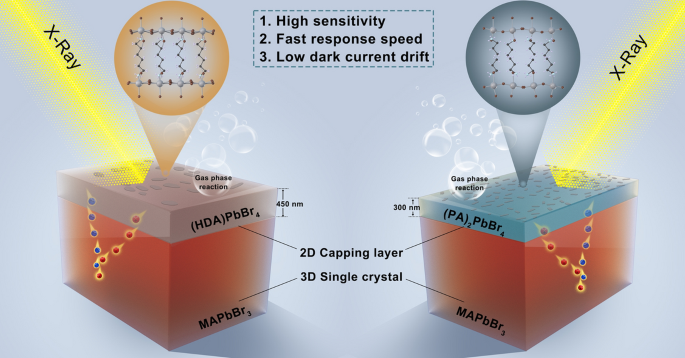

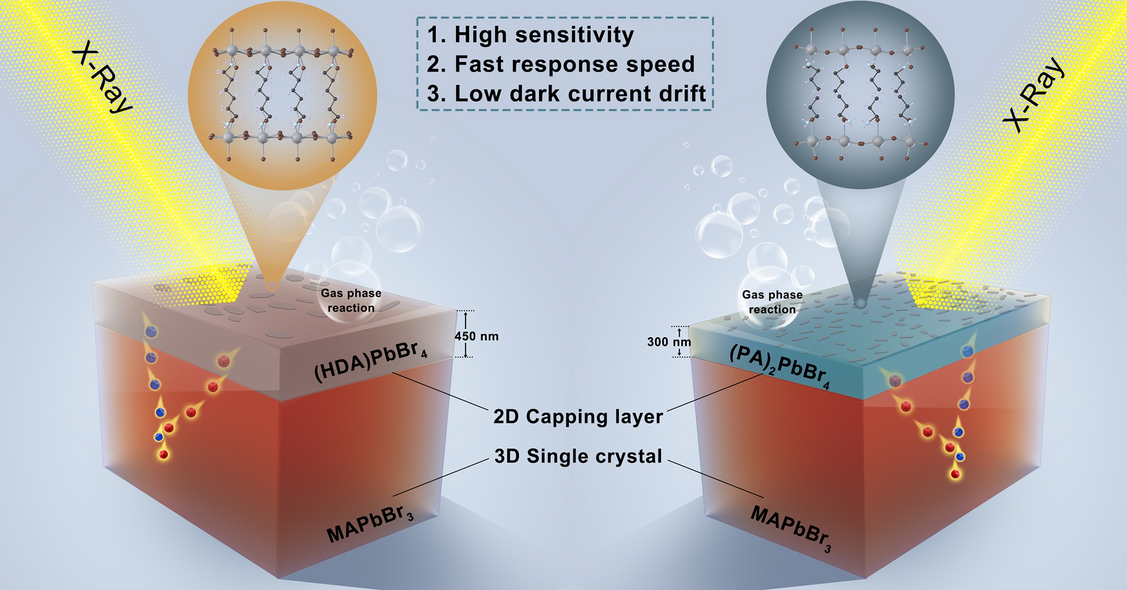

Medical X-ray imaging demands detectors that are both ultra-sensitive and stable under high bias, yet ion migration and surface defects still plague 3-D perovskites. A Shenzhen Technology University-led team (Prof. Shuang Xiao & Prof. Xingzhu Wang) now reports a one-step gas-phase route that grows nanometre-thin, pin-hole-free 2-D (PA)2PbBr4 or (HDA)PbBr4 capping skins directly onto MAPbBr3 single crystals in <1 min. The resulting 2-D/3-D heterojunction delivers a record sensitivity of 22 245 µC Gyair-1 cm-2, 240 µs response time and a dark-current drift only 1.17 × 10⁻⁴ nA cm-1 s-1 V-1—beating the world’s best perovskite X-ray detectors by >10× in signal stability.
Why This Matters
- Ultra-Low Dose Imaging: Detection limit drops to 0.13 µGyair s-1(≈1/100 of a chest scan), enabling paediatric and dental CT with <50 % exposure.
- Ion-Migration Shut-Down: DFT and temperature-conductivity tests show Br- activation energy doubles (0.23 eV) under the sterically crowded propyl-ammonium layer, suppressing bias-induced drift by two orders of magnitude.
- Photoconductive Gain: Staggered type-II band alignment and trap density reduction (9 → 1.5 × 1010 cm-3) extend carrier lifetime to 521 ns, multiplying signal without extra noise.
- Ambient Stability: After 2.15 Gy cumulative dose (≈105 chest X-rays), capped crystals retain >99 % sensitivity and square-wave response in 40 % RH air—no encapsulation needed.
Innovative Design & Features
- Gas-Phase Vapor Exchange: Amine vapour (PA or HDA) reacts with the crystal surface for 40–180 s, converting <300 nm of 3-D lattice into pure n = 1 2-D phase; growth rate scales inversely with molecular size, giving angstrom-level control.
- Steric Hindrance Engineering: Ruddlesden–Popper (PA)2PbBr4 exhibits tighter Pb2+-NH3+ coordination and higher crystal-space occupancy than Dion–Jacobson (HDA)PbBr4, yielding larger dangling-bond formation energy and stronger Br- confinement.
- Negligible Parasitic Absorption: 300 nm (PA)2PbBr4 attenuates only 0.022 % of 60 keV X-rays; 82.9 % absorption still occurs in the 1.5 mm MAPbBr3 bulk, preserving high quantum efficiency.
- Scalable & Universal: Process works on MAPbI3, FAPbI3 and polycrystalline films; no solvents or high vacuum, compatible with roll-to-roll vapor reactors.
Applications & Future Outlook
- Portable Point-of-Care Scanners: 50 µm-pixel arrays on flexible PI are being fabricated for bedside neonatal imaging, targeting 50 µGy per frame—below the yearly background dose.
- Security & Food Inspection: High-speed chopper (1 kHz) and 240 µs response enable real-time line-scanning of luggage and agricultural products at 5 m s-1 belt speed.
- Next-Gen Synthesis: Team is extending the chemistry to mixed-halide and Pb-free perovskites, while integrating the process into existing MOCVD lines for 200 mm wafer processing.
By turning a simple vapor cue into an atomically precise ionic barrier, the work delivers the first perovskite X-ray detector that unites hospital-grade sensitivity, microsecond speed and rock-solid baseline—paving the way for safer, sharper and greener medical imaging anywhere the beam shines.

Editor of Nano-Micro Letters, which is an Open-Access, peer-reviewed journal reported papers that have at least one dimension ranging from a few sub-nanometers to a few hundreds of micrometers. The journal is published by Springer Nature and indexed by SCI, EI, SCOPUS, Pubmed, etc. The 2024 JCR Impact Factor is 36.3. The 2024 CiteScore is 53.1.
Follow the Topic
-
Nano-Micro Letters

Nano-Micro Letters is a peer-reviewed, international, interdisciplinary and open-access journal that focus on science, experiments, engineering, technologies and applications of nano- or microscale structure and system in physics, chemistry, biology, material science, and pharmacy.
Please sign in or register for FREE
If you are a registered user on Research Communities by Springer Nature, please sign in